Elon Musk Challenges California's Rail Project with a Low-Cost Underground Transit Alternative
Los Angeles, Thursday, 9 April 2026.
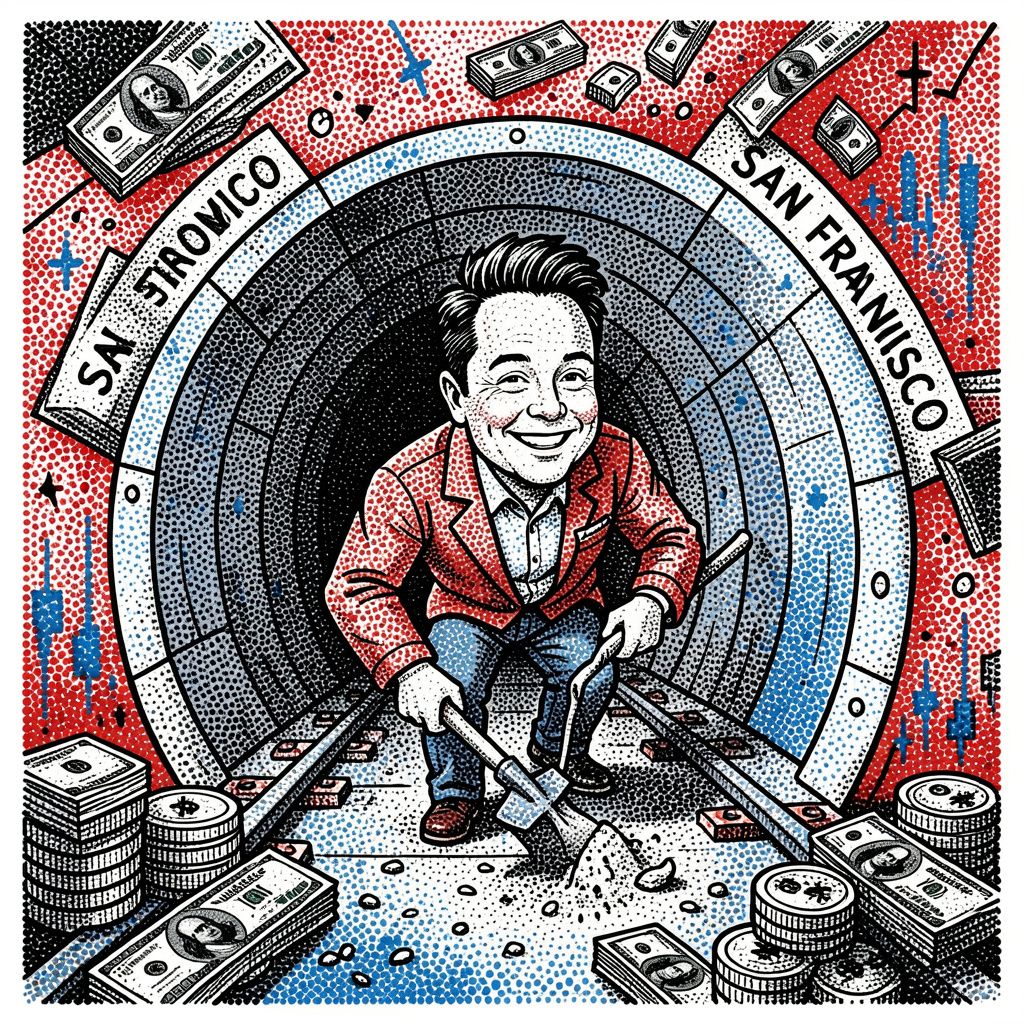
Elon Musk claims he can build a 1223 km/h transit link between Los Angeles and San Francisco for under five percent of California’s ballooning $126 billion rail budget.
From Concept to Subterranean Reality
While a near-supersonic vacuum tube remains theoretical, The Boring Company has spent the last few years proving its tunneling capabilities on a smaller scale. The company’s flagship operational project is the Las Vegas Convention Center (LVCC) Loop, which opened in April 2021 [4]. Built for approximately $47 million, the initial 2.7 km system utilizes electric vehicles manufactured by Tesla (TSLA) to transport passengers through single-bore tunnels with an internal diameter of roughly 3.66 meters [4][GPT]. The Las Vegas system expanded to 3.4 km in 2024 and recently demonstrated its capacity by moving approximately 82,000 passengers over five days during the CONEXPO-CON/AGG 2026 trade show [4].
A Surging Market for High-Speed Transit
Musk’s renewed focus on the San Francisco-Los Angeles route coincides with a broader acceleration in the global hyperloop sector. The hyperloop technology market, valued at $3.05 billion in 2025, is projected to expand to $41.79 billion by 2033, registering a rapid compound annual growth rate of 38.86% [5]. This growth is fueled by international investments and strategic partnerships. For instance, in early 2026, companies like Japan’s Mitsubishi Heavy Industries and Hitachi, Ltd. initiated research collaborations and investments into hyperloop-compatible infrastructure and smart mobility integration [5]. Additionally, Virgin Hyperloop continued testing its next-generation systems with a focus on passenger safety in March 2026 [alert! ‘Source notes Virgin Hyperloop testing status requires a deadline check, indicating potential uncertainty in their exact operational milestones’] [5].