Supreme Court Greenlights Escalating $600 Million White House Ballroom Expansion
Washington, Monday, 7 September 2026.
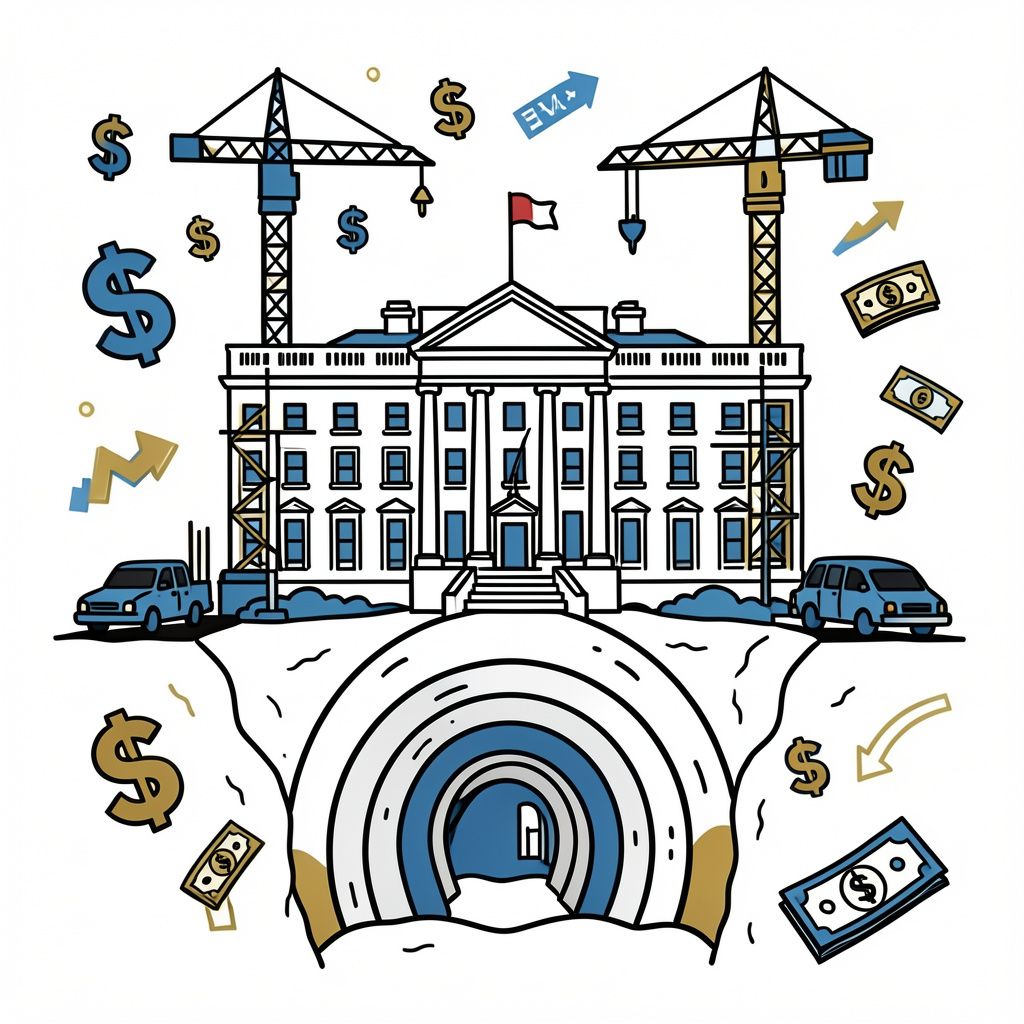
Following an August 31, 2026, Supreme Court 5-4 decision, construction on the controversial White House expansion continues despite mounting legal and financial oversight concerns. Originally estimated at $200 million, total cost projections have expanded to $600 million—with broader capital project estimates exceeding $900 million. While the administration originally framed the project as privately funded, federal records reveal that taxpayers are covering roughly $300 million for underground military infrastructure and security enhancements beneath the demolished East Wing. Beyond the ballroom itself, the accelerated 20-hour workday project includes a five-story subterranean bunker and emergency response facility scheduled for completion ahead of 2029.
Legal Challenges and Judicial Oversight
The legal pathway for the White House expansion was clarified following a narrow 5-4 Supreme Court decision, though discrepancies exist regarding the exact date of the ruling [2][5]. While one report indicates the decision was handed down on August 31, 2026, another cites September 1, 2026, creating a minor timeline ambiguity [alert! ‘Conflicting dates for Supreme Court ruling provided in sources’]. The ruling effectively dismissed a lawsuit brought by preservationists, including Alison Hoagland of the National Trust for Historic Preservation, allowing construction to proceed despite earlier injunctions [2][3]. Chief Justice John Roberts joined the three Democratic-appointed justices in dissent, labeling the project ‘likely unlawful’ in his opinion, highlighting the contentious nature of the executive action [3][5]. Prior to this, U.S. District Judge Richard Leon had issued a preliminary injunction in March 2026, stating the President lacks authority to construct the ballroom without congressional approval [4]. The administration successfully appealed, arguing that halting construction would cause irreparable harm, a stance the Supreme Court majority accepted without ruling on the project’s ultimate legality [3][6].
Financial Implications and Funding Sources
Financial scrutiny has intensified as cost estimates for the ballroom project have surged from an initial $200 million to approximately $600 million [5]. Although President Trump initially framed the initiative as privately funded, federal documents reveal that taxpayers are responsible for roughly $300 million, specifically covering security enhancements and underground infrastructure [3]. The broader renovation budget, which includes over 100 structural changes in Washington, D.C., now exceeds $900 million [3]. Concerns regarding potential conflicts of interest have arisen, with Public Citizen reporting that 14 of 27 publicly listed donors to the project received new or increased government contracts totaling over $50 billion within a six-month period [3]. Senator Sheldon Whitehouse (D-RI) has indicated plans to investigate the project for potential pay-to-play schemes should Democrats gain control of Congress [3]. A Washington Post poll conducted in July 2026 found that 65% of respondents feel dissatisfied or upset with these construction projects, reflecting significant public skepticism [3].
Construction Progress and Future Projects
On the ground, construction activity remains intense, with the site operating 20 hours a day, seven days a week, utilizing a workforce of approximately 250 people [3][5]. While administration filings claim the project is 65% complete, independent estimates and confidential documents suggest progress is closer to 33% [3]. The structure itself is massive, featuring a footprint of approximately 90,000 square feet 8361.27 square meters and rising 70 feet 21.336 meters in height [3]. The project involves demolishing the East Wing, which occurred in October 2025, to make way for the new facility [3][4]. Looking ahead, Interior Secretary Doug Burgum announced on September 3, 2026, that construction on a planned triumphal arch will begin within two weeks, targeting a completion deadline of January 20, 2029, alongside the ballroom [5]. However, previous infrastructure efforts, such as the Reflecting Pool repairs, have faced cost overruns and technical failures, raising questions about the feasibility of these accelerated timelines [5].
Sources
- www.washingtonpost.com
- www.foxnews.com
- nymag.com
- abcnews.com
- www.theatlantic.com
- billingsgazette.com