AI Recommendations Heavily Favor the Top Three Local Businesses
New York, Monday, 31 August 2026.
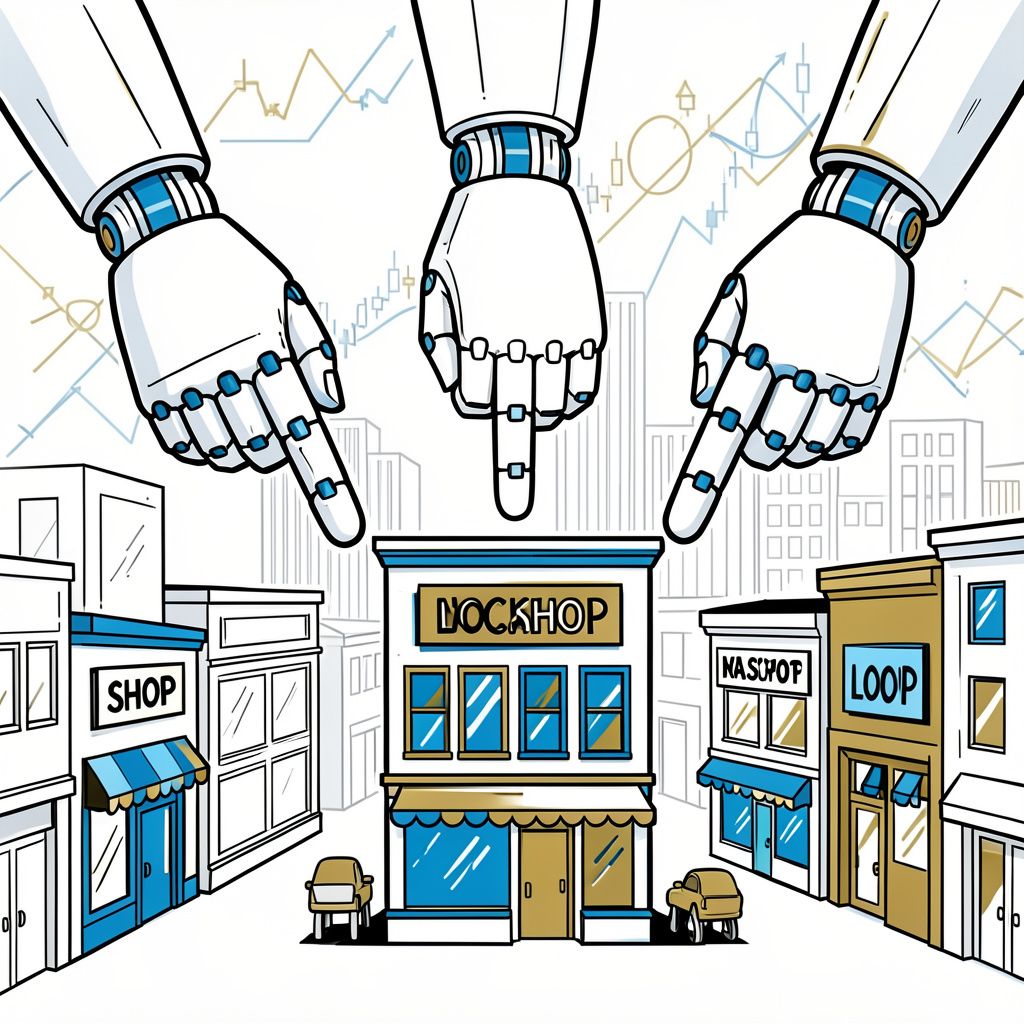
An August 2026 study reveals AI assistants direct over 56% of local service recommendations to just three companies, fundamentally altering market visibility for independent local businesses.
The Winner-Take-All Dynamics of AI Search
The consumer discovery landscape is undergoing a profound structural shift as artificial intelligence engines increasingly mediate local commerce [GPT]. According to a comprehensive study published on August 28, 2026, by the research platform MentionedOn, AI assistants are concentrating local service recommendations into a select few hands [1]. Analyzing 8,400 recommendations across 21 trades and 40 major US metropolitan areas, the study reveals that the emerging AI recommendation economy is heavily consolidated [1]. This paradigm shift presents a double-edged sword for the broader economy: while it streamlines the consumer journey, it threatens to marginalize independent local businesses that fail to secure top-tier algorithmic visibility [GPT].
The Steep Curve of Algorithmic Visibility
The data underscores a steep visibility curve, with AI assistants naming an average of 9.2 businesses per search, alongside a median of 10 [1]. However, this apparent variety is misleading; the top three businesses in any given trade and metropolitan leaderboard capture a staggering 56.2% of all algorithmic mentions [1]. The single most-mentioned business alone dominates the landscape by capturing 24.7% of all recommendations [1]. As John Arndt, the founder of MentionedOn, observed, the critical challenge for modern business owners is no longer simply ensuring that an AI knows they exist, but rather securing a spot in those top three recommendations, as the difference between being listed further down and being entirely invisible has become marginal [1].
The Divide Between National Chains and Local Trades
The degree of AI recommendation concentration varies sharply by industry vertical, creating an uneven playing field for market competitors [1]. National brands—defined in the study as those appearing in at least 10 of the 40 surveyed metropolitan areas—account for an average of 17.9% of total mentions across the 5,552 distinct businesses analyzed [1]. However, in highly standardized sectors, national chains exert immense dominance; they capture 51% of all recommendations in the moving sector, 42% in pest control, and 37% in accounting [1]. The dominance of national brands in the moving sector exceeds that of accounting by 14 percentage points [1]. Remarkably, only two major brands, Two Men and a Truck and Terminix, managed to achieve recommendation presence across all 40 surveyed metropolitan areas [1].
Local Independence in Specialized Verticals
Conversely, independent local businesses maintain a strong footing in more specialized, hands-on service sectors [1]. In five specific trades—heating, ventilation, and air conditioning (HVAC), legal services, veterinary care, real estate, and medical spas—national brand presence in AI recommendations is effectively zero [1]. In these categories, AI search engines draw almost exclusively from local, independent operators [1]. This divergence suggests that local market authority and highly localized digital footprints still play a decisive role in shielding certain service sectors from national brand encroachment [GPT].
Algorithmic Volatility and Grounding Drift
Navigating this new AI-driven local economy is further complicated by the inherent instability of the algorithms themselves [2]. A broad compilation of 145 statistics from 21 separate studies conducted by Steady Demand between December 2024 and August 2026 highlights the volatile nature of AI local search [2]. Specifically, a study titled “Grounding Drift,” published on August 6, 2026, revealed that AI-generated search results are highly unstable when compared to traditional search mechanisms [2]. The researchers noted that the classic Google search “local pack” is approximately ten times more stable than AI-generated search answers when processing identical, repeated queries [2].
Platform Dichotomies and Sudden Shifts
This volatility is compounded by platform-specific behaviors and sudden algorithmic updates [2]. For instance, an August 22, 2026 study analyzing 86,645 citations across 8,000 local-service searches found that Google’s “AI Overviews” and “AI Mode” reward almost opposite citation behaviors [2]. Furthermore, on August 20, 2026, ChatGPT’s source mix for local citations underwent a dramatic, overnight shift, emphasizing the reality that leading engines like Gemini and ChatGPT rarely agree on source recommendations [2]. Additional analysis published on August 21, 2026, disproved the common industry assumption that ChatGPT heavily relies on Foursquare data, proving instead that these systems are constantly evolving and highly unpredictable [2].
Economic Impacts and Strategic Adaptations
The economic implications of these shifting algorithms are substantial for local service providers seeking sustainable customer acquisition [GPT]. An investigation into ChatGPT’s ad predictors published on August 21, 2026, demonstrated that ad placement within these platforms is driven primarily by user intent—specifically explicit requests for recommendations—rather than the general topic of the query [2]. This means that businesses cannot simply rely on organic keyword matching; they must align their digital presence with highly specific conversational prompts [GPT].
Leveraging Local Search Foundations
Despite this volatility, structured local optimization remains a powerful tool for businesses trying to break into the crucial top-three recommendation bracket [GPT]. Long-term testing from March 2023 through December 2024 demonstrated that adding custom services to a Google Business Profile (GBP) boosted keyword rankings within 72 hours, with the positive effects persisting for over a year [2]. Furthermore, historical performance data shows that structured local advertising campaigns, such as Local Services Ads (LSA), can scale successfully, with one cleaning company securing 5,586 leads between September 2023 and November 2025 [2]. As AI continues to reshape the digital storefront, local businesses must blend persistent local optimization with an understanding of conversational AI patterns to survive the high concentration of modern search recommendations [GPT].