Emerging Markets Overtake G7 as Global Renewable Expansion Rate Halves
New York, Tuesday, 10 February 2026.
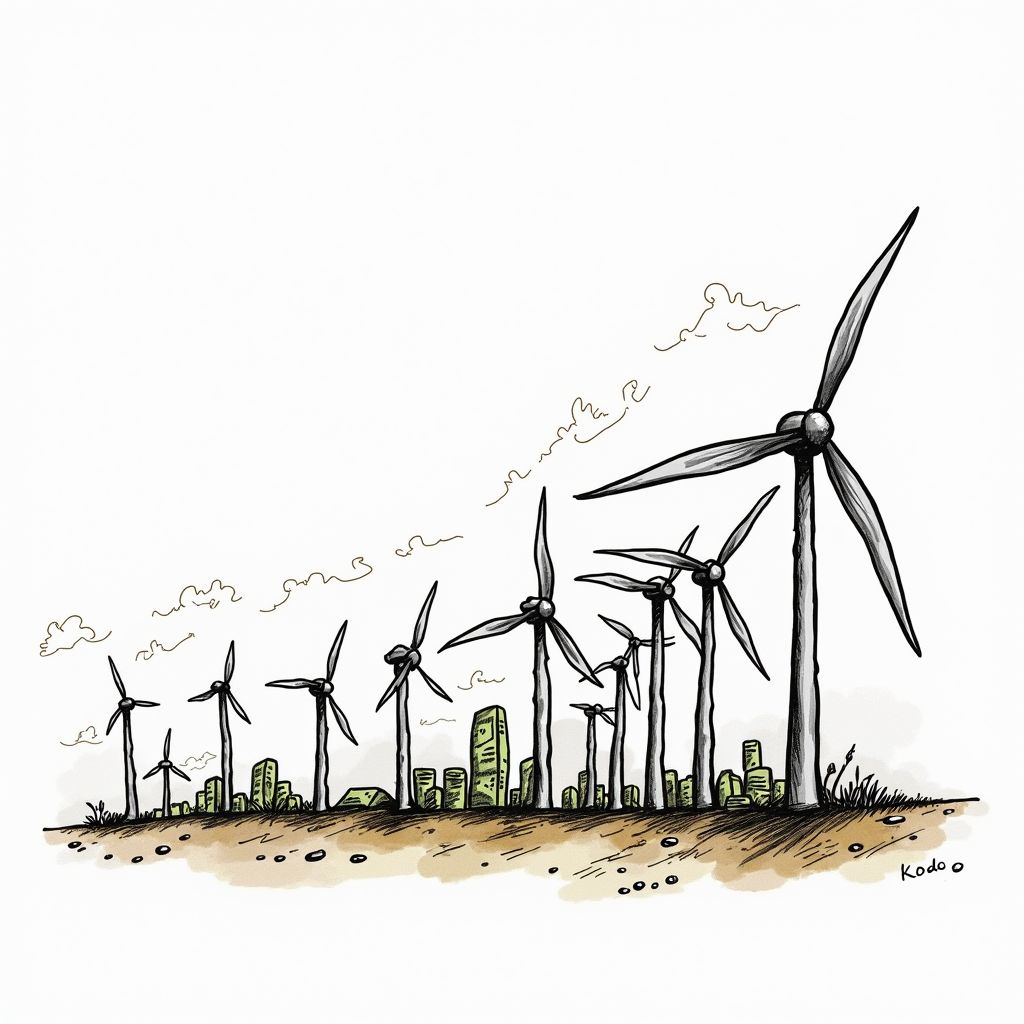
The global drive toward renewable energy hit a significant speed bump in 2025, with the growth rate for wind and solar projects falling to 11%, down sharply from 22% the previous year. This deceleration poses a serious risk to the COP28 goal of tripling capacity by 2030. In a stark geopolitical shift, G7 nations have fallen behind, now representing just 11% of the prospective project pipeline. Conversely, emerging economies are driving momentum, with China alone adding 1.5 terawatts—more than the next six countries combined. While the International Energy Agency forecasts that low-carbon sources could meet 50% of global electricity demand by the decade’s end, this relies on wealthy nations overcoming the grid bottlenecks and failed auctions that stifled progress throughout 2025. The data suggests that without immediate infrastructure investment, the 2030 climate targets may slip out of reach.
A Widening Gap in Global Execution
The deceleration in renewable development reveals a stark divergence between established economies and emerging markets. While the global pipeline for wind and utility-scale solar projects swelled to 4.9 terawatts (TW) in 2025, the G7 nations have largely stagnated, now accounting for a mere 11% of this prospective capacity [6]. The data highlights a decisive shift in the industry’s “centre of gravity” toward developing economies, with China’s dominance becoming increasingly pronounced [1][4]. China currently boasts a project pipeline exceeding 1,500 gigawatts (GW), a figure that surpasses the combined total of the next six leading nations, including Brazil, the United States, and India [4]. In contrast, the G7’s collective pipeline has remained flat at approximately 520 GW since 2023, signaling a troubling plateau in the very nations that championed the COP28 pledge to triple renewable capacity [4][6].
Surging Demand Meets Infrastructure Bottlenecks
The supply-side slowdown is colliding with a robust resurgence in global electricity consumption. Driven by the rapid expansion of data centers, electric vehicles, and cooling systems, global power demand grew by 3% in 2025, following a 4.4% surge in 2024 [8]. The International Energy Agency (IEA), in its report released earlier this month, projects that demand will continue to rise by 3.6% annually over the next five years [5]. To meet this appetite, the IEA forecasts that low-carbon sources—specifically renewables and nuclear—are on track to cover nearly half of global electricity demand by 2030 [5]. Solar photovoltaics (PV) alone are expected to contribute over 600 terawatt-hours (TWh) of new generation annually through the end of the decade [5].
Regional Case Study: Canada’s Mixed Signals
Canada provides a microcosm of the challenges facing G7 nations, displaying a disconnect between slow immediate deployment and ambitious long-term planning. In 2025, the country added only 57 megawatts (MW) of utility-scale solar, a modest figure for a G7 economy [2]. However, the sector is pivoting toward future growth; the Canadian Renewable Energy Association (CanREA) reports that the total installed capacity for wind, solar, and storage reached approximately 25 GW by early 2026, marking a 56% increase since 2020 [3]. Looking forward, the pipeline appears more robust, with projections suggesting Canada could deploy roughly 8 GW of new utility-scale capacity by 2029 [3].
Sources
- www.yahoo.com
- www.pv-magazine.com
- environmentjournal.ca
- www.carbonbrief.org
- www.theenergymix.com
- energy.economictimes.indiatimes.com
- renewablesnow.com
- ecopolitic.com.ua