U.S. Accelerates Artificial Intelligence Expansion in Asia After Diplomatic Thaw
Shenzhen, Saturday, 23 May 2026.
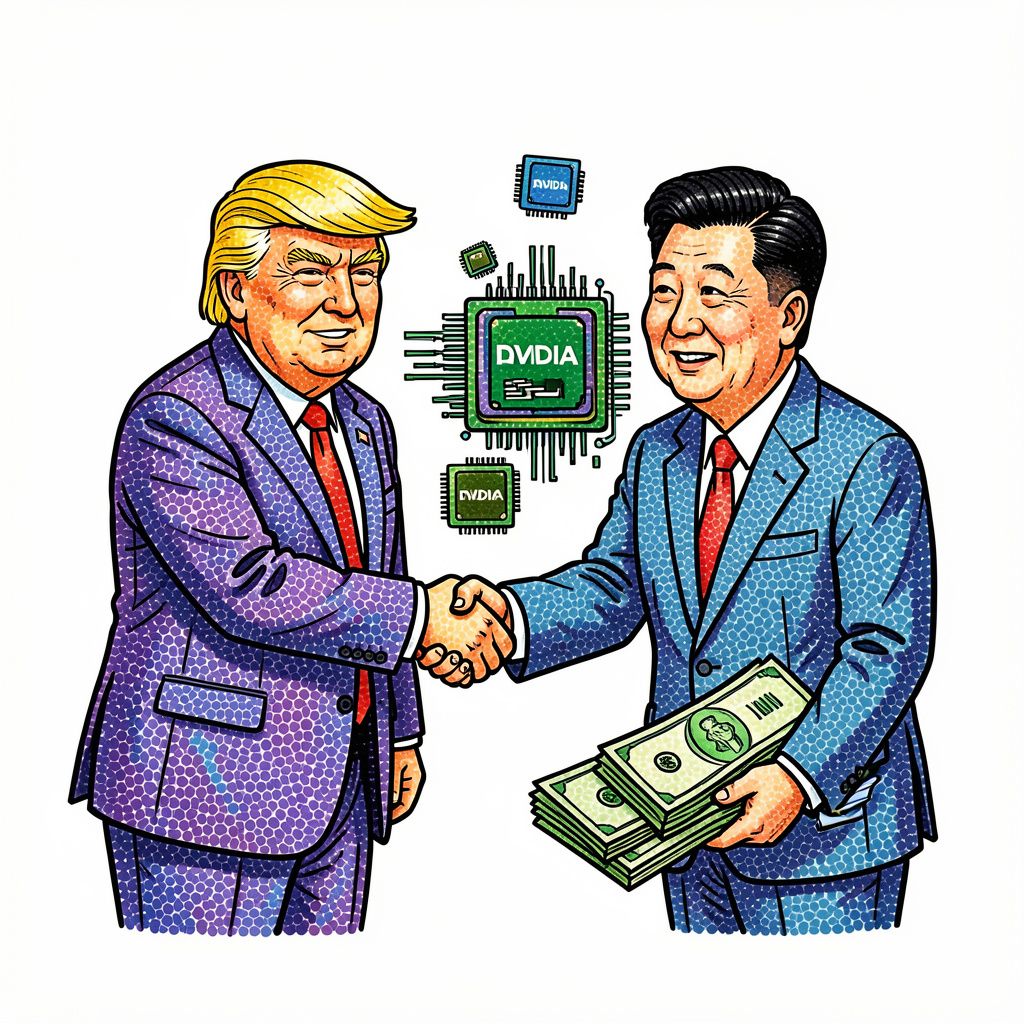
Bolstered by authorized Nvidia chip sales and the May 2026 Trump-Xi summit, the U.S. is aggressively promoting its artificial intelligence across Asia, signaling eased tech trade barriers.
The Diplomatic Catalyst and AI Agenda
Following U.S. President Donald J. Trump’s visit to Beijing from May 13 to May 15, 2026, the geopolitical landscape surrounding technology trade is experiencing a notable shift [6]. This diplomatic engagement, which marked Trump’s first visit to the Chinese capital in nine years, has paved the way for a more collaborative approach to artificial intelligence [6]. A critical component of this thaw was the U.S. administration’s decision to ease export controls, specifically authorizing the sale of Nvidia’s advanced H200 chips to China [6]. This move effectively lowers the barriers that previously restricted Chinese access to high-end American semiconductor technology, a stark reversal from earlier policies that heavily restricted advanced U.S. chips [1][5][6].
Navigating the Competitive Asian Tech Landscape
The American initiative, however, enters an environment already saturated with domestic innovation. China has been rapidly advancing its own technological capabilities, ranging from quantum computing to sophisticated AI applications [6]. For instance, on May 19, 2026, the Chinese tech conglomerate Alibaba unveiled its new, more powerful Zhenwu AI chip alongside a novel large language model [1]. Ryan Fedasiuk, a fellow at the American Enterprise Institute, noted that while the U.S. administration is strategically correct in advocating for American technology, it faces steep competition. As Fedasiuk pointed out, the U.S. “will compete with Chinese hyperscalers and Chinese AI labs that are attempting to do exactly the same” [1][5].
Trade Truces and Broader Economic Implications
The current AI diplomacy is underpinned by broader macroeconomic stabilization efforts that trace back to the October 2025 APEC Summit in Busan, where Presidents Trump and Xi agreed to a one-year truce on trade and tariffs [6]. This “Busan deal” involved the U.S. suspending certain high tariffs in exchange for China relaxing export controls on critical minerals and committing to increased purchases of American goods [6]. The tangible results of this economic détente are already visible; on May 20, 2026, China confirmed a massive order for 200 Boeing aircraft equipped with GE engines, a figure that President Trump suggested could potentially scale up to 750 planes [1][6].
The Road to Shenzhen and Future Summits
The culmination of these diplomatic and technological efforts will occur in November 2026, when China concludes its hosting duties for the APEC trade ministers’ meetings in Shenzhen [1][5]. Shenzhen itself stands as a testament to China’s technological ambitions, operating as a hyper-modern smart city replete with drone food deliveries, street-level wireless charging, and robotic police forces—one of which was notably stationed at the entrance of the recent APEC opening ceremony in Suzhou [2][4]. The APEC Summit in Shenzhen will be closely followed by the G20 Leaders’ Summit in Miami, Florida, in December 2026, providing back-to-back platforms for global economic coordination [6].
Sources
- www.cnbc.com
- news.cgtn.com
- www.bastillepost.com
- www.instagram.com
- www.mexc.com
- frontline.thehindu.com