Massive Wildfires Trigger Historic Evacuations Across France and Spain
Bordeaux, Saturday, 25 July 2026.
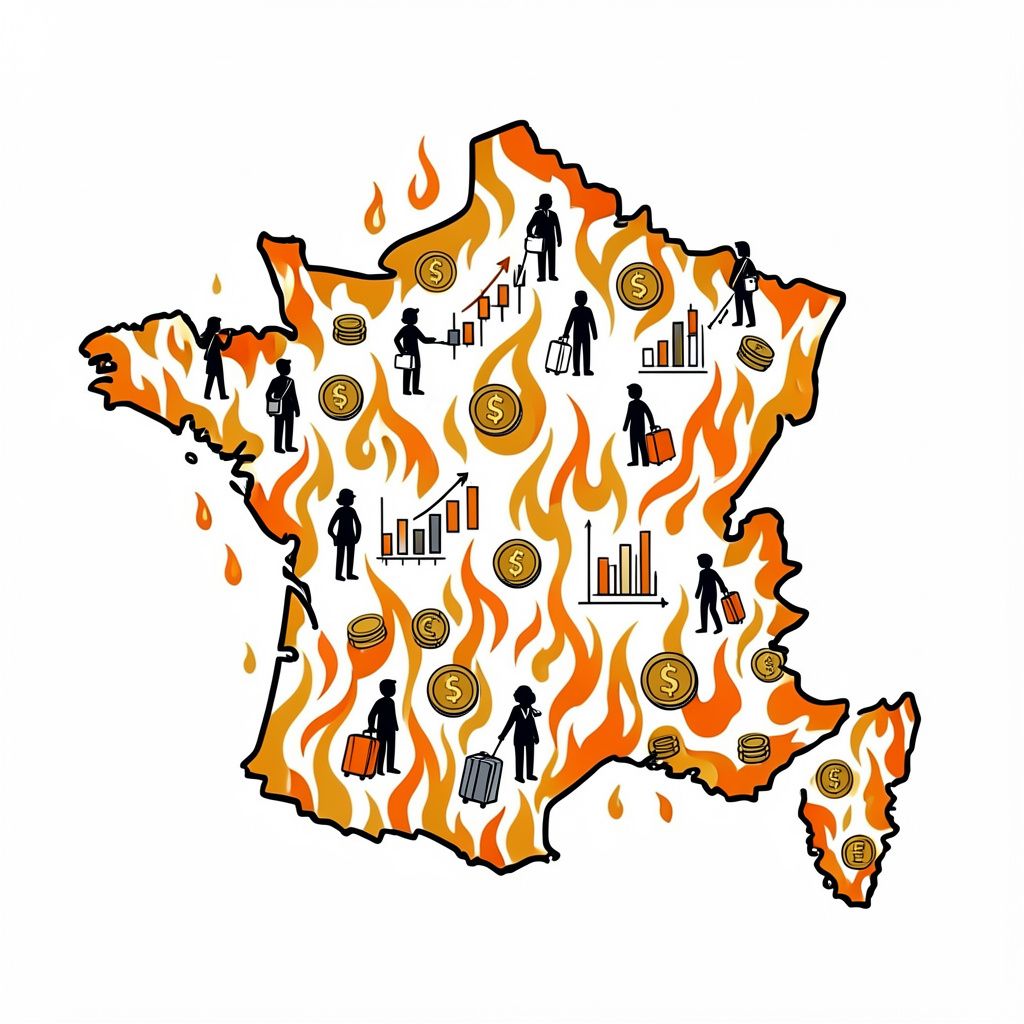
Over 267,000 people have fled historic wildfires in France and Spain, marking France’s worst fire season on record and severely disrupting Southern Europe’s tourism and regional economies.
Unprecedented Displacement and France’s Worst Fire Season
The sheer scale of the displacement across Southern Europe highlights the unprecedented intensity of the 2026 fire season, which has officially been recorded as the worst wildfire year in France’s history [3]. As of today, July 25, 2026, the total number of evacuees across France and Spain has reached 267,000 [3]. French authorities report 197,000 evacuations near the critical wine-producing and tourist hub of Bordeaux, while Spanish authorities are managing 70,000 evacuations west of Madrid [3]. To calculate the distribution of this displacement, France accounts for approximately 73.783% of the total regional evacuations, leaving Spain with the remaining 26.217%. This massive movement of people has severely strained regional infrastructure, forcing local authorities to establish emergency shelters, such as the reception center set up by Bordeaux Métropole at the Parc des Expositions [5].
The French Frontline: Gironde and Landes Under Siege
The crisis in France is heavily concentrated in the southwestern Gironde and Landes regions, where convective fires have exhibited extreme, unpredictable behavior [1]. France’s Interior Minister, Laurent Nuñez, emphasized the extraordinary nature of the blazes, stating that authorities “have never seen a convective fire of this magnitude” [1]. The massive fire in Gironde, which initially consumed 19,000 hectares and destroyed 80 homes [1], has rapidly expanded to scorch over 32,000 hectares of land [3]. This represents a staggering 68.421% increase in burned territory since the earlier assessments. Meanwhile, in the Landes region, a wildfire near Biscarrosse forced the evacuation of more than 23,000 people from homes, campsites, a nursing home, and a summer camp under extreme conditions, including winds of 50 km/h and temperatures reaching 36°C to 37°C [1].
Military Mobilization and International Reinforcements
To combat the out-of-control blazes, the French government has deployed extensive military and civil resources. On July 25, 2026, the French military deployed 1,500 soldiers, bulldozers, drones, and Airbus A400M aircraft to the Gironde region to support firefighting efforts [3]. This deployment follows the activation of the European Union’s civil protection mechanism by French President Emmanuel Macron on July 23, which secured vital international reinforcements, including two Black Hawk helicopters from the Czech Republic and Slovakia [1]. In total, the EU has deployed five planes and two helicopters from the rescEU fleet to France, while Copernicus provides emergency satellite mapping to track the fires’ progression [3]. These resources are fighting to protect vulnerable areas like the Cap-Ferret peninsula, where the prefect of Gironde, Sophie Brocas, triggered immediate FR-Alert evacuations for the coastal villages of Claouey, Le Four, Les Jacquets, Petit Piquey, and Grand Piquey after the fire breached defensive lines [4].
Spain’s National Emergency and the Threat to Madrid
Simultaneously, Spain is facing a historic crisis of its own, prompting the country to declare its first-ever national emergency specifically for wildfires [3]. The situation west of Madrid has been described as “complex” and “apocalyptic” by local residents and officials, as merging fires threaten towns like Robledo de Chavela and Fresnedillas de la Olivia, roughly 50 km from the capital [1][3]. In the Madrid region, wildfires have consumed 6,000 hectares, while another 9,000 hectares have burned in neighboring Ávila [1], totaling 15000 hectares across these two critical zones. Spanish authorities have deployed the Military Emergency Unit (UME) to protect historic sites like El Escorial [1]. However, Carlos Novillo, the emergency management chief for the Madrid regional government, warned that the wildfire is “at its peak and is currently beyond the capacity of firefighters to contain,” forcing officials to rely strictly on defensive measures in certain sectors [1]. While Spanish Prime Minister Pedro Sánchez was scheduled to visit the national emergency coordination center on July 25, 2026 [1], the exact status of this visit remains unconfirmed [alert! ‘official confirmation of the Prime Minister’s visit on July 25, 2026 is unavailable in current reports’].
Severe Economic Disruption and Tourism Halts
The economic fallout from these fires is reverberating across Southern Europe’s vital tourism sector during its peak summer season, when local businesses rely heavily on seasonal revenues [GPT]. Major regional attractions and events have been completely shut down or altered; for instance, the stage of the Tour de France scheduled for Sunday, July 26, 2026, has been shortened from 133 km to 89 km to allow for the redeployment of security personnel to the Bordeaux fire zones [3]. This represents a reduction of 44 km, or 33.083% of the stage’s original length, reflecting the severe strain on public safety resources. Furthermore, tens of thousands of tourists have been evacuated from campsites and hotels across the Gironde and Landes regions [1], dealing a severe blow to local hospitality businesses [GPT].
Long-Term Climate Adaptation and Labor Shifts
As Southern Europe grapples with the immediate destruction, governments are looking toward long-term adaptation strategies to survive an increasingly torrid climate. Since the 1980s, Europe has been warming at more than twice the global average [1]. Recognizing this shift, French Labor Minister Jean-Pierre Farandou and Health Minister Stephanie Rist have begun studying how Spain manages extreme heat [2]. Farandou noted that “France is discovering that in summer, it will become Spain,” and has organized a delegation to Madrid in September 2026 to study Spanish adaptation measures [2]. These include shifting manual and outdoor work hours to cooler predawn hours, implementing frequent rest breaks to recover from heat-induced sleep loss, and emphasizing hydration, mirroring traditional Spanish coping mechanisms like the siesta [2].
A State Pact Against Climate Emergency
The sheer scale of the 2026 disaster has intensified political pressure on European leaders to enact systemic environmental policies. In Spain, where over 28,000 people are currently under strict lockdown orders in the Madrid and Ávila regions to avoid hazardous air quality [3], government officials have called for a unified response. Spanish Prime Minister Pedro Sánchez has advocated for a “state pact against climate emergency” to coordinate national and regional resources more effectively [3]. European Commission President Ursula von der Leyen reaffirmed the bloc’s solidarity, noting that the rescEU fleet’s deployment of aircraft to both France and Spain is a testament to Europe standing together in the face of devastating climate realities [3]. However, as local leaders like Sandy McCook in Scotland’s Cairngorms—where a separate wildfire has burned for 11 days—point out, the gap between official containment claims and the reality of out-of-control blazes remains a critical challenge for regional emergency infrastructure [3].
Sources
- www.bbc.com
- www.nytimes.com
- www.theguardian.com
- www.gironde.gouv.fr
- www.gironde.gouv.fr
- www.gironde.gouv.fr