Local Regulations Block Data Center Growth Despite Widespread Community Support
Washington, Tuesday, 29 September 2026.
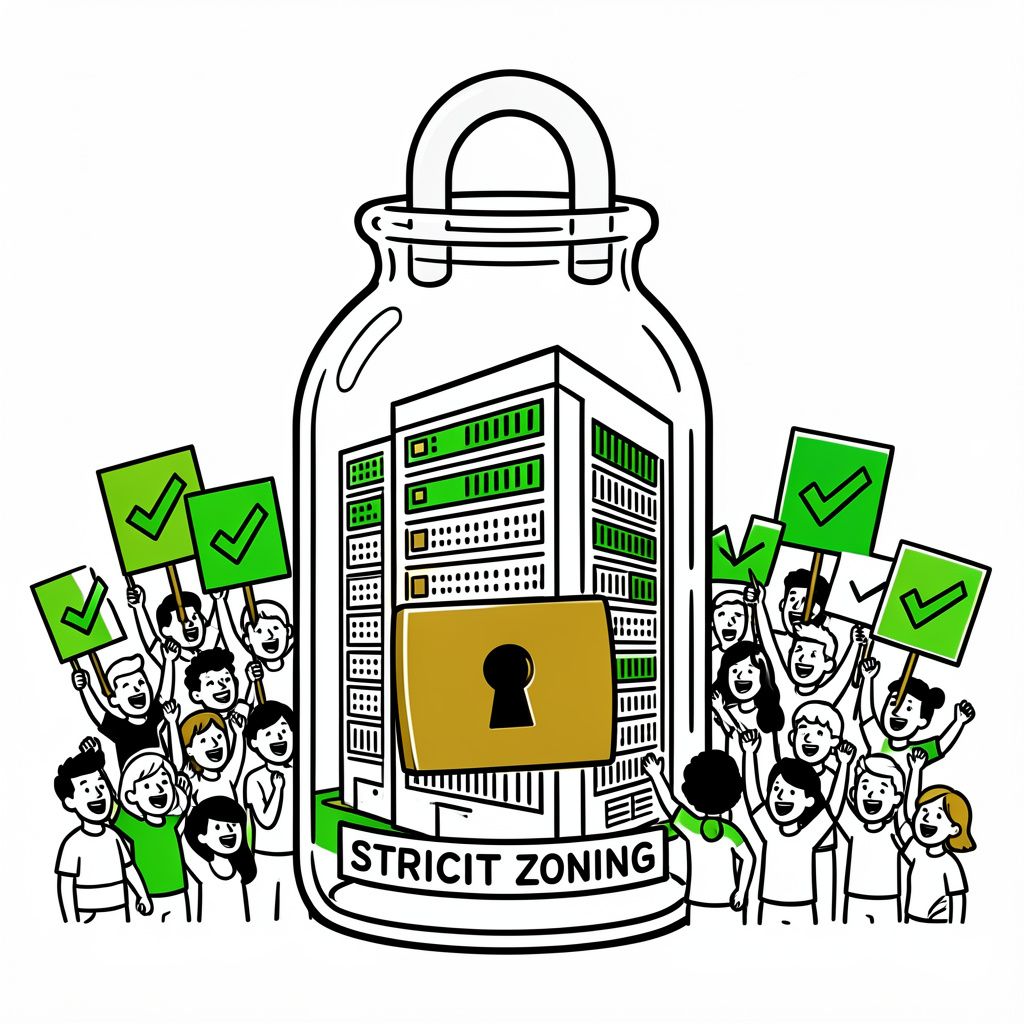
A September 2026 study reveals two-thirds of U.S. counties support data centers, yet strict local zoning regulations render only 1.3% feasible for actual development.
Public Sentiment Versus Regulatory Reality
A comprehensive nationwide analysis released in September 2026 by Learnewable reveals a significant disconnect between public opinion and regulatory feasibility regarding data center expansion across the United States. While 66% of U.S. counties maintain a favorable public sentiment toward data centers, only 1.3% of counties, totaling 42 locations, are rated as favorable for actual development when regulatory conditions are accounted for [1][2]. This disparity highlights a complex economic landscape where community support does not necessarily translate into actionable zoning permissions, creating a bottleneck for artificial intelligence and cloud computing infrastructure projects [1]. The study examined all 3,144 U.S. counties, finding that local municipalities recognize the long-term economic benefits and tax revenue, yet regulatory barriers remain the primary obstacle [2].
Shifting Regulatory Landscapes
The regulatory environment for data center development has undergone a notable transformation between July 2026 and September 2026. While the number of counties with outright bans or moratoriums on data centers decreased from 501 to 332, the number of counties implementing restrictive zoning short of a ban nearly doubled from 324 to 636 [1][2]. This represents a percentage increase in restrictive zoning counties of 96.296 over the two-month period [1]. Consequently, 968 counties, or 31% of the country, currently face regulatory headwinds for data center development, an increase from 825 counties in July 2026 [2]. Jeremy Solomon of Learnewable LLC noted that Americans are not necessarily rejecting data centers, but local rules are increasingly becoming the bigger barrier [1].
Transparency and Local Governance
Concerns over transparency have intensified alongside regulatory shifts, particularly regarding nondisclosure agreements (NDAs) between local governments and developers. In Salem, Oregon, city officials signed an NDA with developer Verrus in March 2025, but the project only became public knowledge in July 2026, leading to resident protests over noise and electricity costs [3]. In response to such transparency issues, the Salem City Council voted to ban NDAs with data center developers on September 14, 2026, and implemented a four-month moratorium on construction on September 21, 2026 [3]. Similarly, Pennsylvania Governor Josh Shapiro signed an executive order on August 18, 2026, prohibiting the use of NDAs for data center development projects to protect consumers [3].
Economic Impact and Community Resistance
The tension between infrastructure needs and local concerns has resulted in significant project rejections despite potential economic gains. In the village of DeForest, Wisconsin, roughly 12,000 residents rejected a proposed hyperscale data-center development valued at approximately $12 billion [4]. This rejection underscores the challenge developers face even in communities that might benefit from the investment, as 363 specific counties have been identified where favorable community sentiment exists despite restrictive local zoning [2]. As the industry expands, the focus is shifting toward understanding under what conditions communities are willing to accept data centers, rather than simply whether they want them [1].