China’s Delivery Jobs Face Extinction: 700,000 Workers to Be Replaced by Robots
Beijing, Monday, 22 June 2026.
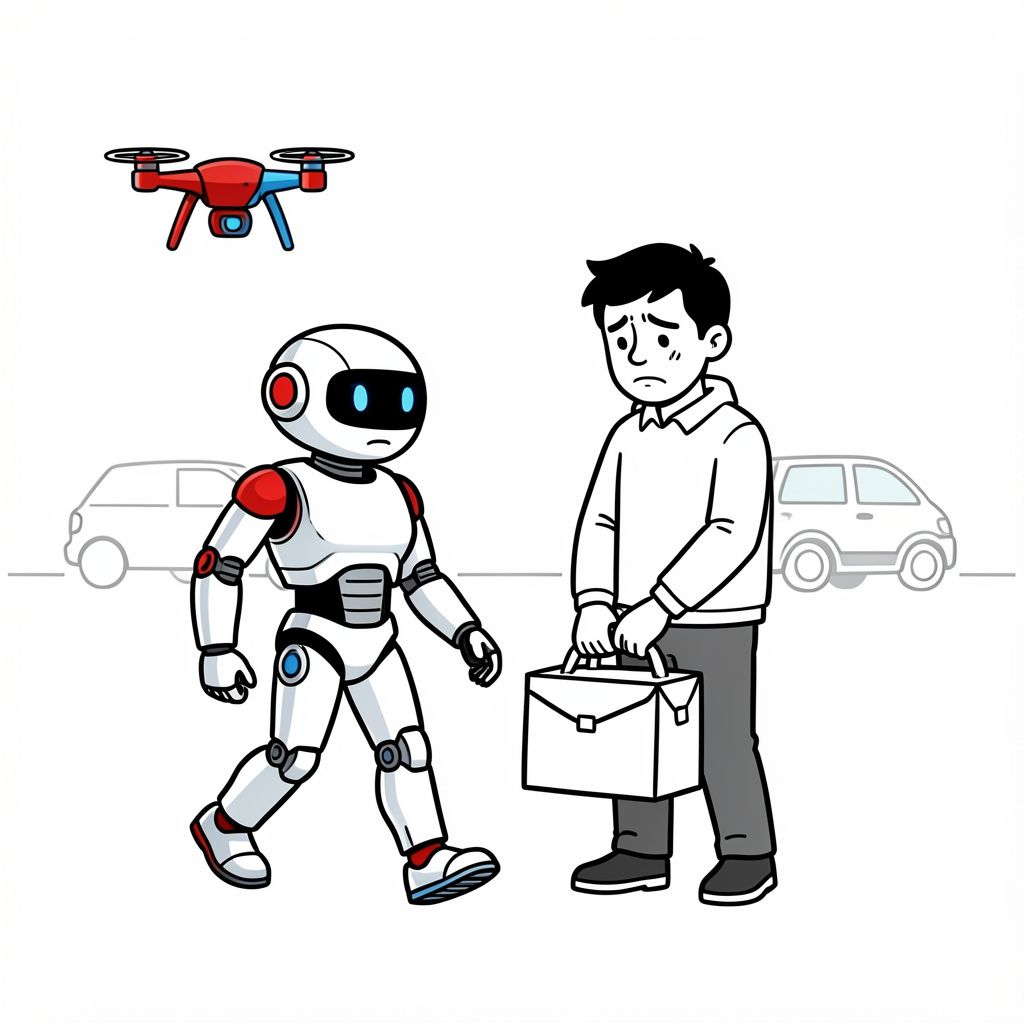
JD.com’s CEO warns that automation will eliminate 700,000 delivery jobs in China, signaling a seismic shift in the gig economy. The company’s ‘Nirvana Plan’ aims to retrain workers as robot technicians, but skeptics question whether reskilling can outpace job losses. With drones and autonomous vehicles already in use, this move could redefine global logistics labor markets by 2030.
The Automation Tsunami: 700,000 Jobs on the Line
On 21 June 2026, JD.com founder and Chairman Richard Liu Qiangdong delivered a stark warning at the APEC China CEO Forum in Beijing: ‘In the future, deliveries will be made by robots. There will be no need for delivery workers’ [1][2][6]. This declaration from one of China’s e-commerce giants signals the acceleration of a trend that could eliminate 700,000 delivery jobs in China alone [1][3][5]. The prediction comes as JD.com, which operates one of the world’s largest automated logistics networks, intensifies its investments in drone delivery, autonomous vehicles, and robotic warehouses [1][4]. The company’s aggressive automation strategy reflects broader industry trends, with China’s gig economy workforce projected to reach 320 million by the end of 2026—representing 40% of the country’s urban and rural employed population [7].
The Nirvana Plan: Retraining as a Lifeline or Lip Service?
In response to mounting concerns about job displacement, JD.com unveiled its ‘Nirvana Plan’—an ambitious initiative to retrain 700,000 frontline employees, primarily delivery workers, for technical roles in robot maintenance and equipment servicing [1][2][7]. The plan involves partnerships with 120 schools across China, aiming to transition workers from manual labor to white-collar technical positions [2][5]. Liu framed the initiative as a welfare measure, stating, ‘I don’t want our 700,000 employees to be left without jobs or income’ [1][2]. However, skeptics question whether the plan can scale effectively. Robot maintenance roles are unlikely to match the volume of delivery positions being phased out, and no enrollment figures or timelines have been disclosed to assess the program’s feasibility [2]. The tension between automation and workforce protection is palpable: while JD.com positions itself as a pioneer in ‘human-machine collaboration,’ the reality is that the company is already deploying robots for tasks ranging from airport food deliveries to supermarket restocking [4][7].
China’s Gig Economy at a Crossroads
The automation wave in China’s logistics sector arrives at a precarious moment for the country’s labor market. Youth unemployment (ages 16-24) stood at 15.6% in May 2026, down slightly from 16.3% in April but still elevated compared to pre-pandemic levels [7]. The gig economy, which has absorbed millions of workers displaced from traditional sectors, now faces its own existential threat. JD.com’s announcement underscores a broader shift in China’s economic priorities, where technological advancement is increasingly prioritized over labor-intensive growth models [1][3]. The company’s ‘Nirvana Plan’ includes a pledge to train 100,000 engineers over five years (2026-2031) in robot and smart-home after-sales maintenance, rebranding former couriers as ‘JD Craftsmen’ [7]. Yet, the scale of the challenge is daunting: China’s gig workforce grew from 200 million in 2021 to a projected 320 million in 2026, with delivery workers comprising a significant portion of this expansion [7].
The Human Cost of Efficiency
The debate over JD.com’s automation strategy extends beyond economic metrics to fundamental questions about the role of technology in society. Liu has framed automation as a force for good, stating, ‘Technology makes life better and work more interesting, rather than stripping humans of their right to work’ [5][7]. Yet, the reality for many delivery workers is less optimistic. China’s gig economy has long been criticized for precarious working conditions, with delivery drivers facing intense pressure to meet tight deadlines while earning modest wages [GPT]. The transition to robotics threatens to exacerbate inequality, as low-skilled workers are displaced by machines while technical roles remain concentrated among a smaller, highly trained workforce. JD.com’s ‘Nirvana Plan’ attempts to bridge this gap, but the logistical hurdles are significant. Retraining 700,000 workers in a country where vocational education has historically struggled to keep pace with technological change is a monumental task [alert! ‘no data on success rates of similar retraining programs in China’] [2]. Moreover, the plan assumes that the demand for robot maintenance technicians will grow in tandem with automation—a premise that remains unproven at scale [2].
A Glimpse Into 2030: The Logistics Labor Market Transformed
By 2030, the logistics industry could look radically different from today. JD.com’s vision of a fully automated delivery network—where drones, autonomous vehicles, and robots handle the bulk of last-mile logistics—may become the norm rather than the exception [1][4]. The company’s investments in robotics are already yielding results: in Shenzhen, JD.com has deployed robots that ride commuter trains to restock supermarkets, while its drone delivery programs have expanded to cover remote rural areas [7]. These innovations are not merely experimental; they are part of a long-term strategy to reduce reliance on human labor. For workers, the implications are stark. The ‘Nirvana Plan’ may soften the blow for some, but the broader trend suggests a future where low-skilled logistics jobs are increasingly rare. Policymakers in China and beyond are grappling with how to manage this transition, with some advocating for universal basic income or expanded social safety nets to cushion the impact [GPT]. However, with automation accelerating faster than regulatory frameworks can adapt, the risk of widespread displacement looms large. As one industry observer noted, ‘JD.com is the first major Chinese company to put a concrete number and a concrete plan behind the transition. The question is whether other firms will follow—or whether they will simply automate without offering alternatives’ [6].