FAA Restricts Texas Airspace After Military Laser Accidentally Downs Border Patrol Drone
Fort Hancock, Friday, 27 February 2026.
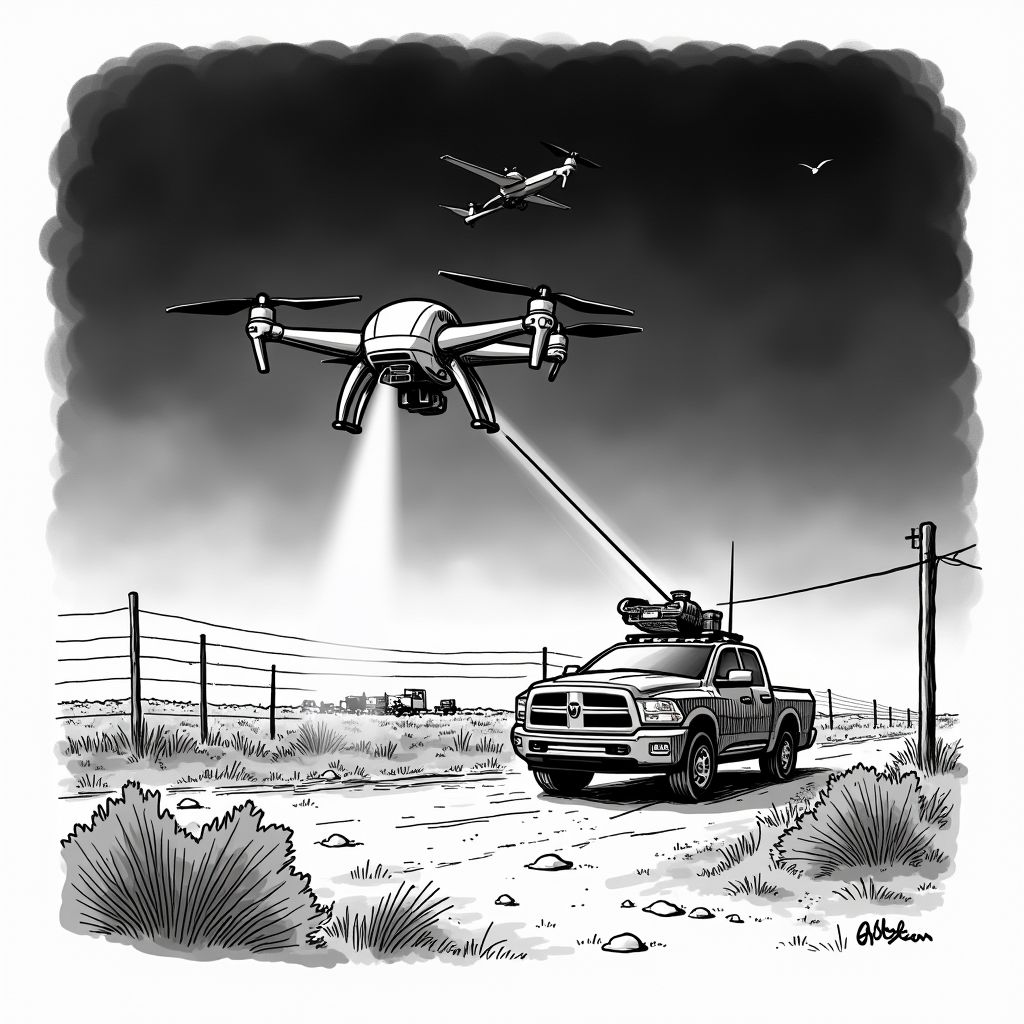
In a significant inter-agency coordination failure, the FAA restricted airspace over Fort Hancock, Texas, after a military laser weapon reportedly destroyed a US Customs and Border Protection drone. This “friendly fire” incident marks the second time this month that advanced anti-drone technology has disrupted domestic aviation operations near the Mexican border.
Incident Specifics and Immediate Fallout
The Federal Aviation Administration (FAA) initiated the airspace restrictions via a Notice to Air Missions (NOTAM) citing “special security reasons” effective from 6:30 p.m. local time on Thursday, February 26 [1]. While the FAA and the Pentagon have not immediately released a joint official comment, congressional aides confirmed that a military laser-based anti-drone system, intended for defense, accidentally targeted and destroyed a drone operated by another federal agency, Customs and Border Protection (CBP) [1][2]. The restricted zone encompasses the area surrounding Fort Hancock, a community located approximately 40 to 50 miles southeast of El Paso along the Mexican border [3][7]. Unlike previous incidents in the region, officials have stated that this specific expansion of the exclusion zone does not currently impact commercial aviation traffic [6][8]. The restriction is scheduled to remain in effect until late June 2026 [1][3].
Legislative Outrage and Coordination Failures
The incident has triggered a sharp rebuke from senior House Democrats on committees overseeing transportation and homeland security. Representatives Rick Larsen, André Carson, and Bennie Thompson issued a joint statement expressing shock at the lack of inter-agency coordination, stating their “heads are exploding over the news” [1][8]. The lawmakers criticized the White House for previously bypassing a bipartisan, tri-committee bill designed to mandate appropriate training for counter-unmanned aircraft system (C-UAS) operators [1][7]. According to the representatives, this legislative measure was intended to address precisely the type of communication breakdown between the Pentagon, the Department of Homeland Security (DHS), and the FAA that resulted in this friendly fire incident [1]. They characterized the event as a predictable result of “incompetence” regarding the deployment of high-risk counter-drone technologies in domestic airspace [5][7].
A Pattern of Disruption in West Texas
This event marks the second significant disruption to Texas airspace involving directed energy weapons in less than three weeks. On February 11, the FAA abruptly halted air traffic at El Paso International Airport for approximately eight hours, a move that caused flight cancellations affecting a city of nearly 700,000 people [5][7]. While Transportation Secretary Sean Duffy initially publicly attributed that closure to a “drug cartel drone” incursion, subsequent reporting revealed a far less malicious cause [6]. It was later confirmed that CBP agents, utilizing a laser system on loan from the Department of Defense (DOD), had mistaken a party balloon for a cartel surveillance drone and shot it down [1][6]. Industry officials indicated that the DOD had failed to share critical safety information regarding these counter-drone tests with the FAA, leading to the sudden and chaotic closure of the airspace [6].
Administrative Response and Future Protocols
The recurrence of these incidents highlights a critical gap in the operational protocols governing advanced military technology on U.S. soil. Following the initial February 11 incident, Secretary Duffy maintained on February 21 that the airspace closure was not a mistake, despite the misidentification of the target [5]. However, the continued friction between the FAA’s mandate to ensure civil aviation safety and the military’s testing of directed energy weapons has drawn scrutiny from both parties, including calls for classified briefings from Senator Ted Cruz (R-Texas) earlier in the month [6]. Secretary Duffy is scheduled to brief members of Congress regarding these operational failures this week [5]. Meanwhile, the current flight restriction over Fort Hancock mandates that any emergency operations, such as medical evacuations or search and rescue flights, must coordinate directly with the Albuquerque air route traffic control center before entering the zone [6].
Sources
- www.theguardian.com
- www.ctvnews.ca
- www.elpasotimes.com
- www.washingtonpost.com
- www.clickondetroit.com
- www.politico.com
- www.cnn.com
- www.theguardian.com