Delhi Proposes Ban on New Gas-Powered Two-Wheelers by April 2028
New Delhi, Sunday, 12 April 2026.
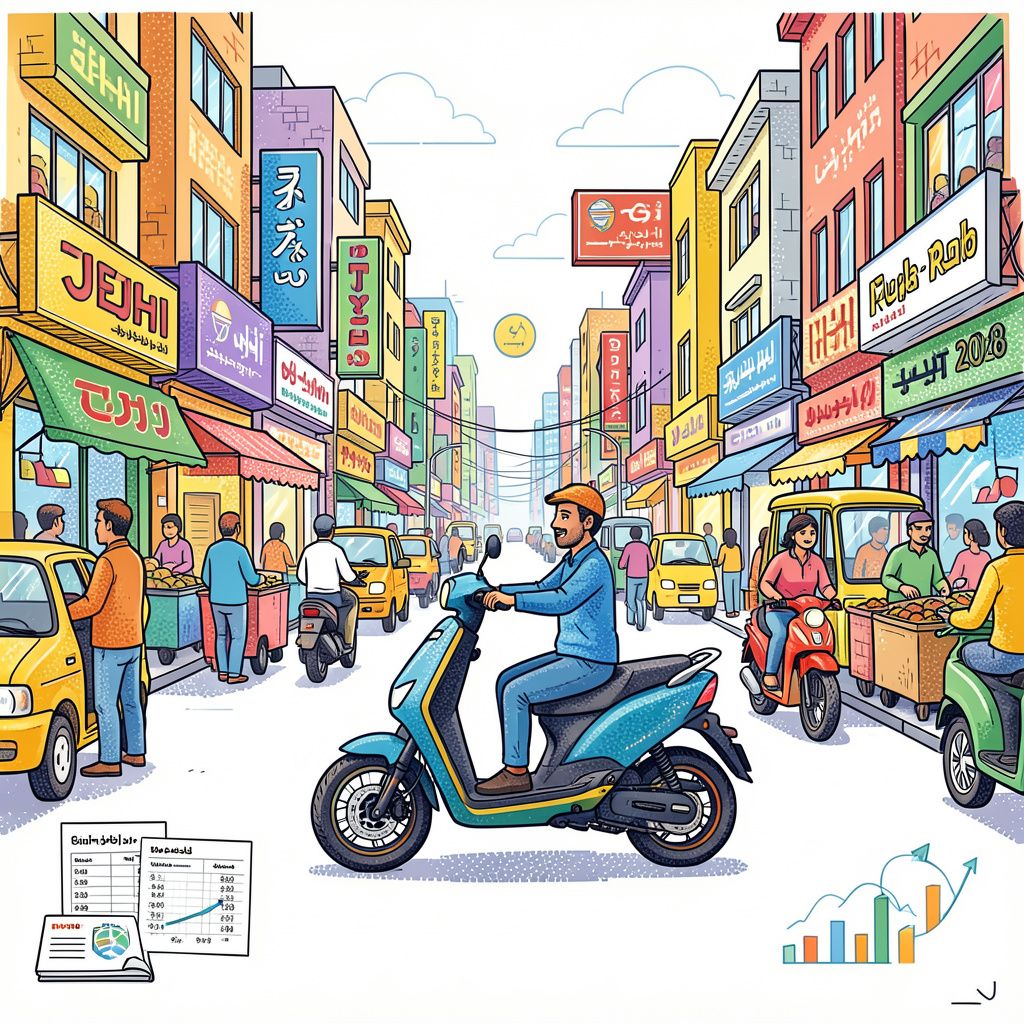
Delhi’s proposed ban on new fossil-fuel two-wheelers by April 2028 will force global automakers to rapidly accelerate battery technology adoption in one of the world’s largest motorcycle markets.
A Phased Approach to Electrification
The Government of the National Capital Territory of Delhi introduced the draft Electric Vehicle (EV) Policy 2026–2030 in early April 2026 [1][4][5]. The framework, currently open for a 30-day public consultation period ending on May 10, 2026, aims to systematically eliminate the registration of internal combustion engine (ICE) vehicles [1][4]. Under the proposed timeline, only electric three-wheelers and auto-rickshaws will be permitted for new registration starting January 1, 2027 [1][2][4][5]. This will be followed by a strict mandate allowing only electric two-wheelers to be registered from April 1, 2028 [1][2][4][5]. This bold legislative move marks Delhi as the first Indian state or union territory to propose a mandatory phase-out of non-electric vehicles [6].
The rationale behind targeting two-wheelers and three-wheelers is deeply rooted in the region’s environmental data [GPT]. Vehicular emissions account for approximately 23% of air pollution in the Delhi National Capital Region (NCR) during the winter months [2]. Furthermore, two-wheelers represent approximately 67% of the total vehicle stock in the city [2]. By enforcing rapid electrification in this dominant transport segment, policymakers anticipate meaningful reductions in urban air pollution [2][5].
Financial Incentives and Budgetary Commitments
To facilitate this transition, the Delhi government has earmarked a substantial budget of ₹3,954 crore for the policy’s implementation [1]. This capital allocation is strategically divided, dedicating ₹1,236 crore to purchase incentives, ₹1,718 crore—which represents 43.45 percent of the total funding—to scrapping incentives, and ₹1,000 crore to the development of charging infrastructure [1]. For consumers purchasing electric two-wheelers priced under ₹2.25 lakh, the government proposes a capacity-linked subsidy of ₹10,000 per kilowatt-hour (kWh), capped at ₹30,000 during the first year of the policy [1][4][5]. These incentives are designed to taper off gradually, reducing to a maximum of ₹20,000 in the second year and ₹10,000 in the third year [1].
The policy also extends significant financial relief to the four-wheeler segment. Buyers of electric cars priced up to ₹30 lakh will benefit from a 100% exemption on road tax and registration fees until March 31, 2030 [1][3][4][5]. Strong hybrid vehicles are also recognized, receiving a proposed 50% exemption on these charges [4][5]. Additionally, the state is heavily incentivizing the removal of older, polluting vehicles from the roads [4]. Residents can claim a scrapping incentive of up to ₹1 lakh when purchasing a new electric car—provided the purchase occurs within six months of receiving a scrapping certificate for an older BS-IV vehicle—alongside smaller scrappage benefits of ₹25,000 for three-wheelers and ₹10,000 for two-wheelers [1][4][5].
Transforming Commercial Fleets and Public Transit
Commercial operations, particularly aggregator and delivery fleets such as Ola, Uber, Zomato, and Swiggy, are facing even tighter regulatory deadlines [1]. A ban on the registration of new petrol and diesel vehicles for these aggregator-based operations has already been in effect since January 1, 2026 [1][5]. While existing BS-VI compliant two-wheelers currently operating within these fleets have been granted a grace period, this exemption is set to expire on December 31, 2026 [1][5]. By 2027, the policy dictates that these commercial fleets must transition to fully electric operations [1].
Public and institutional transit systems are similarly targeted for an overhaul [4]. The draft policy mandates that all newly hired or leased government vehicles must be electric upon the policy’s formal notification [4]. Furthermore, the state has set progressive electrification targets for school buses, aiming for 10% adoption in the second year of the policy, 20% in the third year, and ultimately reaching a 30% electric fleet by 2030 [4][5]. New intra-state buses will also be required to transition to electric power, with provisions left open for the integration of cleaner alternative technologies, such as hydrogen, in the future [5].
Infrastructure and Industry Implications
A transition of this magnitude requires robust foundational support, which the policy addresses through its ₹1,000 crore infrastructure budget [1]. Delhi Transco Limited (DTL) has been appointed to spearhead the expansion of the EV charging network across the capital [5]. Meanwhile, the Delhi Pollution Control Committee will be responsible for overseeing Extended Producer Responsibility (EPR) regulations, ensuring that battery collection and recycling processes are strictly managed [5].
As the May 10, 2026, deadline for public