India and EU Finalize Historic Trade Pact to Counteract US Tariff Pressures
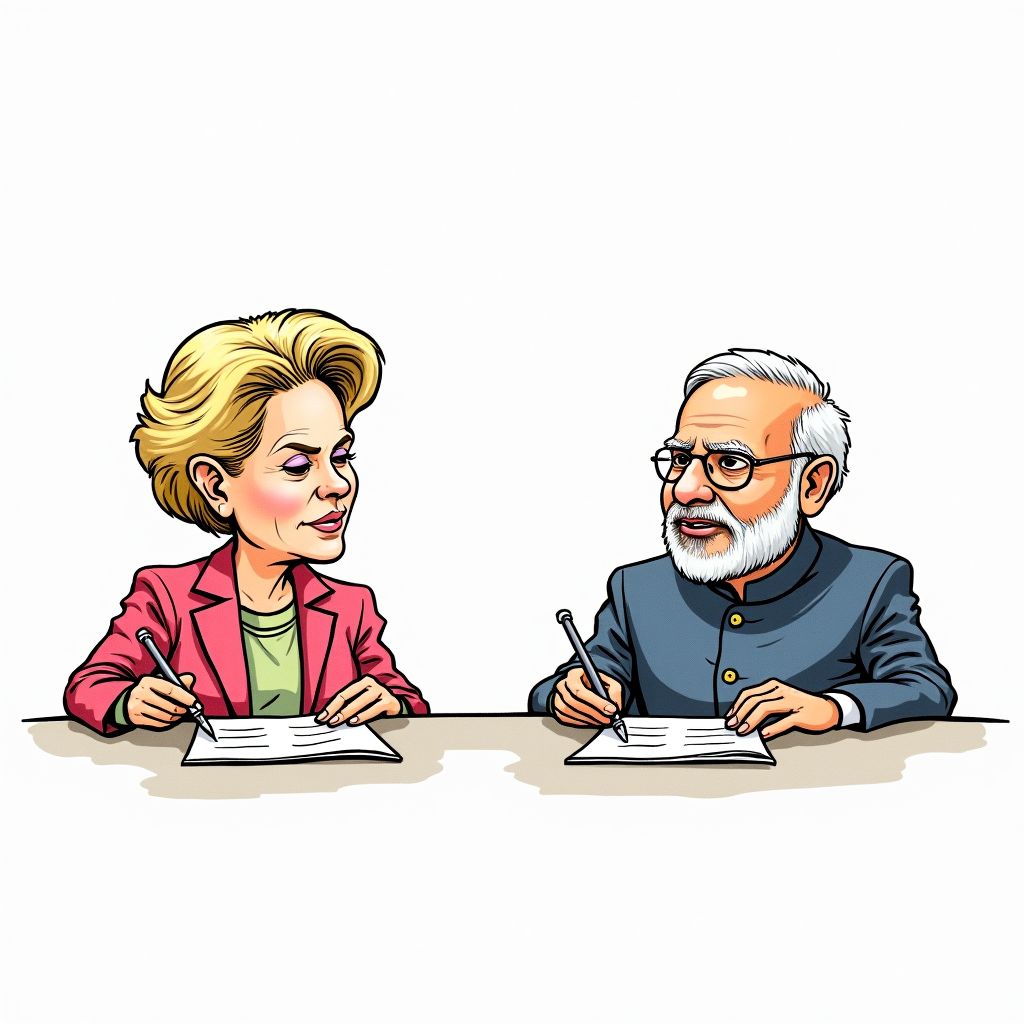
Brussels, Tuesday, 27 January 2026.
On January 27, 2026, India and the European Union finalized a landmark free trade agreement, strategically pivoting away from reliance on the United States amidst rising protectionism. Dubbed the “mother of all deals” by Commission President Ursula von der Leyen, this pact creates a massive free trade zone encompassing two billion people and representing a quarter of global GDP. The agreement slashes tariffs on over 96% of traded goods, including significant reductions on European automobiles and wines entering the Indian market. Beyond economics, this deal signals a profound geopolitical shift as major economies diversify supply chains to mitigate the impact of Washington’s aggressive tariff policies. With formal signing expected later this year, this partnership offers a critical buffer for global trade stability.
Unlocking a Market of Two Billion
The economic architecture of this agreement is staggering in its ambition, designed to integrate two of the world’s largest democratic markets. As finalized on January 27, 2026, the deal covers approximately 25% of the global GDP and creates a combined market of two billion people [1][2]. For European exporters, the agreement unlocks unprecedented access to the Indian subcontinent, with New Delhi committing to eliminate or reduce tariffs on 96.6% of EU goods by value [3][6]. In a reciprocal move, the European Union will reduce duties on 99.5% of Indian imports over a seven-year period [3][6]. This massive liberalization is projected to save European companies roughly €4 billion annually in duties, providing a substantial competitive edge in a rapidly growing market [1][6]. The strategic intent is clear: to double EU exports to India by 2032, diversifying revenue streams at a time when transatlantic trade faces protectionist headwinds [2][6].
Automotive and Luxury Goods: Breaking Down the Walls
For decades, India’s high tariff walls have been a point of contention for Western manufacturers, particularly in the automotive and luxury sectors. This agreement marks a definitive turning point. Tariffs on European cars, which previously stood as high as 110%, will be slashed to 10% over a five-year period for a quota of 250,000 vehicles, while duties on car parts are set to be fully abolished within five to ten years [1][3][6]. The luxury spirits market will see similar liberalization; import duties on premium European wines will drop immediately from 150% to 75%, with a gradual reduction to 20% over time [3][5]. These reductions are expected to significantly lower consumer prices for European luxury goods in India, opening the door for brands that were previously priced out of the market [5].
Opportunities for Indian Industry
While Europe gains access to India’s consumer class, New Delhi has secured critical avenues for its industrial and service sectors. The agreement provides immediate zero-duty access for Indian exports in labor-intensive industries such as textiles, leather, footwear, and gems [3][4]. Beyond traditional manufacturing, the technology sector stands to gain substantially. The India Cellular and Electronics Association (ICEA) projects that the Free Trade Agreement (FTA) will catalyze electronics exports, potentially reaching $50 billion by 2031 [5]. Furthermore, the deal addresses the mobility of talent—a key priority for India—by establishing a pact to ease the movement of skilled workers and students between the two regions, thereby strengthening the services trade that already accounts for a significant portion of the bilateral economic relationship [1][4].
Strategic Convergence Beyond Trade
The finalized pact extends well beyond tariff schedules, embedding economic ties within a broader security and sustainability framework. Recognizing the urgency of climate action, the EU has committed to a €500 million fund over two years to assist India in reducing greenhouse gas emissions and fostering sustainable industrial transformation [3][6]. On the security front, the deal includes a framework for deeper defense cooperation, with EU foreign policy chief Kaja Kallas announcing an annual security and defense dialogue to commence in January 2026 [6]. This alignment is underscored by the current geopolitical climate; with bilateral trade already reaching $136.5 billion in the fiscal year ending March 2025, the partners aim to aggressively expand this figure to approximately $200 billion by 2030 [1][3]. Following a legal vetting process expected to last five to six months, the formal signing is anticipated later in 2026, with implementation targeted for the end of the year [1][4].