Ohio Senate Race Tightens as Manufacturing and Economic Pressures Dominate Final Campaign Push
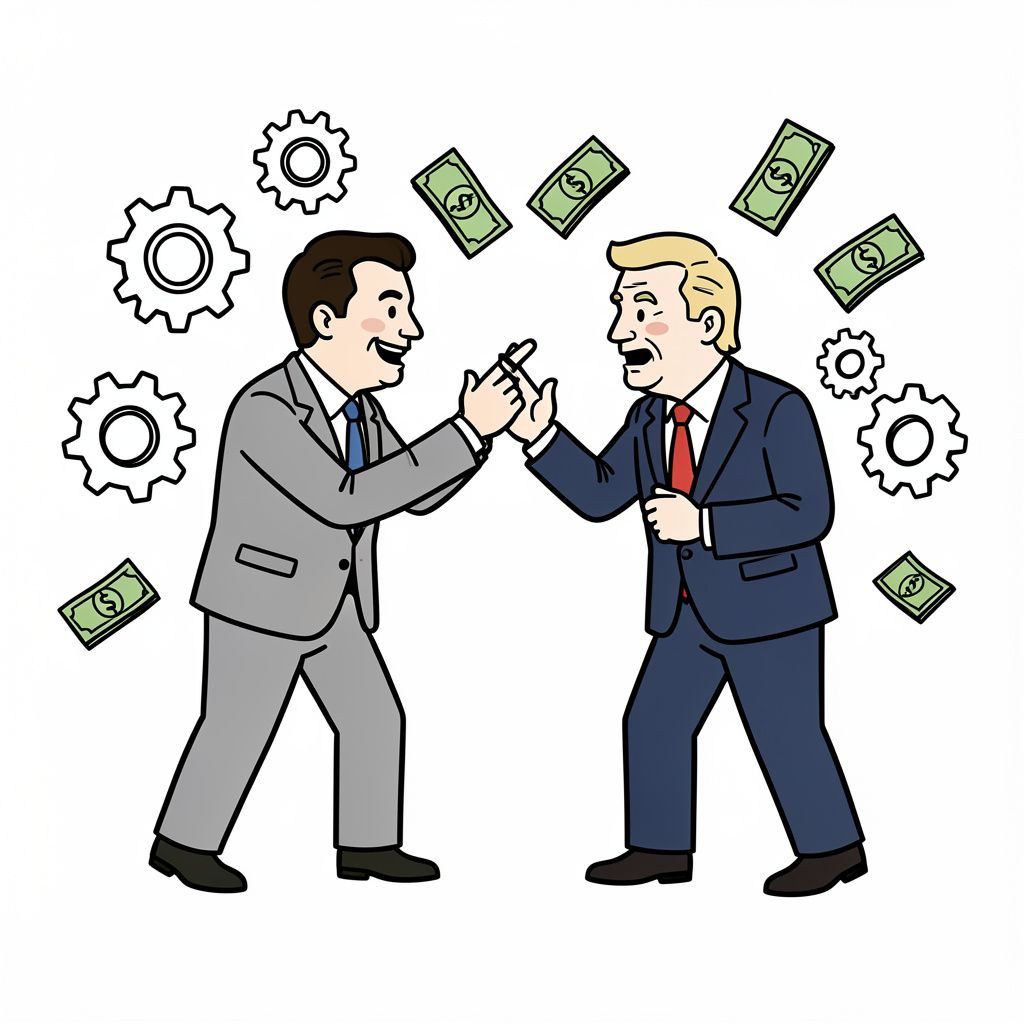
Columbus, Sunday, 1 November 2026.
Ahead of Tuesday’s election, Jon Husted and Sherrod Brown clash over regional manufacturing and 3.7% inflation, while millions in third-party campaign meddling could decisively swing the outcome.
A race defined by manufacturing and inflation fears
With Election Day just 48 hours away, the Ohio Senate race between Republican incumbent Jon Husted and Democratic challenger Sherrod Brown has crystallized around two volatile economic issues: a regional manufacturing sector under strain and inflation that remains stubbornly high at 3.7% as of September 2026 [1]. The candidates are trading accusations over who bears responsibility for the state’s industrial decline, with Husted pointing to federal policies and Brown blaming corporate consolidation and decades of Republican-backed deregulation [2]. The debate is unfolding against a backdrop of Ohio’s shifting political landscape, where the state has voted Republican in the last three presidential elections and has not elected a Democrat to statewide executive office since 2008 [3].
Candidates stake competing visions on Ohio’s economic future
Sen. Jon Husted, appointed to the Senate in 2025 after JD Vance became Vice President, has positioned himself as the champion of Ohio’s manufacturing revival, citing his sponsorship of a bill to require data centers to pay their own utility costs and his support for trade protections that helped secure 1,000 new jobs at Kenworth in Chillicothe over the past year [4][5]. Husted argues that his policies embody an ‘America First’ agenda aimed at protecting American industry from unfair trade practices [5]. Meanwhile, Sherrod Brown, a former senator seeking to return to Washington, has framed the race as a referendum on corporate power, accusing Husted of serving ‘big corporations, billionaires’ and advocating for policies that prioritize Wall Street over working families [1][2]. Brown has pledged to ‘stand up to big tech’ and ‘oil companies,’ positioning himself as a defender of middle-class interests [1].
Third-party candidates and outside groups inject uncertainty into a tight race
The race is further complicated by the presence of third-party candidates William B. Redpath (Libertarian) and Gregory Levy (Socialist), whose combined polling support hovers around 3% in recent surveys [6]. The involvement of outside groups adds another layer of unpredictability: a GOP-backed organization has spent over $2.3 million to boost Levy, while a newly formed Buckeye Freedom PAC is running ads critical of Husted under the slogan ‘Both parties suck, vote for the real conservative’ [6][8]. Political analysts suggest that even small shifts in third-party support could determine the outcome, particularly among independents disillusioned with both major parties [6]. ‘We are seeing a bit more leakage in Republican support, and an overall discontent with both parties among independents,’ noted Robert Alexander, a Bowling Green State University professor of political science [6].
Campaign spending and political crosscurrents intensify ahead of Tuesday
The financial stakes are high, with Brown outraising Husted $68.4 million to $19.9 million as of mid-October, a disparity that reflects both Brown’s national fundraising network and the competitive nature of the race [9]. The total spending on advertising in the race has exceeded $500 million, making it one of the most expensive Senate contests in U.S. history [7]. Meanwhile, former President Barack Obama campaigned in Ohio over the weekend of October 24–25 to support Brown, while former President Donald Trump headlined an event with Husted in Chillicothe on October 28 [6][10]. The candidates’ final rallies underscore the intensity of the final stretch, with Husted warning that Brown’s policies would lead to ‘open borders and sanctuary cities,’ while Brown accused Husted of enabling corporate power at the expense of Ohio workers [2][4].
Sources
- www.cleveland.com
- eu.dispatch.com
- www.instagram.com
- www.statenews.org
- www.newsweek.com
- www.facebook.com
- eu.dispatch.com
- www.newsweek.com
- apnews.com
- www.facebook.com