Why Supermarket Prices Stay High When Inflation Falls
Washington, Sunday, 9 August 2026.
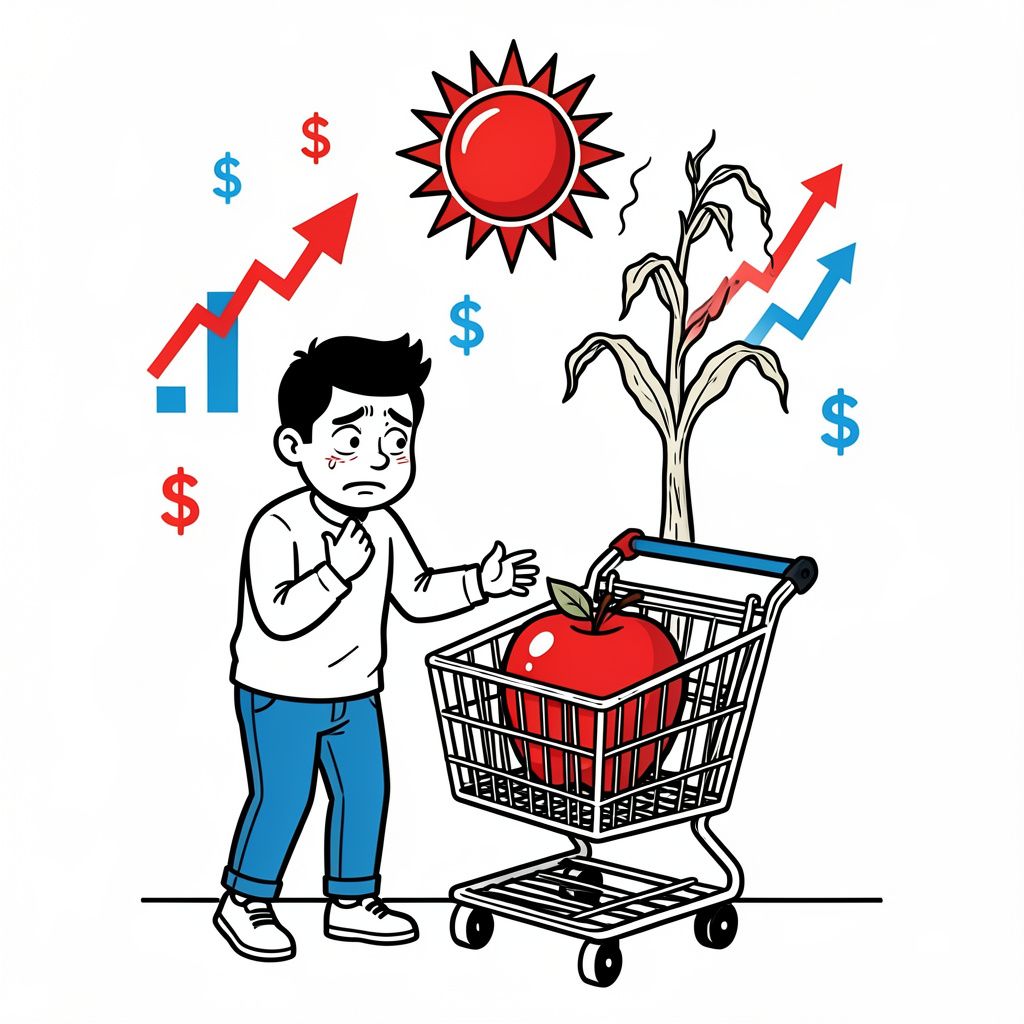
Although broader inflation has slowed, global food prices reached a three-year high in July 2026, as asymmetric retail pricing and severe weather shocks keep consumer grocery bills elevated.
Understanding the ‘Rockets and Feathers’ Phenomenon
The disconnect between cooling top-line inflation metrics and stubbornly high supermarket bills is explained by an economic pattern known as the “rockets and feathers” effect [1]. When external supply shocks occur, retail prices shoot up rapidly like a rocket [1]. However, when those pressures ease, retail prices drift downward slowly like a feather [1]. This asymmetry is largely driven by corporate profit maximization strategies and retailers’ reluctance to lower prices on high-cost inventory they already hold [1]. According to Jared Bernstein, a senior policy fellow at the Stanford Institute for Economic Policy, “There’s less competitive force on the feather side of the mountain” [1].
The Long-Term Impact on Household Budgets
This pricing friction has left a lasting mark on consumer finances. As of August 2026, grocery prices in the United States have surged by 33% over the last seven years [4]. Specific staple items have seen dramatic increases since 2020: flour prices are up 36%, beef roasts have increased by 38%, bread and crackers are up 39%, and peanut butter and oils have risen by 44% [6]. Although food price inflation peaked at 11.4% in 2022, the U.S. Department of Agriculture (USDA) reported on July 31, 2026, that food-at-home prices are projected to increase by another 2.7% in 2026 [1]. This rate exceeds the inflation rates of both 2024 and 2025, bringing grocery inflation back near the historical average of 2.6% [1].
Climate Shocks and Geopolitical Pressures
Beyond retail dynamics, global agricultural supply chains face severe structural disruptions. The United Nations Food and Agriculture Organization (FAO) reported that its Food Price Index reached 131.1 points in July 2026, representing a 0.6% increase from June 2026 and a 1% increase year-over-year [3][5]. This surge was led by a 5.8% jump in wheat prices due to Black Sea export disruptions, a 5.6% rise in sugar, and a 3.4% increase in cereals [3][5]. Extreme weather events, such as heatwaves and El Niño conditions, continue to threaten crop yields globally [3][5]. Because commodity price changes take approximately three to six months to filter down to final consumer products, these elevated wholesale costs represent a delayed financial burden that will pressure retailers and households later in 2026 [3].
Policy Tariffs and Global Price Disparities
Government trade policies have also exacerbated grocery bills. For instance, a 17% import tax on Mexican tomatoes contributed to a 19.5% price spike for U.S. consumers in June 2026 compared to June 2025 [1]. Meanwhile, long-term supply challenges have driven coffee prices up 54% in U.S. cities since 2019 [1]. Interestingly, global food pricing is highly regional. While a kilogram of bananas in the United Kingdom cost £1.04 in 1986 and actually decreased to £1.02 in 2025—representing a nominal change of -1.923% and a massive 74% decline in real terms [2]—the same fruit is a luxury elsewhere. In Venezuela, a country with a monthly minimum wage of $240.00 USD, a single kilogram of bananas can cost upwards of $2.50 USD [2].
Shifting Consumer Behavior and Retail Responses
Squeezed by these persistent costs, consumer behavior has shifted dramatically. A study by Bain & Co. and NielsenIQ revealed that grocery purchase volumes declined in the second half of 2025, with a sharper drop starting on February 1, 2026, driven by high gas prices, the rising popularity of GLP-1 weight-loss medications, and reduced government food assistance [1]. To cope, consumers are increasingly abandoning name brands in favor of store brands, pushing private label sales to a record $282.8 billion in 2025 [1]. Data from the second quarter of 2026 shows discount retailers like Walmart, Costco, and Aldi capturing market share from traditional supermarket chains like Kroger and Albertsons [1]. In response, Walmart initiated price rollbacks in early July 2026 on staples like ground beef, corn, and cherries to attract budget-conscious shoppers [1].
Sources
- www.cherokeephoenix.org
- www.instagram.com
- t2conline.com
- www.instagram.com
- www.jurist.org
- www.linkedin.com