Los Angeles County Population Shrinks as Official Forecasts Ignore Outflow Trends
Los Angeles, Sunday, 23 August 2026.
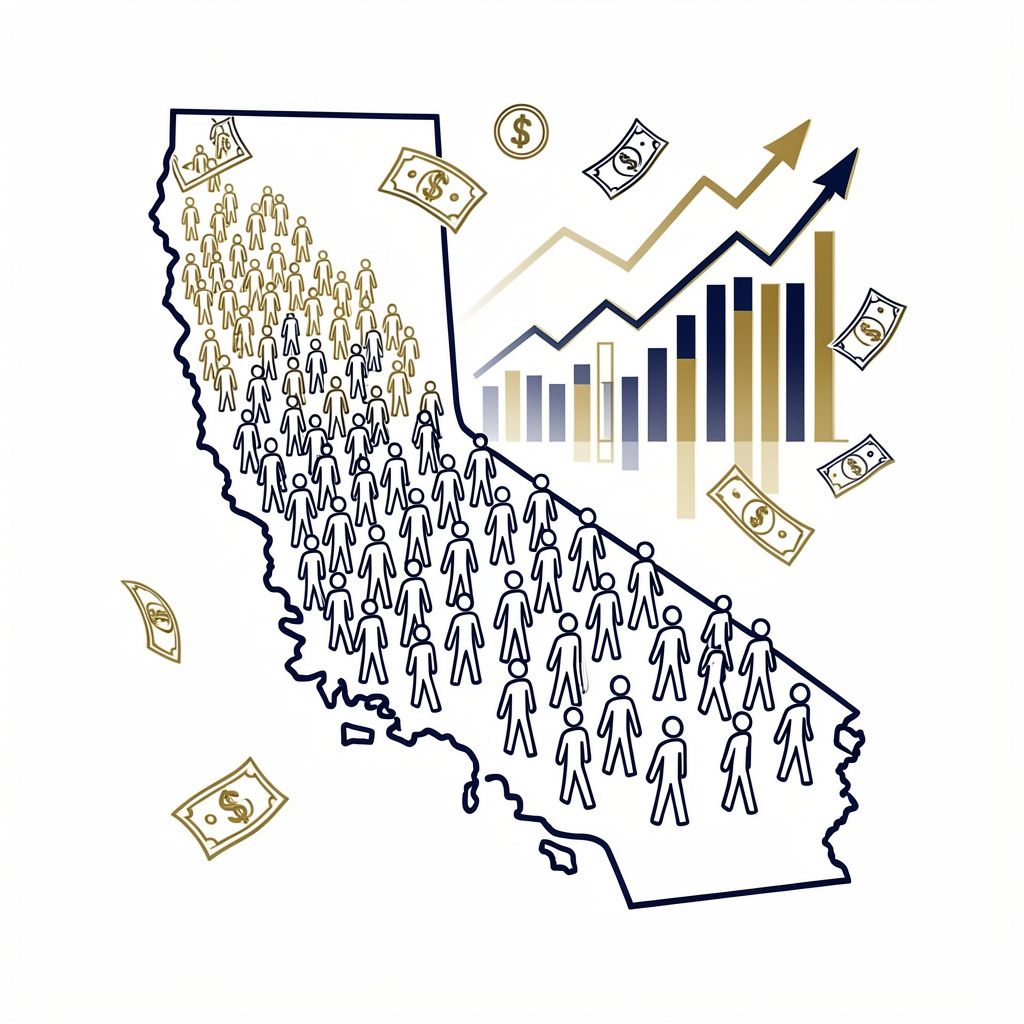
Los Angeles County lost over 300,000 residents since 2020. Unrealistic state projections undercount future losses by 800,000 people, signaling serious long-term economic risks for California’s workforce and tax base.
Demographic Decline and Data Discrepancies
Los Angeles County has experienced a population reduction of 301,576 residents between 1 July 2020 and 1 July 2025, representing a 3.017 percent decline [1]. This demographic contraction marks the most severe five-year performance among the 25 largest counties in the United States [1]. While the U.S. Census Bureau estimates the 2025 population at 9,694,934, the California Department of Finance estimates 9,853,435, creating a discrepancy of 158,501 people [1]. Such variance exceeds the entire population of Pasadena before analysts argue over projection decimals [1]. Between 2024 and 2025, California lost approximately 9,500 residents, while Los Angeles County specifically experienced a population decline of roughly 50,000 residents annually over the previous three years [5]. This outflow is driven by domestic out-migration, high costs, and wildfires [5]. The county finished last among the 25 largest U.S. counties for population performance during this period, contrasting sharply with growth in peers like Bexar County, Texas, which saw a 7.2 percent increase [1].
Projection Models and Migration Assumptions
Official state forecasts significantly underestimate future population losses by assuming net out-migration will abruptly plateau [1]. The California Department of Finance Vintage 2026 release projects the county population will drop to 8,413,331 by 2070, a total loss of roughly 1.44 million people over 45 years [1]. However, analytical projections indicate the state is still 808,429 high in its estimates because its forecast assumes people stop leaving [1]. Net migration has run at negative 51,370 a year since 2022, yet the state has it settling at negative 3,047 and staying there for forty years [1]. This single line is doing most of the work in the official forecast, representing a judgment that the trend stops happening in about five years and then stays stopped for forty [1]. Under a continued migration scenario without changes to current variables, the county population is projected to fall to 6,254,683 by 2100 and 5,558,967 by 2125 [1]. This represents a 42.7 percent century loss if current variables remain unchanged [1].
Regional Migration Patterns in 2026
Domestic migration patterns in the U.S. have cooled significantly compared to the pandemic era, with no state recording net inflows or outflows exceeding 0.7 percent of its starting population in 2025 [2]. Los Angeles is experiencing a moderating decline in population, with net migration improving from negative 0.8 percent in 2023 to negative 0.3 percent in 2025 [2]. This indicates that the big-city exodus narrative is fading, though Los Angeles, Chicago, and New York metro areas continue to experience net outflows [2]. Migration trends are currently influenced by return-to-office mandates, higher mortgage rates, and a narrowing affordability gap between coastal cities and previous COVID-era hotspots [2]. Affordability remains a primary migration driver; in 2025, seven of eight top destination metros analyzed had lower typical home values than their largest feeder markets [2]. For the nation’s six most populous states, net in-migration did not exceed 0.2 percent in 2025 [2].
Housing Development Amidst Population Loss
Construction activity continues in areas like Santa Monica even as Californians vote with their feet and leave the state [5]. Santa Monica’s sixth-cycle Regional Housing Needs Allocation target mandates the city plan for 8,895 housing units between 2021 and 2029, with a primary focus on lower-income households [5]. Current developments include a mixed-use complex at the former Pico Bowl site and a senior affordable supportive housing project at 14th and Wilshire [5]. While the broader Los Angeles County region experiences flat or declining population trends, Santa Monica maintains a strategy of increasing density through state-mandated streamlining and density bonuses for market-rate projects [5]. Despite high construction volume, overall housing costs remain high and working families continue to migrate out of California, raising questions about the efficacy of these policies for the broader public [5]. The development strategy utilizes a combination of city-owned sites and off-site affordable consolidation programs to expand the number of residents whose housing is tied to the current political order [5].