Last-Minute US-Iran Ceasefire Triggers Massive Global Market Rally
Washington, Wednesday, 8 April 2026.
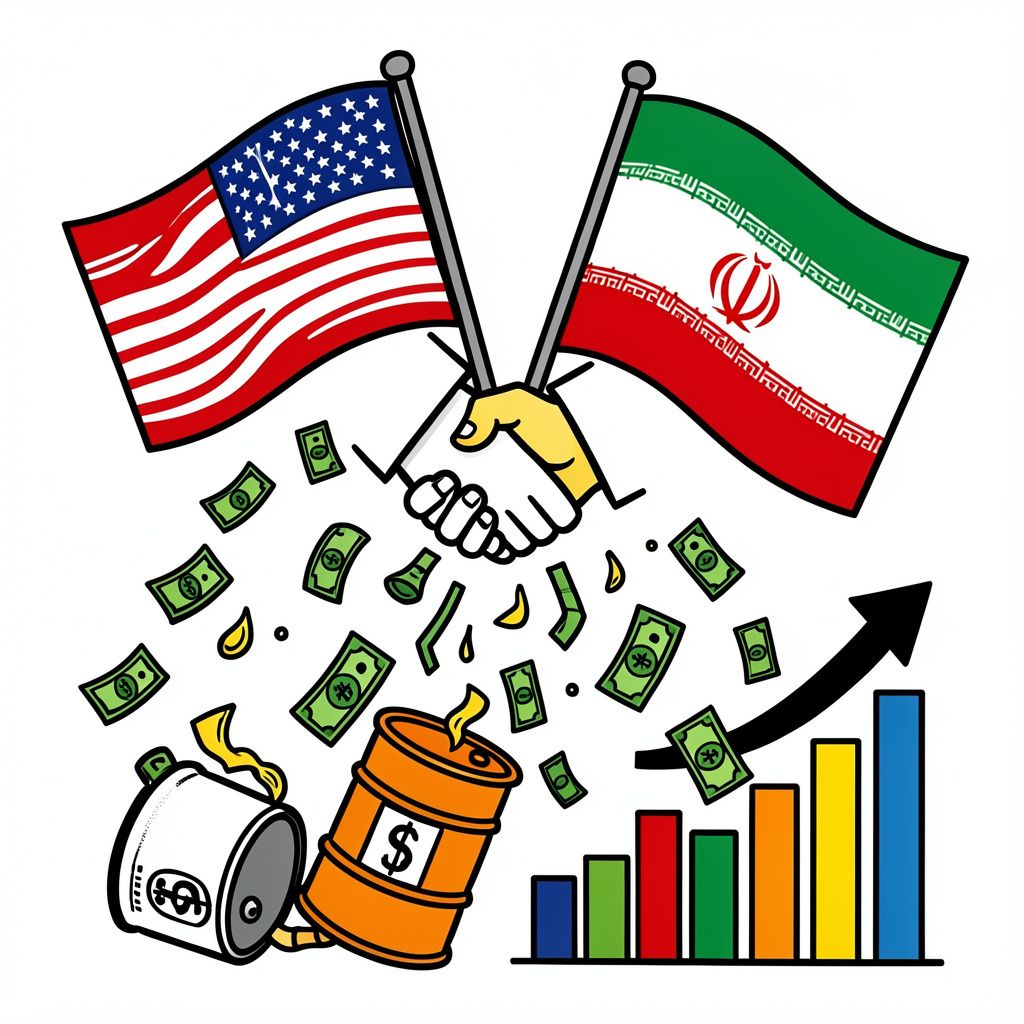
A sudden two-week ceasefire between the US and Iran has provided immediate relief to global markets, causing oil prices to plummet at their fastest rate in almost six years.
The 11th-Hour Reprieve
As global energy markets recently braced for a catastrophic escalation following President Trump’s Tuesday ultimatum over the blocked Strait of Hormuz [9], an eleventh-hour diplomatic intervention fundamentally altered the geopolitical landscape. Less than two hours before a 20:00 Eastern Time deadline that threatened the destruction of Iranian power plants and bridges, the United States and Iran agreed to a conditional two-week ceasefire [2][6]. The breakthrough, heavily mediated by Pakistani Prime Minister Shehbaz Sharif and Field Marshal Asim Munir, suspends offensive military operations in exchange for the immediate and safe reopening of the Strait of Hormuz [1][6]. For a global economy that had spent five weeks suffocating under the strain of a disrupted energy supply chain [2], the sudden pivot from the brink of war to the negotiating table triggered an immediate and aggressive recalibration across financial markets [1].
Markets Rebound as Geopolitical Tensions Thaw
The financial response to the de-escalation was instantaneous and overwhelmingly positive. On Tuesday night, Dow futures leaped by more than 1,000 points, while S&P 500 and Nasdaq 100 futures climbed over 2.1% and 2.3%, respectively [1]. This bullish sentiment echoed globally, with European stock futures surging 5% and South Korea’s Kospi index jumping 5.8% [1]. The electric vehicle sector, which is highly sensitive to macroeconomic shocks and supply chain disruptions [GPT], experienced a particularly sharp rebound. By 4:30 a.m. Eastern Time on Wednesday, April 8, 2026, Tesla shares were surging more than 5% in pre-market trading, alongside roughly 4% gains for both Ford and General Motors [1].
Energy Sector Breathes a Sigh of Relief
Nowhere was the impact of the ceasefire more pronounced than in the global energy sector. The agreement to reopen the Strait of Hormuz—a crucial maritime corridor that handles a fifth of the world’s global energy supply [2]—caused oil prices to plunge at their fastest rate in nearly six years [1]. West Texas Intermediate (WTI) crude plummeted by as much as 19%, falling below $93 per barrel, while Brent crude saw a steep decline of up to 16% [1]. This dramatic contraction starkly contrasts with the panicked trading seen just days earlier, when US crude oil had traded as high as $117 per barrel [7].
The Diplomatic Breakthrough and Lingering Complexities
The path to this temporary truce was fraught with apocalyptic rhetoric. Just hours before the agreement, President Trump had publicly warned that a “whole civilization will die tonight” if Iran did not concede, threatening to decimate bridges and power plants within a four-hour window [7][8]. However, the successful mediation by Pakistan shifted the trajectory toward diplomacy. President Trump ultimately declared the ceasefire a “big day for World Peace,” expressing optimism about the economic reconstruction process [5][7]. Peace talks between the US and Iran are slated to begin in Islamabad in the coming days [alert! ‘Sources conflict on the exact start date of negotiations, citing both April 10 and April 11’] [6][7], utilizing the two-week window to negotiate a permanent settlement based on competing 10-point and 15-point proposals [6][7].
The Regional Reality: Lebanon Remains a Flashpoint
Despite the optimism surrounding the US-Iran detente, the broader Middle Eastern conflict remains highly fragmented. While Israel agreed to suspend its direct strikes against Iran [6], Israeli Prime Minister Benjamin Netanyahu explicitly clarified that the two-week truce does not extend to Israel’s ongoing military operations against Hezbollah in Lebanon [4][5]. This significant carve-out contradicts earlier assertions by Pakistani mediators that the ceasefire would be effective “everywhere, including Lebanon” [4][5] [alert! ‘Conflicting reports between Pakistani mediators and Israeli officials regarding the scope of the ceasefire in Lebanon remain unresolved’].
Sources
- eletric-vehicles.com
- www.theguardian.com
- www.bbc.com
- www.aljazeera.com
- apnews.com
- www.axios.com
- www.nbcnews.com
- www.pbs.org
- wsnext.com