Albertsons Reshapes Grocery Network Following Canceled Kroger Merger
Boise, Monday, 17 August 2026.
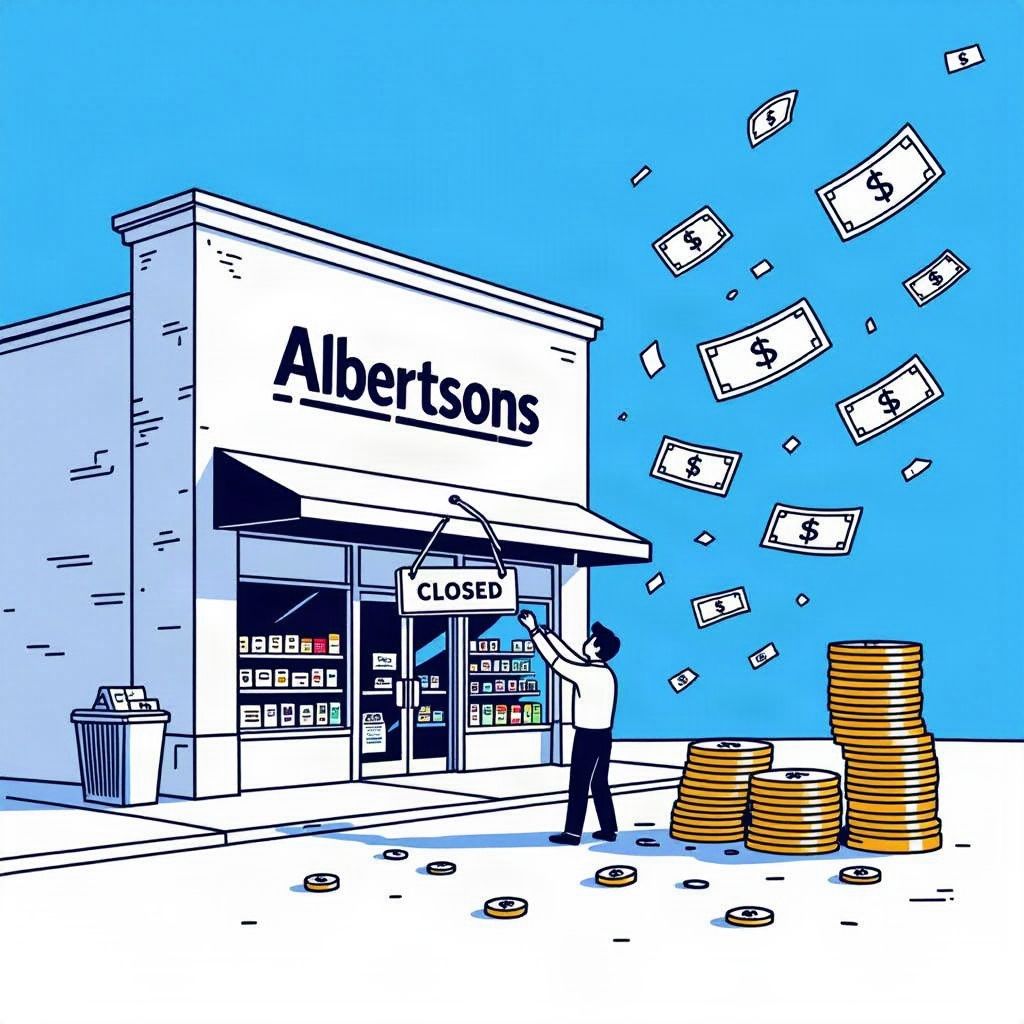
Following the collapse of its $24.6 billion Kroger merger, Albertsons is optimizing its retail footprint by closing underperforming locations to protect margins while reallocating resources toward high-demand growth markets.
Fiscal Restructuring and Closure Rates
Albertsons Companies, Inc. (NYSE: ACI) has significantly accelerated its store closure strategy following the dissolution of its proposed merger with Kroger Co. (NYSE: KR). During fiscal 2025, the grocer closed 35 stores, a sharp increase from the 10 closures recorded in fiscal 2024 and 8 in fiscal 2023 [1][8]. This represents a 250 increase in closure activity year-over-year, signaling a decisive shift toward footprint optimization [1][8]. In February 2026, the company announced a corporate restructuring plan aimed at cutting spending by $1.5 billion over three years, further underscoring the urgency of cost containment measures [2].
Fiscal Restructuring and Closure Rates
The net impact of these store closures in fiscal 2025 reduced sales by $63.4 million, while expenses related to closed stores and surplus properties rose to $45.1 million from $15.9 million the prior year [8]. As of February 28, 2026, Albertsons operated 22 grocery banners across 35 states and Washington, D.C., employing approximately 280,000 workers [8]. The company continues to evaluate its network to open locations in high-demand areas while closing underperforming ones, though the total scope of downsizing remains unclear [alert! ‘Albertsons has not released a full inventory of closures’] [3][5].
Specific Location Impacts in 2026
Confirmed closures in 2026 include specific Safeway locations that have reached the end of their lease terms or underperform relative to market demands. In Washington, D.C., the Safeway at 1601 Maryland Ave. permanently closed on May 16, 2026, ending nearly 40 years of operation at the Hechinger Mall location [4][5]. Similarly, the store at 231 W. Jackson St. in Hayward, California, closed in late February 2026, and the location at 2220 N. Coast Highway in Newport, Oregon, closed in July 2026 after more than 30 years in business [4][5].
Specific Location Impacts in 2026
On August 14, 2026, Albertsons confirmed it is continually evaluating its stores and making changes to position the company for the future [3][5]. While most closures are attributed to expiring leases rather than a broad market retreat, the company is reinvesting resources into existing stores with strong long-term opportunity [4][5]. In June 2026 alone, data tracked by ScrapeHero.com indicated that Albertsons closed two stores and opened one, reflecting a cautious approach to net footprint growth amidst the restructuring [2].
Legal Fallout and Strategic Outlook
The strategic contraction follows the legal termination of the $24.6 billion merger agreement, which was officially blocked by a U.S. District Court injunction on December 10, 2024 [1][6]. Following the collapse, Albertsons sought a $600 million termination fee from Kroger, while Kroger filed counterclaims in Delaware in May 2026 alleging Albertsons undermined the regulatory process [1][5]. Additionally, C&S Wholesale Grocers sued for a $125 million termination fee following the merger collapse, reaching a friendly settlement in Summer 2025 [5].
Legal Fallout and Strategic Outlook
Albertsons has stated it is working to place affected associates at other locations, though no comprehensive public list of all closures has been released [3][5]. As of August 15, 2026, the company continues its store review and closure process as part of a footprint reshuffling post-failed merger [6]. This recalibration presents market share reallocation opportunities for competing regional and national supermarket chains as the U.S. grocery landscape adjusts to the独立 operation of these major entities [1][3].
Sources
- www.foxbusiness.com
- www.supermarketnews.com
- www.hindustantimes.com
- www.fastcompany.com
- www.usatoday.com
- www.aol.com