Robust Third-Quarter Growth Masks Deepening Consumer Gloom Entering 2026
New York, Wednesday, 24 December 2025.
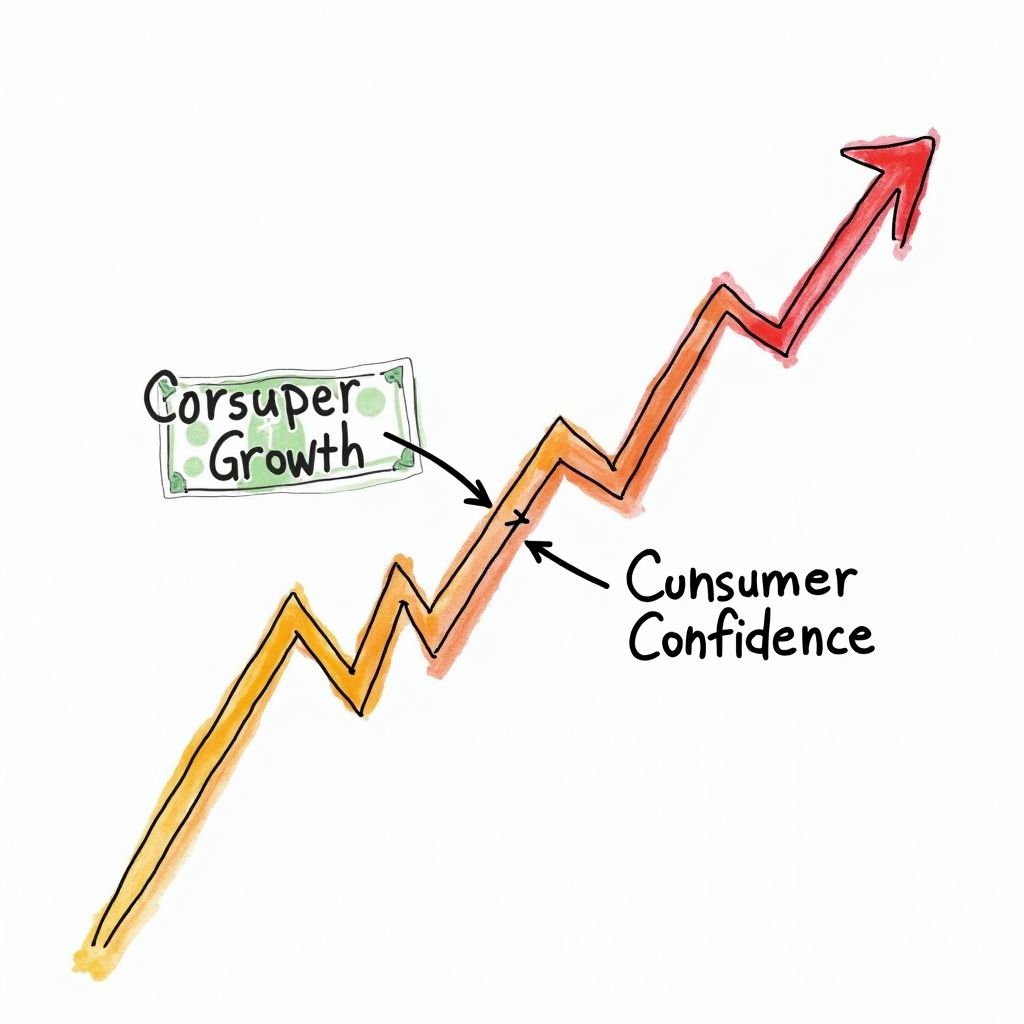
Despite a robust 4.3% GDP surge, consumer confidence fell for the fifth straight month, underscoring a stark “K-shaped” divergence between national metrics and household financial sentiment.
A Widening Gap Between Data and Sentiment
The Commerce Department released data on Tuesday, December 23, revealing that the U.S. GDP grew at an annual rate of 4.3% in the third quarter of 2025 [2][3]. This figure represents the fastest pace of growth in two years [1][5], accelerating from the 3.8% growth recorded in the second quarter [4][7]. The report, which was delayed from its original October schedule due to the government shutdown that lasted from October 1 to November 12 [8], indicates that the expansion was fueled largely by a 3.5% increase in consumer spending and a 7.4% surge in exports [5][7]. However, economists caution that these aggregate numbers obscure significant underlying weaknesses, with growth described as “K-shaped,” driven primarily by higher-income households while lower- and middle-income consumers pull back [1][7].
Corporate Gains Versus Household Pains
While corporate balance sheets appear healthy, with profits increasing at a rate of $166.1 billion in the third quarter—a massive jump from the $6.8 billion pace in the previous quarter [7]—household sentiment tells a different story. The Conference Board reported that consumer confidence declined for the fifth consecutive month in December, dropping by 3.8 points to 89.1 [6]. This pessimism is rooted in tangible financial strains; disposable personal income remained flat in the third quarter as inflation offset wage gains [3], and the median age of first-time homebuyers reached a record high of 40 this year [1]. Consequently, 75% of Americans recently graded the economy as a C, D, or F in a December survey [1].
Labor Market Softening and Policy Responses
The deterioration in sentiment also correlates with a softening labor market. The unemployment rate ticked up to 4.6% in November 2025, the highest level in four years [1], while layoffs reached 1.1 million through November [1]. This cooling environment has placed the Federal Reserve in a difficult position, prompting the central bank to cut interest rates three times this year to a benchmark range of 3.50% to 3.75% as of December [4][7]. Despite these cuts, the “Expectations Index”—a component of consumer confidence—has tracked below 80 for 11 consecutive months, a level that historically signals an impending recession [6].
Uncertainty Clouds the 2026 Outlook
Looking ahead, the economic landscape remains volatile due to shifting fiscal and trade policies. President Trump’s tariffs, announced in April 2025, caused imports to decline and contributed to a contraction in the first quarter, though the economy has since shown resilience [3][4][8]. While the White House touts the effectiveness of these measures and promises that 2026 will be “even better” as the economic agenda takes effect [1], business leaders remain cautious. Greg Daco, chief economist at EY-Parthenon, noted that “any type of uncertainty is going to lead to slower business decisions, whether it’s hiring or investment” [1]. As the nation heads into the new year, experts like Michael Pearce of Oxford Economics suggest the economy may strengthen due to tax cuts and looser monetary policy [7], yet for many Americans facing high costs and a stagnant housing market, the “American dream” feels increasingly delayed [1].
Sources
- www.cbsnews.com
- www.nytimes.com
- www.npr.org
- abcnews.go.com
- www.bbc.com
- www.conference-board.org
- www.reuters.com
- www.theguardian.com