Standard WiFi Routers Can Secretly Identify People
New York, Tuesday, 25 August 2026.
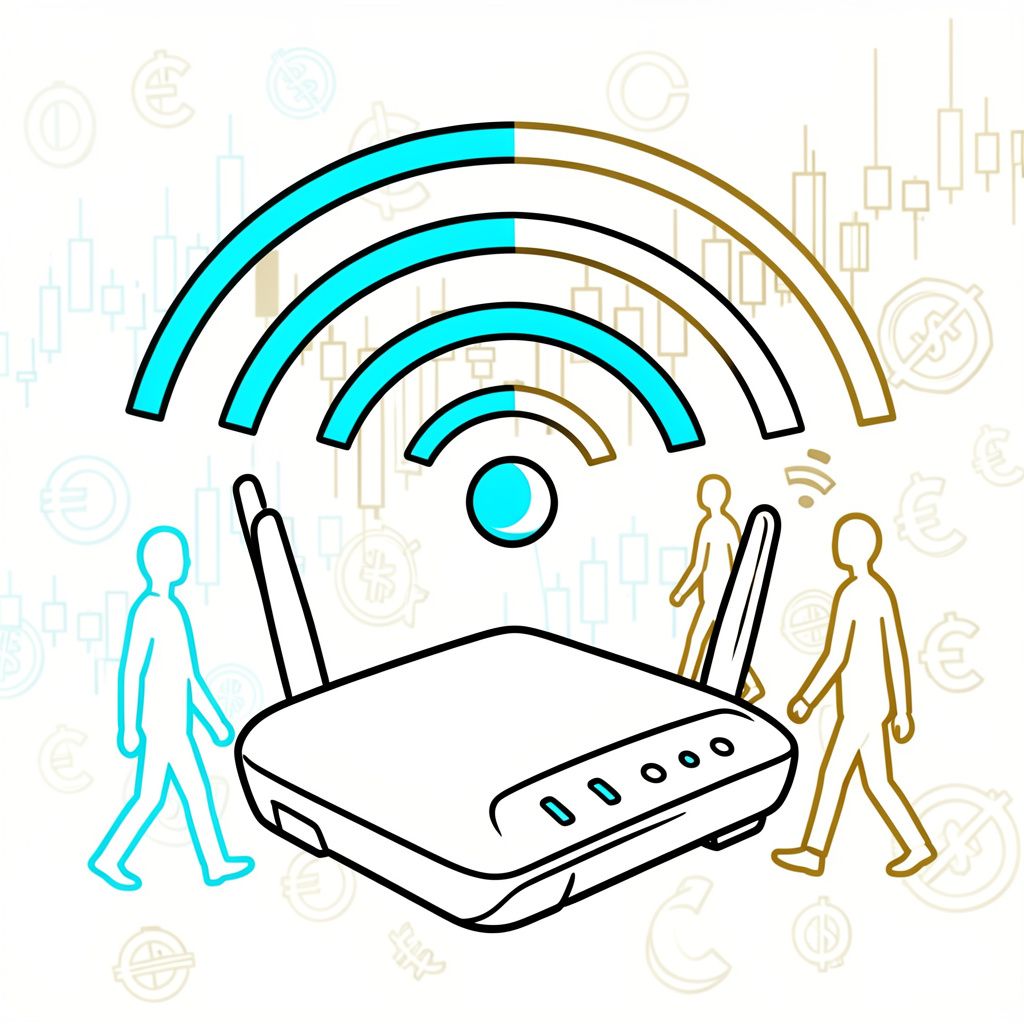
Researchers revealed that unencrypted radio signals from ordinary WiFi routers can track physical gaits to identify individuals with up to 99.5% accuracy, even without a phone present.
How Ambient Waves Map the Human Body
The technical mechanism behind this capability is known as BFId (Beamforming Feedback Information identification), developed by researchers Julian Todt, Felix Morsbach, and Thorsten Strufe at the KASTEL Institute of Information Security and Dependability at the Karlsruhe Institute of Technology (KIT) [5]. The system exploits unencrypted beamforming feedback information (BFI), a physical-layer metadata format that has been routinely transmitted by standard Wi-Fi 5 (802.11ac) and newer routers for over a decade [5]. Unlike older Wi-Fi tracking experiments that required customized firmware to extract Channel State Information (CSI), BFId intercepts BFI signals that are publicly broadcast to optimize signal directionality toward connected devices [5].
Achieving Near-Perfect Recognition
As radio waves propagate through an office or public space, they bounce off physical surroundings and human bodies [1][5]. Because the human body uniquely absorbs and scatters these signals, it leaves a distinct signature of physical gait and silhouette distortions in the local radio field [4][5]. Professor Thorsten Strufe noted that this process functions similarly to a standard camera, but utilizes radio waves instead of light waves [1][5]. In empirical tests involving 197 participants, the BFId system achieved a 99.5% accuracy rate, identifying approximately 196.015 individuals based on their physical movement and presence alone, regardless of whether they carried a Wi-Fi-enabled device [5].
Corporate Security and Commercial Opportunities
For enterprise leadership and facility managers, this technology introduces both significant operational opportunities and novel security threats [GPT]. On the commercial front, Wi-Fi-based tracking offers a non-invasive method to monitor office occupancy, optimize heating and cooling systems, or track workforce movements without the high cost of camera networks [GPT]. This aligns with parallel experimental research from Carnegie Mellon University, known as “DensePose From WiFi,” which utilizes artificial intelligence to turn Wi-Fi signal changes into 2D maps of human body postures, even through solid walls [2]. Such systems could soon revolutionize automated physical security and workplace safety protocols [GPT].
The Dark Side of Invisible Surveillance
However, the ease of intercepting unencrypted BFI signals creates immediate corporate vulnerabilities [GPT]. Because BFI is broadcast openly, anyone with a standard laptop within network range can intercept the metadata to track individuals [5]. Researcher Julian Todt warned that this capability essentially turns every standard router into a potential surveillance tool [1][5]. This means corporate espionage actors or unauthorized parties could passively monitor foot traffic near executive offices or public locations, identifying high-profile individuals without their knowledge or consent [1][5].
Navigating the Regulatory Minefield
This invisible tracking capability presents immediate compliance risks under global privacy frameworks [GPT]. Because the technology identifies specific individuals using unique physical gaits and body signatures, this data is classified as biometric information [5]. In the United States, body signatures are protected under strict biometric laws such as the Illinois Biometric Information Privacy Act (BIPA) [5]. Meanwhile, in the United Kingdom and the European Union, these radio-based biometric profiles are subject to the stringent protections of Article 9 of the General Data Protection Regulation (GDPR) [5].
The Path Toward Secure Wireless Standards
To mitigate these risks, researchers are actively urging the wireless industry to integrate privacy safeguards into upcoming standards [1][5]. KASTEL researchers are advocating for the encryption or randomization of BFI within the forthcoming IEEE 802.11bf Wi-Fi standard and future 6G networks, which will increasingly rely on Integrated Sensing and Communication (ISAC) [5]. Until these security protocols are standardized and deployed, businesses operating commercial Wi-Fi networks must remain highly aware of the passive tracking capabilities already latent in their everyday hardware [5].