How Drones Are Set to Deliver Blood to Active Combat Zones
Phoenix, Thursday, 12 November 2026.
ZenaTech has partnered with Rattler Medical to build autonomous blood-delivery drones for front lines, targeting a booming medical delivery market projected to reach $1.27 billion by 2030.
A Strategic Partnership for Combat Medical Logistics
On November 12, 2026, ZenaTech, Inc. (Nasdaq: ZENA), a technology solutions provider specializing in AI-powered drones, announced the signing of a memorandum of understanding (MOU) between its subsidiary ZenaDrone and Rattler Medical Inc. to develop an autonomous drone-based battlefield blood delivery system targeting U.S. military logistics [1][2][3][5][7][9]. The partnership aims to address one of the most critical challenges in combat medicine: delivering blood to wounded service members in contested environments while maintaining precise temperature control [1][2][3][5][7][9]. Shaun Passley, Ph.D., CEO of ZenaTech, emphasized the logistical difficulty, stating, ‘Getting blood to a wounded service member quickly, and at the right temperature, is one of the most difficult logistics problems in combat medicine’ [1][2][3][5][7][9].
Technical Collaboration: Drones and Temperature-Controlled Containers
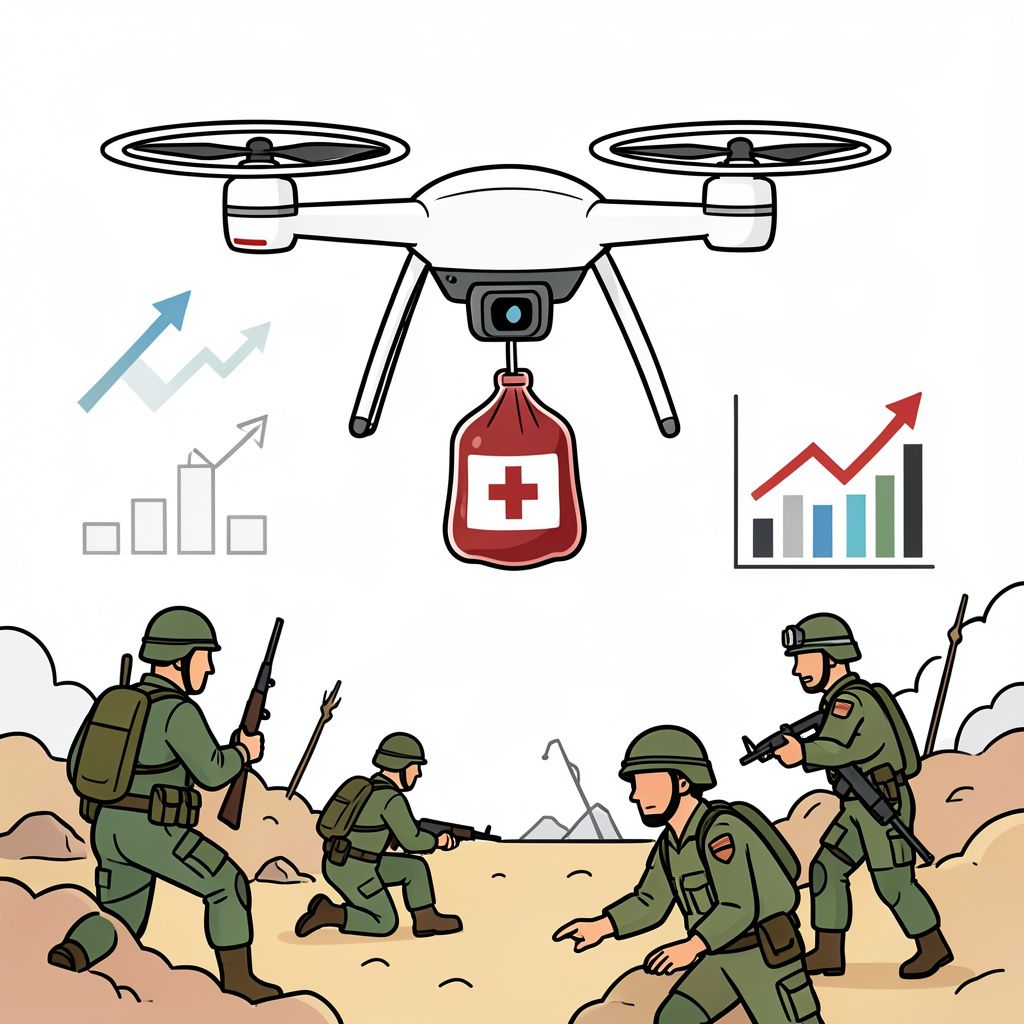
The collaboration leverages ZenaDrone’s cargo drone platforms, designed for defense and industrial applications, and Rattler Medical’s temperature-controlled blood transport containers, engineered for austere environments [1][2][3][5][7][9]. The delivery system will utilize the temperature-controlled container as a payload beneath a ZenaDrone aircraft, enabling either airdrops or on-landing delivery for medical personnel to detach [1][2][3][5][7][9]. Donald Young, CEO of Rattler Medical and a U.S. Army combat medic veteran, highlighted the operational necessity: ‘As a combat medic, I saw how much a casualty’s outcome can depend on how fast blood reaches the medic treating them’ [1][2][3][5][7][9]. Rattler Medical, founded by Young, specializes in manufacturing containers that extend the ability of military and emergency medical personnel to carry blood closer to the patient [1][2][3][5][7][9].
Timeline and Milestones: From Prototype to Military Demonstration
ZenaTech and Rattler Medical have outlined a clear timeline for development and testing. The companies plan to complete a flying prototype within two to three months from the November 12, 2026 announcement, targeting February 2027 [1][2][3][5][7][9]. Following the prototype phase, the system is scheduled for demonstrations at a U.S. military facility in summer 2027 [1][2][3][5][7][9]. This timeline reflects the urgency of addressing battlefield medical logistics, where rapid, temperature-controlled blood delivery can significantly impact survival rates [1][2][3][5][7][9]. The companies’ roadmap also includes evaluating aerial release versus landing-based deployment methods during the prototype testing phase [6].
Market Potential and Strategic Implications
The partnership arrives at a pivotal moment for the medical drone delivery market, which is projected to grow from $510 million in 2026 to $1.27 billion by 2030 at a compound annual growth rate (CAGR) of 25.5%, according to the Business Research Company [1][2][3][5][7][9]. This market expansion underscores the growing demand for innovative solutions in medical logistics, particularly in defense and emergency response sectors [1][2][3][5][7][9]. ZenaTech’s involvement in this project aligns with its broader strategy to expand its defense portfolio into battlefield medical logistics, applications the company has long targeted for its drone platforms [1][2][3][5][7][9]. The company’s global manufacturing footprint—spanning Arizona (USA), Dubai (UAE), and Taiwan—positions it to scale production and deployment rapidly [7][9].
Broader Defense Applications and Future Outlook
Beyond battlefield blood delivery, the technology developed through this partnership could have broader applications in defense medical logistics, including the delivery of other critical medical supplies to forward operating bases and contested areas [GPT]. The integration of AI-enabled unmanned aerial vehicles (UAVs) for such missions represents a significant advancement in military medical support, reducing reliance on ground transport and mitigating risks to personnel and supply chains in hostile environments [GPT]. As ZenaTech and Rattler Medical progress toward their 2027 milestones, the collaboration signals a transformative shift in how combat medics receive essential resources on the front lines [GPT].
Sources
- www.einpresswire.com
- www.morningstar.com
- www.zenatech.com
- x.com
- www.tradingview.com
- www.globenewswire.com
- www.onvista.de
- www.citybuzz.co