How Middle East Oil Exporters Are Avoiding the Strait of Hormuz
Dubai, Friday, 9 October 2026.
By rerouting 40 percent of crude oil through alternative pipelines and sea routes, Middle East suppliers maintain global output, though steep transport costs keep consumer fuel prices elevated.
Global Supply Chains Reroute Amid Strait Tensions
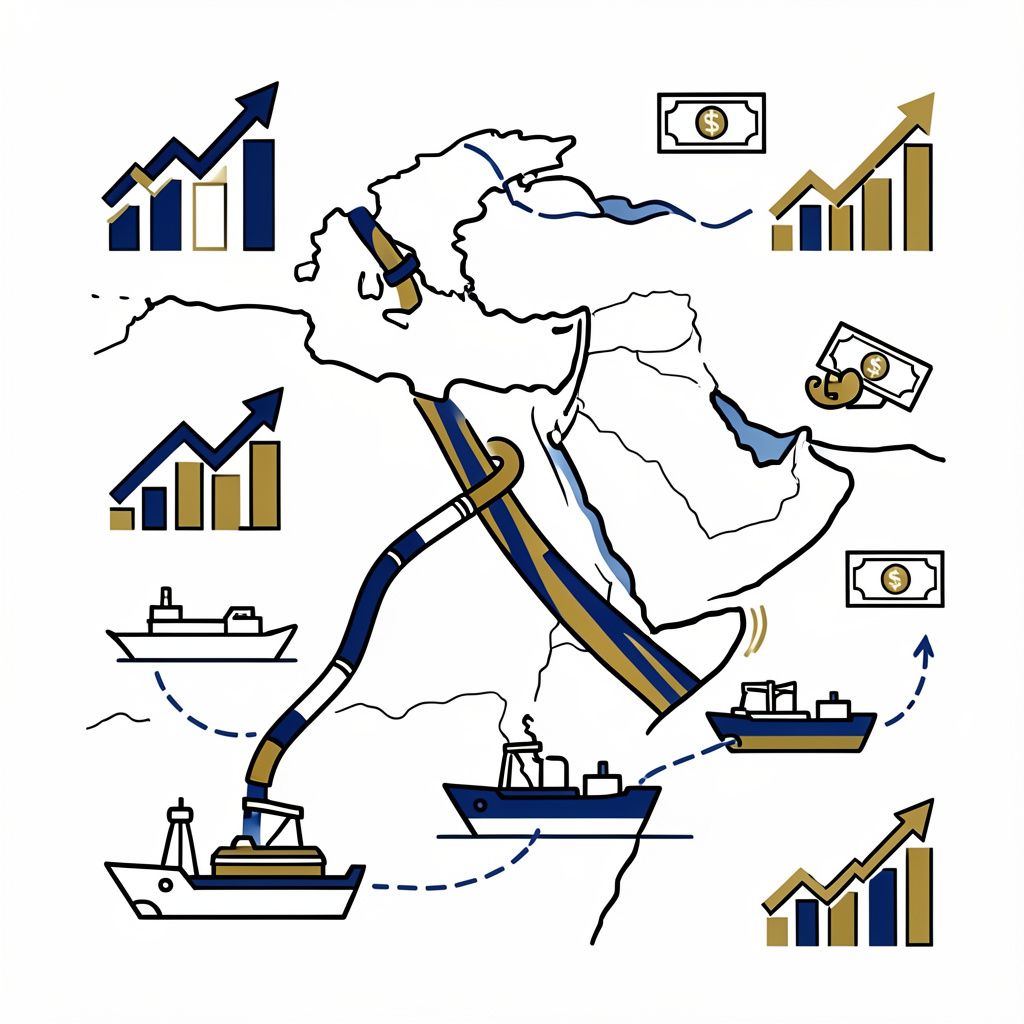
Global oil infrastructure is undergoing a significant adjustment as of October 2026, with energy intelligence firm Kpler reporting that approximately 40% of crude oil from the Middle East is now bypassing the Strait of Hormuz [1][3]. Despite improvements in maritime traffic flow reported on Wednesday, 2026-10-07, retail gasoline prices remain elevated above $4.30 per gallon [3]. This structural shift highlights long-term investments in alternative pipeline routes and overland transport, altering supply risk assessments for Western economies [1]. The persistence of high fuel costs follows a large-scale U.S.-Israeli attack during the winter of 2025/2026, which triggered Iran’s closure of the strategic strait [3]. Analysts attribute the continued price pressure to increased transportation costs for crude rerouting and investor fears regarding potential renewed conflict [1]. In recent months, U.S. forces have supported the shipment of over 1.25 billion barrels of crude oil from Gulf partners through the region [4].
Alternative Routes and Rising Costs
Saudi Arabia’s East-West pipeline, which has a total capacity of approximately 7 million barrels per day, restored exports to 5.8 million barrels per day on 2026-10-05 following a temporary closure [3]. Transportation costs have surged, with tanker captains facing increased base salaries of up to $100,000 per month plus $50,000 per-trip bonuses, significantly higher than the typical $15,000 per month rate [3]. These logistical adjustments contribute to a Brent crude spot price that reached $125.44 per barrel on 2026-10-06 [5]. Calculations based on pre-war estimates suggest a significant price premium; using a pre-war benchmark of $85 per barrel, the increase to $125.44 represents a 47.576 percent rise [5]. Some analysts suspect Gulf producers may be paying Iran undisclosed fees for safe passage, though these claims remain unverified [2]. Michelle Brohard, Head of Policy and Geopolitical Risk at Kpler, noted the unsustainability of paying Iran 10 percent to 20 percent of cargo value [2]. [alert! ‘Verification of toll payments is pending official confirmation’]
Security Risks and Market Outlook
Security incidents in the Strait of Hormuz and Gulf of Aden have intensified, with the United Kingdom Maritime Trade Operations reporting at least one attack daily since 2026-10-02 [6]. On 2026-10-05, a tanker entering the strait near Oman was hailed by Iran’s Islamic Revolutionary Guard Corps and ordered to turn around [6]. Consequently, crude flows through Hormuz averaged about 10.3 million barrels per day in the week ending 2026-10-03, representing 76% of prewar levels [8]. Refined product flows, including diesel and gasoline, totaled only 1.3 million barrels per day, down from greater than 20% of total flows prewar [8]. Full recovery of oil fields and refineries is unlikely before well into 2027, according to industry analysts [8]. U.S. diesel prices reached record averages of approximately $6.50 per gallon in late September 2026 [8].
Sources
- www.lawtonradio.com
- oilprice.com
- abcnews.com
- www.facebook.com
- www.kingdomexploration.com
- www.aljazeera.com
- investinglive.com