Supreme Court Justices Signal Skepticism Over President Trump's Push to Restrict Birthright Citizenship
Washington, D.C., Wednesday, 1 April 2026.
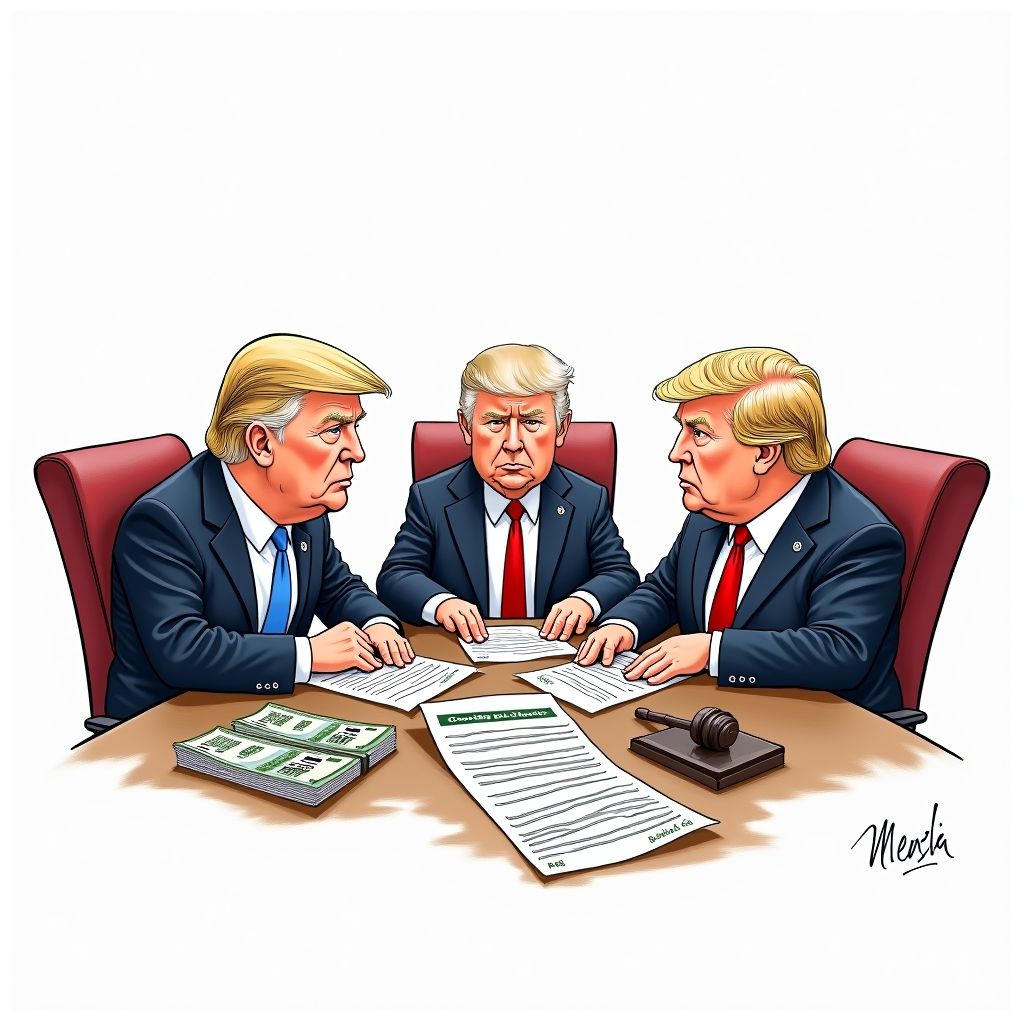
As President Trump made history by attending the hearing, Supreme Court justices signaled deep skepticism toward his executive push to end birthright citizenship, anticipating profound demographic and economic impacts.
An Unprecedented Presidential Presence
On Wednesday, April 1, 2026, the Supreme Court heard over two hours of oral arguments in Trump v. Barbara, a landmark case challenging President Donald Trump’s January 20, 2025, executive order [2][5][6]. This directive attempts to end automatic citizenship for children born on United States soil to undocumented immigrants or temporary visa holders [2][5]. In a historic first, President Trump attended the proceedings in person, spending just over an hour in the courtroom alongside Attorney General Pam Bondi and Commerce Secretary Howard Lutnick [1][2]. The president departed shortly after Cecillia Wang, the national legal director for the American Civil Liberties Union (ACLU), began her arguments against the administration’s policy [2].
The Constitutional Battlefield: Domicile and the 14th Amendment
The legal debate heavily centers on the Citizenship Clause of the 14th Amendment, ratified in 1868, which grants citizenship to all persons born in the U.S. and “subject to the jurisdiction thereof” [2][5][8]. The Trump administration relies on a narrow interpretation, asserting that undocumented parents lack legal allegiance to the United States, thereby exempting their children from automatic citizenship [5]. Scholars and historians have widely argued that the Framers intended the amendment to apply broadly to the children of immigrants [4][8], though the administration counters that its purpose was strictly to protect formerly enslaved individuals [8]. Solicitor General Sauer faced sharp questioning regarding this interpretation and the applicability of the 1898 precedent United States v. Wong Kim Ark, which established citizenship for children of immigrants [1][4][5]. Justice Sonia Sotomayor directly asked Sauer if he was requesting the court to overturn the 1898 decision, while Justice Neil Gorsuch expressed doubts about how helpful the administration’s historical citations were to their case [1][2].
Demographic and Economic Ramifications
Beyond constitutional theory, the economic and demographic implications of the policy are profound. Research from the Migration Policy Institute and Pennsylvania State University’s Population Research Institute indicates that the executive order could strip birthright citizenship from over 250,000 babies born in the United States each year [2]. Furthermore, demographic projections suggest that repealing this constitutional guarantee would expand the unauthorized immigrant population by an estimated 2.7 million individuals by the year 2045 [5]. Such a shift would drastically alter the future labor market, creating a large underclass of stateless residents and directly impacting workforce stability [GPT].
The Path Forward and Expected Ruling
The birthright citizenship arguments follow a busy week for the court, which also heard oral arguments in unrelated cases such as Pitchford v. Cain on March 31 [6][7]. The Supreme Court’s ruling on Trump v. Barbara, expected by the end of June 2026, will determine the fate of a policy that fundamentally redefines American identity [1][alert! ‘Exact release date of the ruling is an estimate based on the typical Supreme Court term schedule’]. The ACLU and other challengers remain confident, with ACLU executive director Anthony Romero expressing hope that the president was “schooled in the importance of birthright citizenship” while sitting just six feet away during the proceedings [1]. Until a decision is reached, the executive order remains blocked by lower courts, including a federal court in New Hampshire, preventing it from taking immediate effect [2]. As business leaders and legal scholars await the verdict, the outcome promises to be one of the most consequential judicial decisions of the decade [GPT].
Sources
- www.nbcnews.com
- apnews.com
- www.nytimes.com
- www.scotusblog.com
- www.npr.org
- www.scotusblog.com
- www.supremecourt.gov
- www.brennancenter.org