Super El Niño: The $3 Trillion Climate Threat Hitting Your Wallet by 2027
Washington DC, Sunday, 14 June 2026.
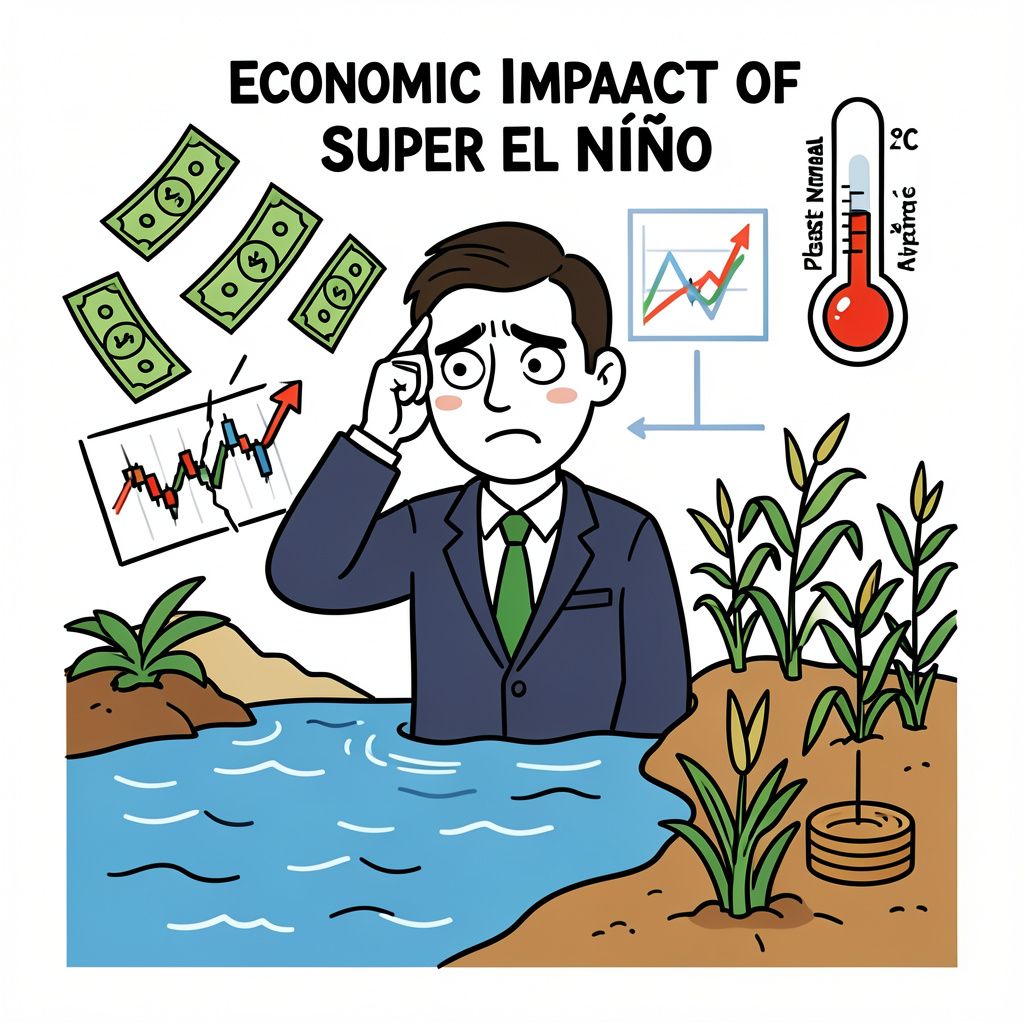
A ‘Super El Niño’ is officially underway, and economists warn it could drain over $3 trillion from the global economy by 2027—making it the costliest on record. With Pacific Ocean temperatures surging 2 °C above normal, this climate phenomenon is set to trigger extreme weather, disrupt supply chains, and spike food prices. From California’s flood risks to Southeast Asia’s drought-stricken crops, no region is spared. Experts predict a domino effect: fertilizer shortages, soaring commodity prices, and economic instability. The last Super El Niño in 1997-98 caused $7 trillion in losses—this one could be worse. Is your portfolio ready?
The Official Declaration: A Super El Niño is Here
On 11 June 2026, the U.S. National Oceanic and Atmospheric Administration (NOAA) officially declared the onset of a ‘Super El Niño,’ marking the beginning of what experts warn could be the most economically damaging climate event in recorded history [1]. Satellite data from the first week of June 2026 confirmed sea-surface temperatures in the tropical Pacific Ocean had surged to 2 °C (3.8 °F) above the long-term average, meeting the threshold for a ‘very strong’ El Niño event [2]. This declaration came just days after Indonesia’s rice farmers accelerated planting schedules in anticipation of drought conditions, while Malaysia’s economic minister warned of potential 8–10% crop yield reductions in 2026 [3]. The World Meteorological Organization (WMO) described El Niño as ‘a major driver of global weather and climate patterns’ with impacts extending far beyond the Pacific region [4].
The Trillion-Dollar Economic Threat
Economic models project this Super El Niño could inflict cumulative global losses exceeding $3 trillion by 2027, potentially surpassing the record $7 trillion in damages caused by the 1997–98 event [5][6]. Dartmouth geographer Justin Mankin, who studies the economic impacts of climate phenomena, stated, ‘The current forecasts imply this could be the costliest El Niño on record’ [7]. The U.S. alone faces projected losses exceeding $1.8 trillion by 2032, with the most severe impacts expected between 2026 and 2027 [8]. These estimates represent 2.857% of current global GDP [GPT], comparable to the economic output of entire nations. The 1982–83 El Niño caused $4.1 trillion in global income losses, while the 1997–98 event resulted in $5.7 trillion in damages according to a 2023 study [9].
California’s Flood Risks and Supply Chain Disruptions
California faces particularly severe risks from this Super El Niño, with federal forecasters warning of a ‘wetter, stormier’ winter in 2026–27 [10]. The state’s Central Coast and Southern California regions are at heightened risk for urban flooding, debris flows, and burn scar dangers due to above-normal rainfall [11]. Paradoxically, while precipitation may increase, the Sierra Nevada snowpack—which serves as a crucial water storage reservoir—could diminish, straining both water supply and flood-control systems [12]. These conditions threaten to disrupt California’s $3.6 trillion economy, which represents 12.857% of U.S. GDP [GPT]. Supply chain experts warn that transportation delays and infrastructure damage could create ripple effects across multiple industries, from agriculture to technology manufacturing [13].
Regional Winners and Losers: Where El Niño Helps and Hurts
While most regions face negative impacts, some areas may experience temporary benefits from the Super El Niño. Eastern Brazil, Uruguay, Italy, Romania, and regions around the Caspian Sea could see improved crop yields, particularly for soybeans [19]. However, these localized benefits stand in stark contrast to broader disruptions. Southeast Asia and India face below-normal rainfall, with Malaysia expecting 8–10% reductions in crop yields [20]. Indonesia’s rice farmers are already experiencing planting disruptions, while experts warn of cascading effects on global rice markets [21]. Kyle Tapley of Vaisala Xweather noted, ‘El Niño is likely to have a negative impact on crop yields in Southeast Asia and India… where El Niño is typically associated with below-normal rainfall’ [22]. The U.S. may experience milder Atlantic hurricane seasons but faces increased risks of extreme weather events along the West Coast and Gulf regions [23].
The Economic Domino Effect: From Crops to Portfolios
Financial institutions are already adjusting risk assessments in anticipation of the Super El Niño’s economic impacts. The phenomenon’s effects extend far beyond immediate weather damage, creating a complex web of economic consequences. Agricultural losses lead to commodity price spikes, which then ripple through supply chains, affecting everything from food processing to retail [24]. Infrastructure damage from floods and storms disrupts transportation networks, increasing costs for manufacturers and retailers [25]. Celeste Saulo of the WMO highlighted the broad scope of these impacts, stating that El Niño affects ‘agriculture, energy supplies, trade, water resources, supply chains, and livelihoods across entire regions’ [26]. The 1997–98 El Niño demonstrated how these disruptions can compound over years, with total costs exceeding $7 trillion by 2003 [27]. Economists warn that similar long-term effects could emerge from the current event, potentially affecting investment portfolios and retirement savings through increased market volatility and sector-specific risks [28].
The Urgent Call for Climate Resilience Planning
As the Super El Niño intensifies, experts emphasize the critical need for climate resilience planning among businesses and policymakers. The economic fallout underscores the interconnected nature of global supply chains and the vulnerability of modern economies to climate disruptions [29]. Justin Mankin noted that past El Niño events caused losses through ‘agricultural losses, interrupted labor, interrupted schooling, disruption to commodities markets, transport sector disruptions, and unrealized investments’ [30]. Governments and corporations face urgent decisions about infrastructure investments, supply chain diversification, and emergency preparedness. The World Meteorological Organization has developed graphics to illustrate potential worldwide impacts, though these remain under review as of June 2026 [31]. With the Super El Niño’s effects expected to persist through 2027 and beyond, the window for proactive mitigation measures is rapidly closing [32].
Sources
- www.usatoday.com
- www.desertsun.com
- www.aol.com
- www.instagram.com
- www.usatoday.com
- www.aol.com
- www.usatoday.com
- www.usatoday.com
- www.usatoday.com
- www.desertsun.com
- www.desertsun.com
- www.desertsun.com
- www.desertsun.com
- www.usatoday.com
- www.usatoday.com
- www.usatoday.com
- www.usatoday.com
- www.usatoday.com
- www.usatoday.com
- www.usatoday.com
- www.usatoday.com
- www.usatoday.com
- www.usatoday.com
- www.aol.com
- www.desertsun.com
- www.aol.com
- www.usatoday.com
- www.aol.com
- www.usatoday.com
- www.aol.com
- www.instagram.com