Escalating US Military Intervention in Nigeria Signals Shift in West African Geopolitics
Abuja, Friday, 26 December 2025.
US forces struck Islamic State targets in Nigeria on Christmas Day, a direct intervention President Trump claims protects Christians, raising stability concerns for West Africa’s largest economy.
Strategic Escalation on Christmas Day
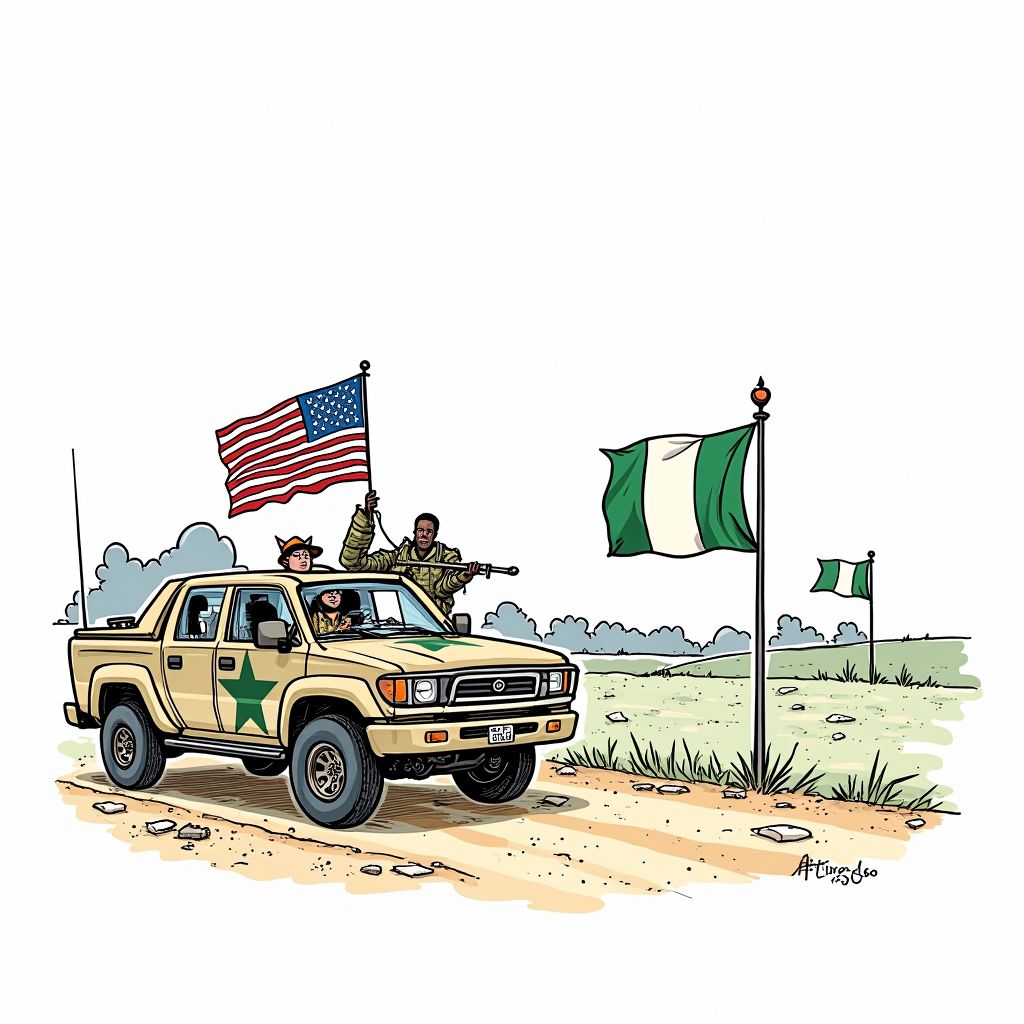
In a decisive move that underscores a shift in American foreign policy toward West Africa, the United States executed precision airstrikes against Islamic State (ISIS) targets in Nigeria’s northwestern Sokoto State on Thursday, December 25, 2025 [1]. This operation, directed personally by President Donald Trump and Secretary of War Pete Hegseth, marks a rapid escalation in U.S. military involvement in the region, coming just one week after a similar engagement on December 18 [1][2]. The U.S. Africa Command (AFRICOM) confirmed that the Christmas Day strikes were conducted in coordination with Nigerian authorities and resulted in the deaths of multiple ISIS operatives, with initial assessments reporting no civilian casualties [1][2]. While the White House frames these interventions as necessary measures to protect religious minorities, the intensification of kinetic operations in Africa’s largest economy raises complex questions regarding regional stability and long-term geopolitical strategy [3].
Operational Specifics and the Lakurawa Threat
The Christmas Day operation targeted specific ISIS camps in Sokoto State, a region that has seen deteriorating security conditions due to the encroachment of extremist factions [1]. U.S. Gen. Dagvin Anderson, commander of U.S. Africa Command, stated that the objective is to disrupt violent extremist organizations “wherever they are” to protect American interests and innocent lives [1]. Security analysts have pointed to the emergence of the “Lakurawa” group—a militant entity controlling territories in Sokoto and Kebbi states—as a likely focus of these intensified efforts [4]. The group has become increasingly lethal, complicating the security landscape in the northwest, which differs from the decade-long insurgency in the northeast dominated by Boko Haram and the Islamic State West Africa Province (ISWAP) [3][4]. This distinct operational focus suggests the U.S. is expanding its theater of engagement beyond traditional strongholds of insurgency to address emerging threats in Nigeria’s border regions [4].
The Religious Narrative vs. Regional Realities
A central driver of this military surge is the Trump administration’s explicit focus on curbing the persecution of Christians. President Trump has characterized the targets as “terrorist scum” responsible for “viciously killing, primarily, innocent Christians,” a stance that precipitated the recent designation of Nigeria as a “Country of Particular Concern” by the U.S. State Department [3][4]. This designation, reserved for nations with severe violations of religious freedom, was accompanied by visa restrictions on Nigerian officials accused of complicity in religious violence [3][4]. However, data from conflict monitoring groups presents a more nuanced reality. Organizations such as ACLED report that jihadist violence in Nigeria has indiscriminately affected communities for over a decade, killing thousands of people, predominantly Muslims [3]. Furthermore, frequent clashes in central Nigeria often stem from resource competition between herders and farmers rather than purely religious ideology, leading to heavy casualties on both sides [3]. Despite this, the White House maintains that the existential threat to the Christian population demands direct intervention [3].
Diplomatic Friction and Economic Implications
The diplomatic backdrop to these military strikes is fraught with tension. While Nigerian Foreign Minister Yusuf Maitama Tuggar characterized the December 18 engagement as a “joint operation” targeting terrorists regardless of religion, the U.S. administration’s rhetoric has placed the Nigerian government under significant pressure to address specific religious grievances [3]. President Bola Tinubu has affirmed his government’s commitment to protecting all faiths, yet the U.S. designation of Nigeria as a Country of Particular Concern introduces reputational and economic risks for investors [3][4]. For the global finance community, the primary concern is whether this increased militarization will stabilize the resource-rich nation or exacerbate internal divisions. As the U.S. signals a willingness to bypass traditional diplomatic niceties in favor of unilateral or heavily pressured joint military action, the risk premium for assets in West Africa may see volatility in the coming quarters [GPT].