Trump Orders Immediate Suspension of United States Trade with Spain
Washington, Wednesday, 8 July 2026.
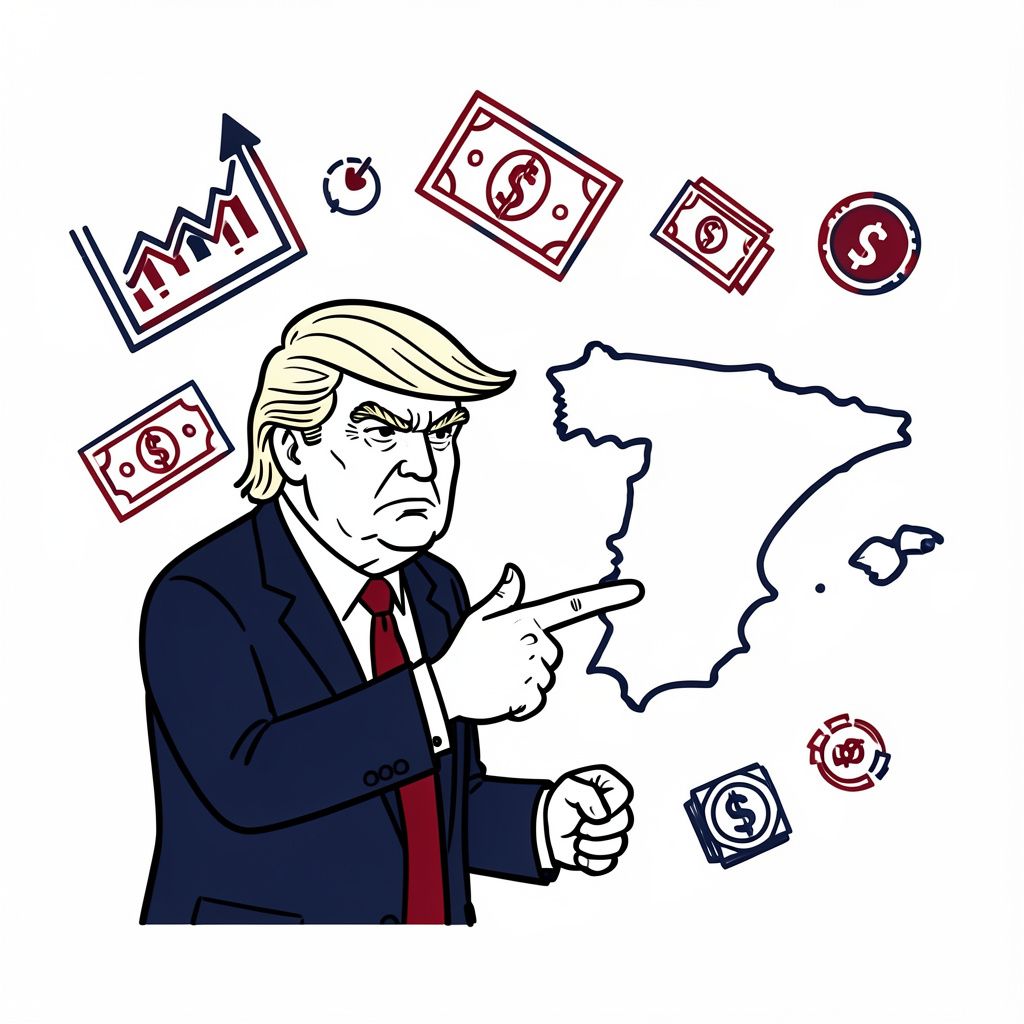
Following Spain’s refusal to permit military airspace access for the Iran war, President Trump ordered an immediate trade suspension, sending Spanish bond yields climbing and shaking global markets.
The Trade Order and Airspace Dispute
During a press conference at the NATO summit in Ankara, Turkey, President Donald Trump escalated transatlantic tensions by ordering Treasury Secretary Scott Bessent to immediately suspend all United States trade with Spain [1][3]. This dramatic directive follows a sharp geopolitical disagreement over the ongoing war in Iran, where Spanish Prime Minister Pedro Sanchez refused to allow the U.S. military to use Spain’s airspace or its dual-use military bases [3]. Trump expressed deep frustration with the European ally, stating, “Spain doesn’t agree to anything, and you shouldn’t carry them,” before adding, “I don’t want to do any trade with them, alright? Take it immediately. Don’t even talk to them. They’re hopeless. They’re bad people” [3].
The NATO Spending Dispute
The trade threat is also heavily tied to long-standing disputes over NATO defense spending [1][3]. During a joint press conference with NATO Secretary General Mark Rutte, Trump lambasted Spain’s failure to commit to the alliance’s 5% GDP defense spending target by 2035, calling Spain “a terrible partner in NATO” that does not participate or pay [1]. Rutte attempted to defend Spain’s contributions, noting that the country had made a “huge step” recently [1][3]. However, Spain remains the only NATO member that did not sign onto the 5% spending commitment during the June 2025 summit, fueling Trump’s insistence on a total trade and travel cutoff [1].
Financial Tremors and Market Reactions
The immediate economic fallout of Trump’s aggressive rhetoric was felt across global financial networks on July 8, 2026 [1]. Following the trade threat and Trump’s concurrent declaration that the interim Iran ceasefire was “over,” global equity markets declined sharply [1]. Spain’s benchmark IBEX 35 index fell by 2.8%, while the pan-European Stoxx 600 dropped by 1.9% [1]. Simultaneously, Spanish 10-year bond yields climbed by nearly 10 basis points to reach 3.5682%, reflecting heightened sovereign risk and investor anxiety [1].
Defense Spending Metrics
The spending dispute highlights the widening gap between U.S. expectations and European defense realities. Spain’s defense spending had reached 2.1% of GDP in 2025 [1]. This represented an increase of 50% from its 2021 level of 1.4% of GDP [1]. Despite this growth, recent data from July 7, 2026, indicates that Spain, along with Slovenia, Belgium, and the Czech Republic, is still failing to meet even the older 2% defense spending target [4]. This shortfall persists despite the broader European trend, which has seen NATO allies and Canada add $1.2 trillion to defense spending since 2017—a figure dubbed the “Trump Trillion” by Secretary General Rutte [4].
The Legal and Structural Hurdles of Decoupling
Despite the administration’s aggressive posture, trade experts and European officials emphasize that a unilateral U.S. trade halt against Spain faces immense legal and practical hurdles [2]. Spain is the fourth-largest economy in the European Union, meaning its trade relations are governed by bloc-wide agreements rather than bilateral treaties [2]. European Commission spokesperson Olof Gill responded on July 8, 2026, stating that Brussels expects the U.S. to honor its commitments under the trans-Atlantic trade pact signed on July 7, 2025, and finalized around June 17, 2026 [2][3]. Gill warned that “the Commission will always ensure that the interests of the European Union and all our member states are fully protected” [2][3].
Economic and Tourism Ties
Furthermore, a complete suspension of trade and tourism could severely damage both economies. Spain is the world’s largest olive oil exporter and shares critical military cooperation with the U.S., including two jointly operated military bases in southern Spain [3]. Additionally, Spain’s tourism sector is a cornerstone of its economy, accounting for 12% to 13% of its GDP, with 94 million international visitors generating over €126 billion in revenue in 2024 [5]. While Trump threatened to discourage American travel to Spain, airline operators such as Iberia, American Airlines, Delta, United, and Air Europa report that flights and operations remain completely unaffected as of July 8, 2026, with no official travel restrictions yet implemented [5].
Broader NATO Friction and Strategic Shifts
The dispute with Spain is part of a broader pattern of friction between the Trump administration and its NATO allies. Beyond Spain, Trump has issued trade threats against other nations, including China, Iran, Greenland, and Oman since April 27, 2026, and threatened 100% tariffs on countries with digital services taxes on June 26, 2026 [2]. The NATO summit in Ankara also saw Trump clash with Danish Prime Minister Mette Frederiksen over his renewed efforts to claim Greenland [4]. Amid these “growing pains”—as U.S. Ambassador Matthew Whitaker described the spending disputes—the U.S. continues to recalibrate its military footprint, with the Pentagon initiating a six-month review of troop drawdowns in Europe [1][4].