AT&T Stock Teeters on Edge: Copper Theft Crisis and Earnings Loom
New York, Tuesday, 23 June 2026.
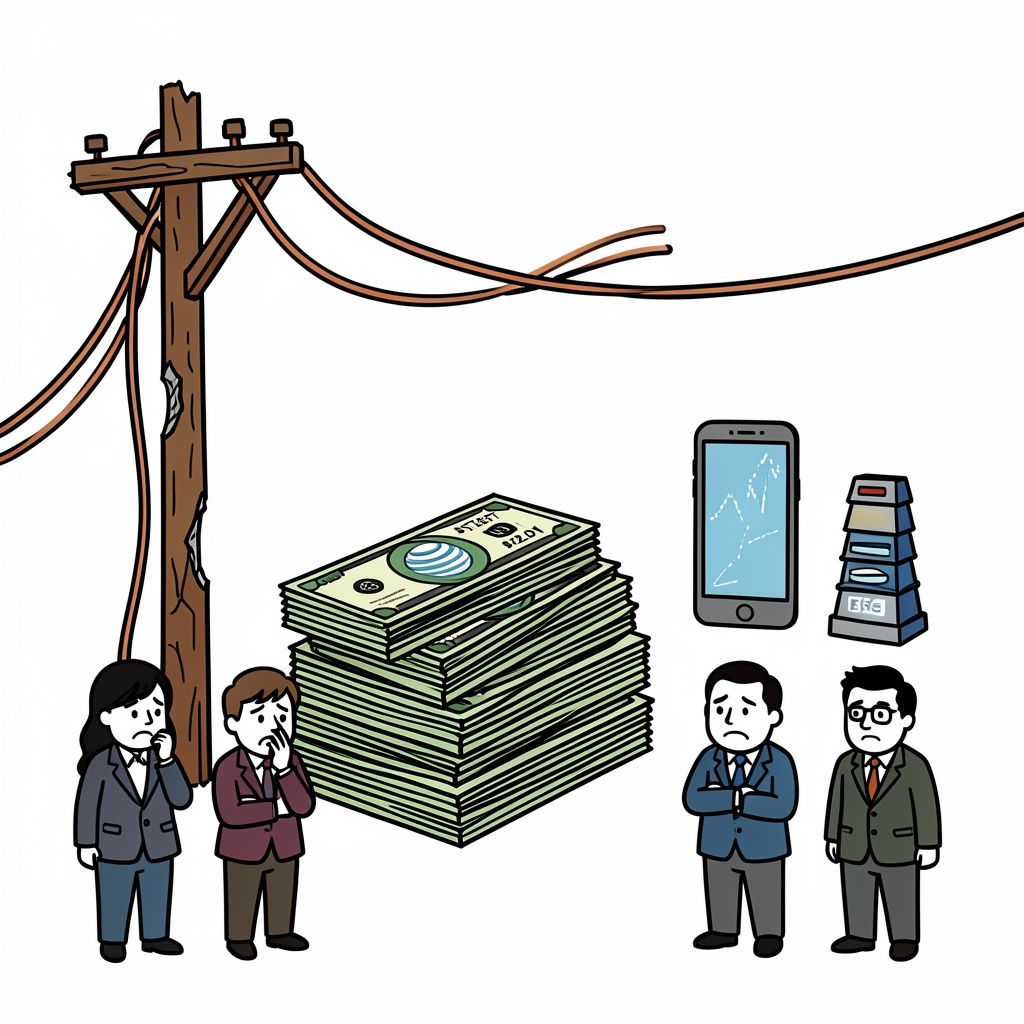
AT&T’s stock hovers just above a 52-week low at $22.01, as a California copper theft dispute threatens $1 billion in annual maintenance costs. With Q2 earnings due July 22, investors are bracing for impact—will the telecom giant’s shift to 5G and fiber offset its crumbling legacy network?
The Copper Crisis: A Billion-Dollar Drain on AT&T’s Legacy Network
AT&T’s financial health faces a significant threat from an unexpected source: copper cable theft. The company spends approximately $1.0 billion annually to maintain its copper-line network, which now serves only 3% of California homes [1]. This maintenance burden comes as copper theft has surged nationwide, with California emerging as a hotspot for infrastructure crimes. The state’s utility regulator recently urged both a U.S. court and the Federal Communications Commission (FCC) to block AT&T’s plan to discontinue new copper-line phone service, arguing that the transition would leave vulnerable populations without reliable connectivity [1]. The dispute highlights the growing tension between legacy infrastructure maintenance and the shift toward advanced connectivity solutions.
Stock Performance: Hovering Near a 52-Week Low
AT&T’s stock (NYSE:T) closed at $22.01 on June 18, 2026, just two cents above its 52-week low of $21.99 [1]. The premarket trading on June 22, 2026, showed a slight uptick to $22.10, but investor sentiment remains cautious [1]. The stock’s decline reflects broader concerns about the company’s ability to manage its legacy infrastructure costs while investing in next-generation technologies. With a market capitalization of approximately $154.7 billion at the current share price, AT&T’s valuation implies around 7 billion shares outstanding, calculated as 1547 [1]. This valuation places additional pressure on the company to demonstrate strong financial performance in its upcoming earnings report.
Q2 2026 Earnings: What Investors Are Watching
AT&T is scheduled to release its second-quarter 2026 earnings before the market opens on July 22, 2026 [1]. Analysts and investors will be closely scrutinizing several key metrics, including free cash flow, which the company has projected to be 2.1 to 2.3 times its quarterly common dividend requirement [1]. In Q1 2026, AT&T reported a 2.9% revenue increase to $31.5 billion, driven by growth in postpaid phone customers (+294,000) and advanced connectivity internet net additions (+584,000) [1]. However, free cash flow dropped to $2.5 billion as the company accelerated its fiber buildout investments [1]. The decline in legacy revenue, which fell by 25.3% in Q1 2026, underscores the urgency of AT&T’s transition to 5G wireless and fiber broadband services [1].
Dividend Sustainability Under Scrutiny
AT&T’s dividend policy remains a critical focus for income investors. The company currently pays an annual dividend of $1.11 per share, which translates to an annual payout of approximately $7.77 billion based on 7 billion shares outstanding, calculated as 68 [1]. While the company’s free cash flow outlook for Q2 2026 suggests coverage of 2.1 to 2.3 times the dividend requirement, the sustainability of this payout ratio may be tested if legacy infrastructure costs continue to rise [1]. Brian Mulberry, chief market strategist at Zacks Investment Management, emphasized the shifting revenue landscape in telecommunications, stating, ‘Data is going to be the revenue of the future’ [1]. This sentiment reflects the industry-wide pivot away from traditional voice services toward data-driven connectivity solutions.
The Broader Telecom Infrastructure Challenge
AT&T’s copper theft dispute in California is not an isolated incident but part of a growing national trend. Copper theft has become a pervasive issue for telecom providers, with municipalities across the U.S. implementing innovative solutions to combat the problem. For example, Louisville, Kentucky, launched a solar-powered lighting pilot program in 2026 aimed at deterring copper wire theft by illuminating high-risk areas [2]. The program reflects the broader challenges telecom companies face in securing their infrastructure while transitioning to modern networks. Additionally, the FCC’s E-Rate program, which provides funding for broadband connectivity in schools and libraries, has faced criticism from advocacy groups. The Schools, Health, and Libraries Broadband (SHLB) Coalition and CW Consulting recently urged the FCC to reconsider its decision to enforce a mandatory electronic bidding portal, arguing that stakeholders were not given sufficient time to comment on the new rule [3]. These regulatory and operational challenges add another layer of complexity to AT&T’s efforts to modernize its network.
Analyst Perspectives: Balancing Legacy Costs and Future Growth
Market analysts are divided on AT&T’s ability to navigate its current challenges. Some view the company’s aggressive investment in fiber and 5G as a necessary step to future-proof its business, while others express concern about the short-term financial strain of maintaining legacy infrastructure. The company’s Q1 2026 results showed promising growth in advanced connectivity services, which now account for the majority of domestic consumer and business revenue [1]. However, the 25.3% decline in legacy revenue highlights the urgency of completing the transition [1]. The upcoming earnings report will be a critical test of AT&T’s ability to balance these competing priorities. Investors will be looking for clear signals that the company can sustain its dividend while managing the financial impact of copper theft and regulatory disputes.