Trump Administration Unveils Strategy to Revitalize American Shipbuilding Through Foreign Vessel Fees
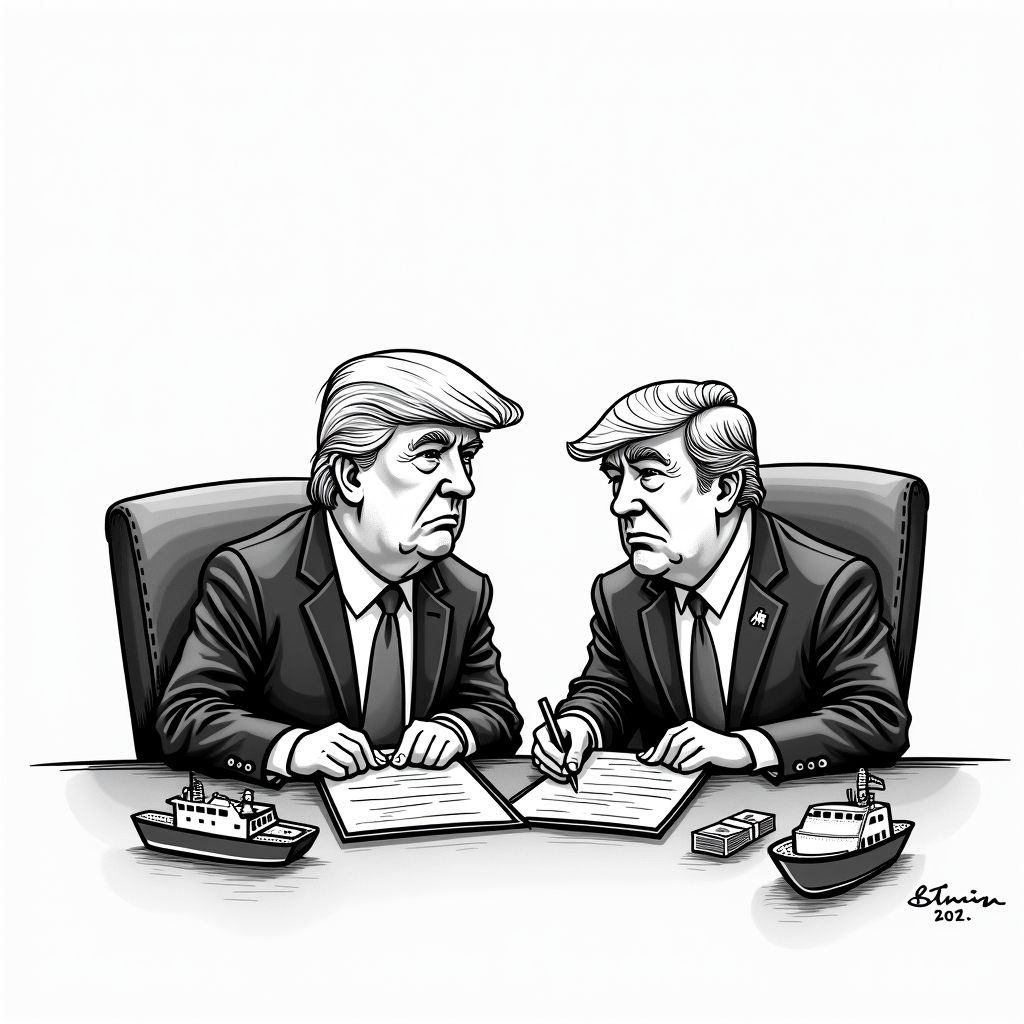
Washington D.C., Saturday, 14 February 2026.
The White House proposes revitalizing domestic shipyards via levies on foreign vessels, a move projected to generate up to $1.5 trillion for a new Maritime Security Trust Fund.
Funding the Fleet: A Trillion-Dollar Proposition
The financial cornerstone of the Trump administration’s strategy, released on Friday, February 13, 2026, relies on a controversial new revenue stream: a universal fee on foreign-built vessels docking at American ports [2][3][5]. This mechanism is designed to capitalize the newly proposed Maritime Security Trust Fund, directly linking import volume to domestic industrial revitalization [1]. The economic projections for this fee vary wildly based on the implementation rate; administration estimates suggest that a fee of $0.01 per kilogram of imported tonnage would generate $66 billion over a decade [2][6]. However, should the administration pursue the upper limit of $0.25 per kilogram, the revenue could skyrocket to $1.5 trillion over the same period [2][5]. This capital is intended to subsidize the expansion of U.S. shipyards, which currently construct less than 1% of the world’s commercial ships [2][3].
Zoning in on Growth
Beyond direct levies, the Maritime Action Plan (MAP) utilizes tax policy to stimulate private equity investment through the creation of “Maritime Prosperity Zones” [1][2]. Modeled after the Opportunity Zones established in 2017, this initiative authorizes the Secretary of Commerce to designate 100 specific zones where investors can receive favorable tax treatment for ten-year periods [1][2]. These zones are designed to channel capital into shipyard communities and maritime industrial bases that have suffered from chronic underinvestment [2]. Additionally, the administration aims to extend the Capital Construction Fund to shipyard owners, allowing them to defer taxes on earnings if those funds are reinvested into infrastructure and modernization efforts [2].
The Capacity Deficit
The scale of the challenge outlined in the 35-page document is substantial [2]. Currently, the United States possesses only 66 shipyards, of which only eight are active yards capable of constructing vessels longer than 121.9 meters [1][3]. The administration argues that this withered capacity poses a direct threat to national security, asserting that the U.S. cannot rely on foreign-built, foreign-crewed, and foreign-flagged ships to transport trade or defend American interests [1]. To address the human capital crisis accompanying this infrastructure deficit, the plan includes a new Mariner Incentive Program and modernization efforts for the U.S. Merchant Marine Academy to stabilize and expand the workforce [1][2].
Sources
- www.workboat.com
- gcaptain.com
- news.usni.org
- maritime-executive.com
- www.nytimes.com
- www.freightwaves.com