Jordan Pioneers Industrial Green Energy with First Floating Solar Plant
Amman, Monday, 25 May 2026.
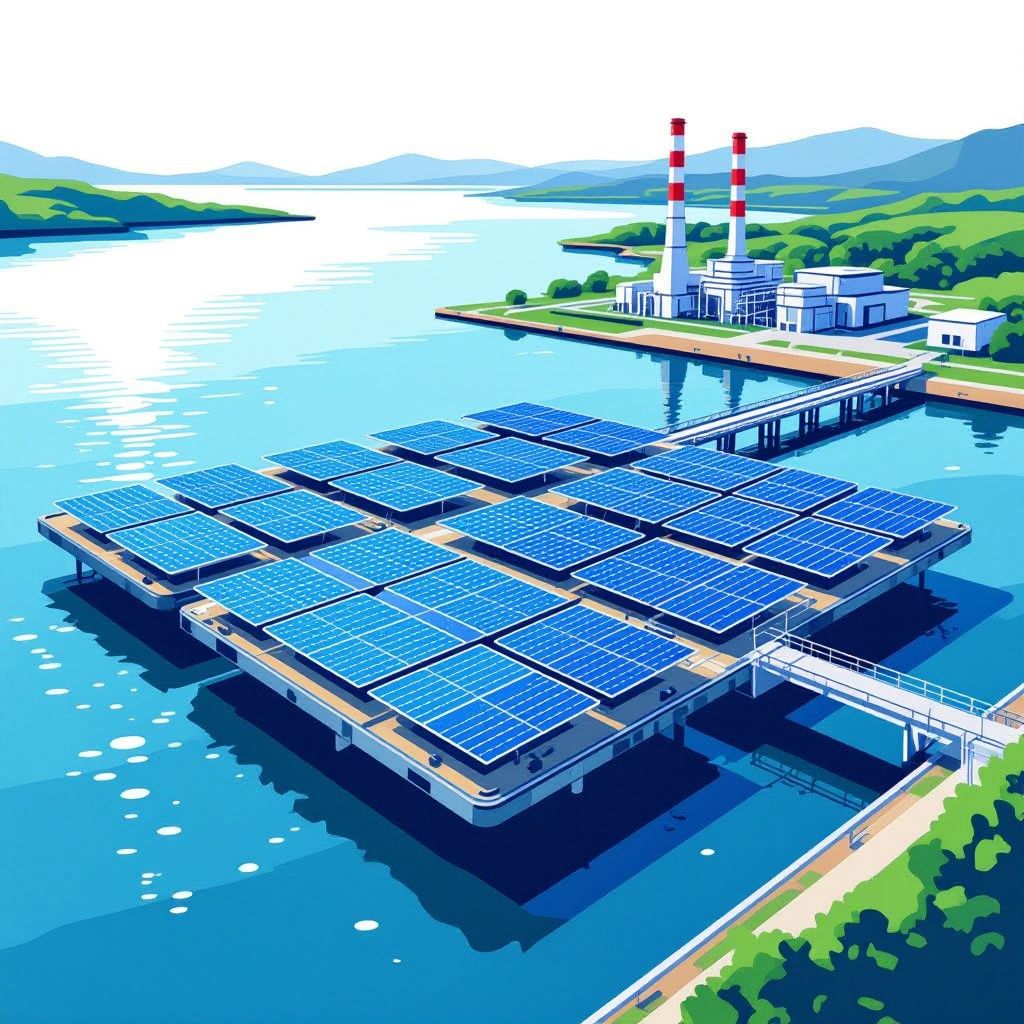
Announced in May 2026, Jordan’s innovative 6-megawatt floating solar plant will cut industrial carbon emissions by 9,000 tonnes while saving 20,000 cubic meters of water annually.
Engineering the Dead Sea’s Energy Future
The strategic shift in Middle Eastern energy infrastructure materialized on May 24 and May 25, 2026, when the Alternative Energy Projects Company (AEPCo) and Electro-Mechanical & Communication Engineers (EMC) secured a landmark contract [1]. The consortium was selected to build a 6-megawatt floating photovoltaic (FPV) power plant for the Arab Potash Company (ASE: APOT) [1][GPT]. Situated on the industrial water reservoirs of the Arab Potash Company in Ghour Al-Safi within the Dead Sea basin, the project represents Jordan’s first commercial-scale floating solar facility [1].
Global Context: The Utility-Scale Solar Boom
While Jordan pioneers specialized floating infrastructure, the broader global solar market is experiencing unprecedented acceleration in utility-scale deployments [GPT]. A prime example of this momentum emerged concurrently in May 2026 in India, where SAEL Limited successfully commissioned two solar plants with a combined capacity of 600 megawatts in Kadapa, Andhra Pradesh [3]. The scale of the Indian project highlights the rapid evolution of the sector, utilizing over 1.2 million TOPCon bifacial solar panels across more than 2,400 acres [3].
Economic Implications for Industrial Operators
The contrasting yet complementary projects announced in May 2026 illustrate a maturing global renewable energy landscape [GPT]. In India, the focus remains on rapid, massive-scale land deployment to meet ambitious national targets, which aim for 10 trillion rupees in clean energy investments by 2029 [3]. Conversely, the AEPCo and EMC venture in Jordan demonstrates how heavy industries, such as mining and mineral extraction, are adopting specialized technologies to optimize existing infrastructure without requiring additional land acquisition [1].