South Korea Bets Big on Power Semiconductors to Secure Tech Leadership
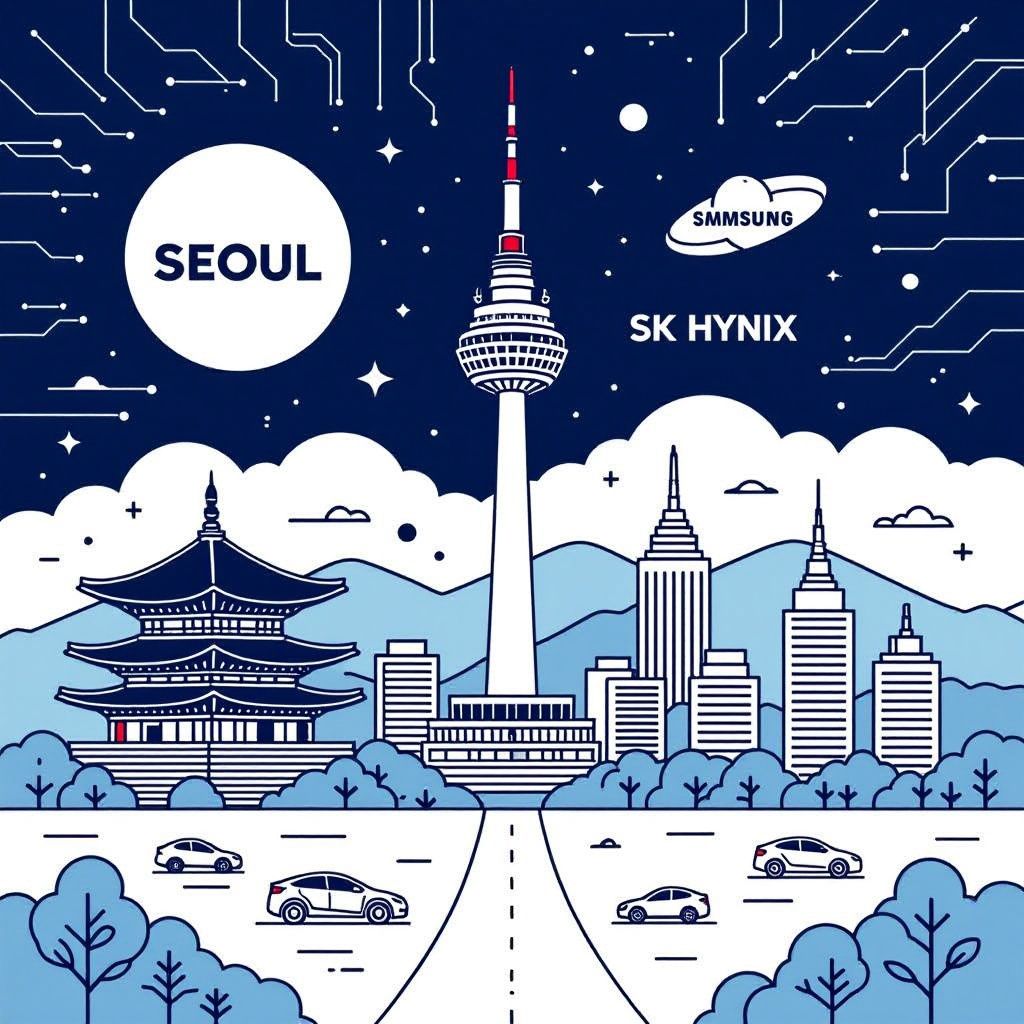
Seoul, Saturday, 13 June 2026.
South Korea is investing 500 billion won ($370 million) to dominate next-gen power semiconductors, critical for AI, EVs, and defense. This strategic move aims to reduce reliance on memory chips and reshape global supply chains, positioning domestic giants like Samsung and SK Hynix at the forefront of a high-stakes tech race.
The Strategic Imperative: Why Power Semiconductors Matter
South Korea’s 500 billion won ($370 million) investment in next-generation power semiconductors represents more than a financial commitment - it marks a strategic pivot in the nation’s technological future. Power semiconductors, particularly those based on silicon carbide (SiC) and gallium nitride (GaN), outperform traditional silicon in high-temperature, high-voltage, and high-frequency environments [1]. These characteristics make them indispensable for emerging industries where efficiency and performance are non-negotiable: artificial intelligence data centers, electric vehicles, robotics, and renewable energy grid stabilization [1]. The Ministry of Trade, Industry and Energy (MOTIE) has identified declining competitiveness in this sector as a direct threat to South Korea’s supply chain security across five critical industries: automobiles, batteries, shipbuilding, energy, and defense [1].
The ‘Second Memory’ Vision: Redefining South Korea’s Semiconductor Identity
The government’s designation of power semiconductors as the ‘second memory’ industry carries profound symbolic and economic significance. Memory chips have been the cornerstone of South Korea’s semiconductor success, with Samsung Electronics and SK Hynix dominating global markets [1]. However, this dominance has also created vulnerability - memory chips accounted for 58.7% of South Korea’s semiconductor exports in 2025, exposing the nation to cyclical market fluctuations [2][GPT]. The 500 billion won R&D initiative, announced on June 12, 2026, aims to replicate the memory sector’s success in power semiconductors while diversifying the nation’s technological portfolio [1]. This strategic realignment comes as global competition intensifies, with China investing $47.5 billion in its semiconductor industry in 2025 alone and the U.S. CHIPS Act providing $52.7 billion in subsidies [3][4].
The Integrated R&D Ecosystem: From Materials to Market
MOTIE’s approach to power semiconductor development represents a paradigm shift in industrial policy. The ministry is implementing a full-cycle integrated R&D program that links demand companies with public fabrication facilities from the earliest stages of development [1]. This model, which bundles materials research, device development, module integration, and system demonstration, aims to compress the technology-to-commercialization timeline by 30-40% compared to traditional sequential development [1]. The program will leverage three key infrastructure nodes: the Busan Power Semiconductor Specialized Complex (public fabrication), the Pohang demonstration facility (system integration), and the Naju testing center (reliability validation) [1]. With private sector matching funds, the total R&D investment could reach 750 billion won (≈$555 million), though the final scale will be determined during the 2027 budget proposal process [1].
Global Supply Chain Implications: Opportunities and Challenges
South Korea’s power semiconductor push arrives at a critical juncture in global supply chain realignment. The initiative is expected to create new opportunities for U.S. and European partners, particularly in equipment manufacturing and materials science [1]. However, it also introduces competitive pressures for established players like Infineon Technologies (Germany) and onsemi (U.S.), which currently dominate the SiC and GaN markets [6]. The timing coincides with the European Union’s Chips Act, which aims to capture 20% of the global semiconductor market by 2030, and Japan’s $6.8 billion semiconductor subsidy program [7][8]. Analysts project the global power semiconductor market to reach $45.2 billion by 2028, growing at a compound annual rate of 57.491% from its 2023 value of $28.7 billion [9]. South Korea’s share of this market stood at just 3.2% in 2025, compared to Japan’s 22.1% and the U.S.’s 18.3% [10].
The Commercialization Challenge: From Lab to Fab
While the R&D initiative has generated optimism, industry observers caution that commercialization remains the critical hurdle. MOTIE has acknowledged this challenge, stating plans to develop a commercialization technology roadmap to support private companies’ transition to mass production [1]. The ministry’s approach mirrors strategies employed in South Korea’s memory chip industry during the 1980s, when government-backed R&D consortia played a pivotal role in establishing domestic manufacturing capabilities [GPT]. However, power semiconductors present unique challenges: the SiC substrate market, for instance, is currently dominated by a handful of suppliers, with Cree (U.S.) controlling approximately 60% of global production capacity [11]. Samsung Electronics and SK Hynix, while possessing advanced fabrication capabilities, lack experience in power semiconductor manufacturing at scale [alert! ‘Market entry barriers for memory chip manufacturers transitioning to power semiconductors remain unquantified’].
The Broader Innovation Ecosystem: Robotics and Global Collaboration
The power semiconductor initiative forms part of a broader innovation push that includes robotics and international collaboration. MOTIE’s recent showcase of HD Hyundai Heavy Industries’ autonomous manufacturing systems demonstrates the interconnected nature of these technological developments [12]. The ministry’s focus on robotics aligns with the power semiconductor initiative, as advanced robotics systems require high-efficiency power management solutions [GPT]. On the international front, the upcoming 2026 World Korean Scientists and Engineers Conference (July 7-8 in Seoul) will provide a platform for global collaboration, potentially accelerating technology transfer and joint research initiatives [13]. This event, organized by the Korean Federation of Science and Technology Societies, reflects South Korea’s recognition that technological leadership in the 21st century requires both domestic investment and international partnerships [13].
Sources
- en.sedaily.com
- www.semiconductors.org
- www.semiconductorindustry.org
- www.congress.gov
- v.daum.net
- www.yolegroup.com
- digital-strategy.ec.europa.eu
- www.meti.go.jp
- www.marketsandmarkets.com
- www.statista.com
- www.coherentmarketinsights.com
- www.instagram.com
- www.instagram.com