FAA Investigation into United Airlines Near-Miss Could Signal Tighter Airspace Regulations
Santa Ana, Friday, 27 March 2026.
After a United Airlines 737 narrowly avoided a military helicopter by just 160 meters, a new FAA investigation could trigger costly regulatory shifts for the commercial aviation sector.
A Narrow Escape Over Santa Ana
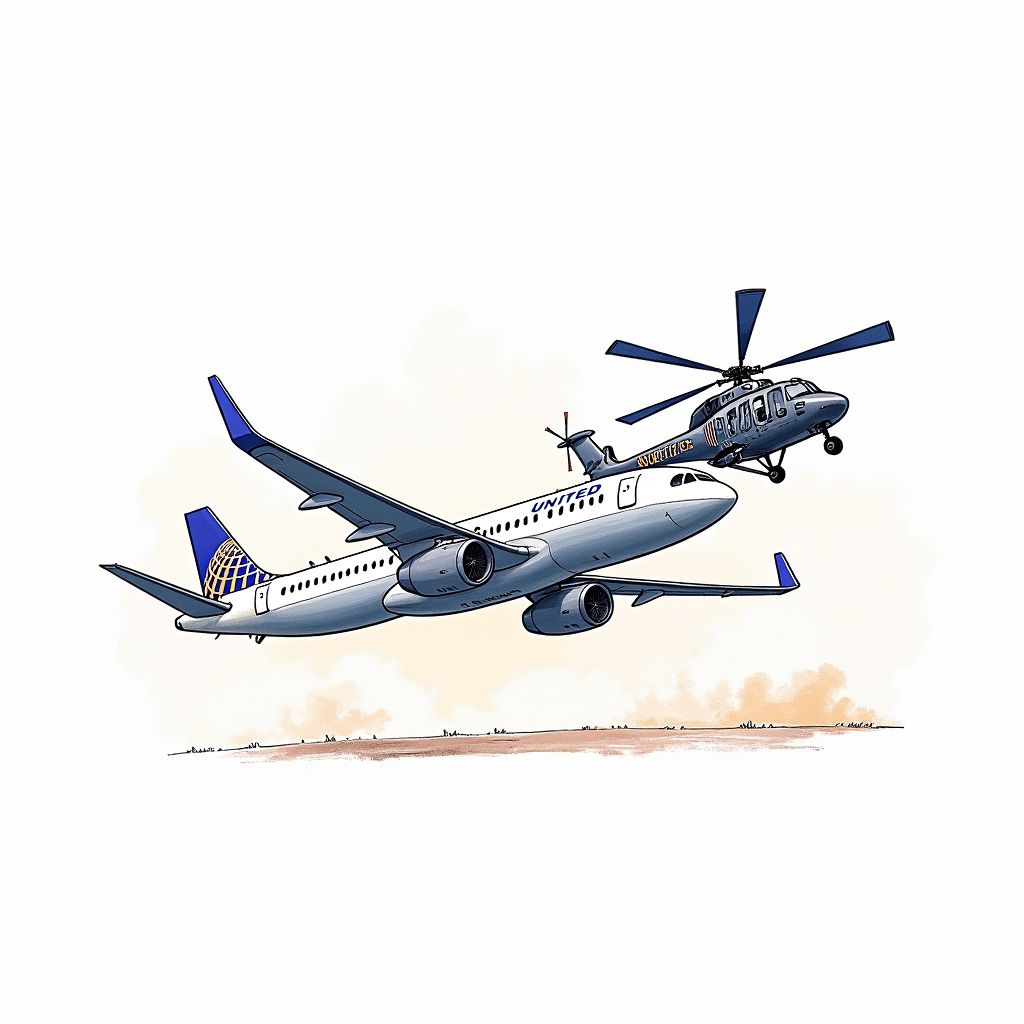
On Tuesday, 24 March 2026, United Airlines (NYSE: UAL) Flight 589, a Boeing 737-800 traveling from San Francisco, was on its final approach to John Wayne Airport in Santa Ana, California [1][2]. At 03:40:35 UTC, a collision avoidance alarm—specifically a TCAS Resolution Advisory—sounded in the cockpit as a US Army UH-60M Black Hawk helicopter crossed the passenger jet’s path [1][2]. The military aircraft, operated by the California Air National Guard under the callsign Knife 25, came within a vertical separation of 160 meters and a lateral distance of 433 meters from the commercial jet [1][2]. At the time of the incident, the United Airlines flight was descending through 609 meters, while the helicopter maintained an altitude of 434 meters, reflecting an initial altitude gap of 175 meters before the closest point of approach [2].
Regulatory Scrutiny and the ‘See and Avoid’ Protocol
The Federal Aviation Administration (FAA) formally announced an investigation into the near-miss on Thursday, 26 March 2026 [2]. A central focus of this probe is whether air traffic controllers applied a newly implemented safety measure designed to prevent such encounters [2] [alert! ‘It is not yet confirmed if the controllers failed to apply the new radar separation measure or if other factors contributed to the incident’]. Earlier in March 2026, the FAA issued an order effectively banning the use of visual separation—a practice known as ‘see and avoid’—between helicopters and fixed-wing aircraft operating near busy airports [1][2]. This mandate requires controllers to actively track helicopters using radar when they traverse the flight paths of commercial planes taking off or landing [1].
Echoes of Past Tragedies and Industry Impact
The urgency of the FAA’s current investigation is heavily underscored by recent aviation history. In January 2025, a catastrophic collision occurred when a US Army Black Hawk on a training mission struck an American Airlines regional jet landing at Ronald Reagan Washington National Airport [1]. That disaster resulted in 67 fatalities, marking the deadliest US aviation accident in nearly two decades [1]. Subsequent investigations into the 2025 crash revealed systemic failures, pinpointing the FAA’s routing of helicopter paths near runway approach corridors as a primary cause [1].