White House Promotes New Gas Station Network to Lower Fuel Prices
Philadelphia, Wednesday, 8 July 2026.
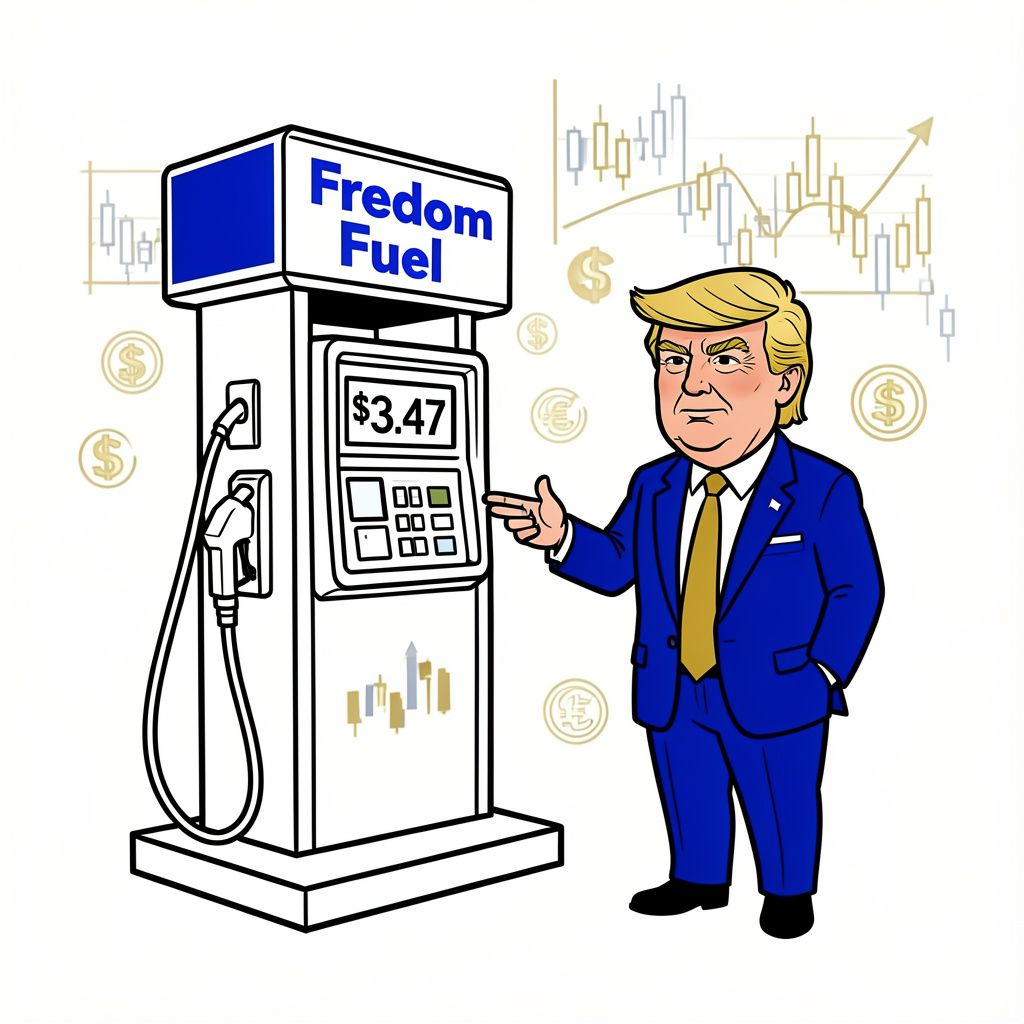
The Trump administration is promoting a new “Freedom Fuel” network offering gas at $3.47, but experts warn this unsustainable rate is quietly subsidized by an unknown source.
Political Promotion Meets Retail Reality
The official rollout of the “Freedom Fuel” network on July 7, 2026, marks an unusual political branding effort by Republican President Donald Trump’s administration [1][2]. The White House announced the initiative on the social media platform X, sharing promotional footage of drivers thanking President Trump for lowering prices at the pump [1]. The first physical site, a former Sunoco station located in Dresher, Pennsylvania (Upper Dublin Township), debuted its rebranding with regular gasoline priced at $3.47 per gallon [2][4]. This rollout comes at a crucial political juncture, as both Republicans and Democrats prepare for the highly contested November 2026 midterm elections, where consumer energy costs remain a top voter concern [1][2].
The Corporate Structure Behind the Brand
Despite the heavy White House promotion, administration officials have clarified that the Freedom Fuel Network is actually a private company—specifically registered as Freedom Fuel Network, LLC in Delaware on July 1, 2026 [2][3]. The administration asserts that no federal funding has been provided to the network, and the private entity does not purchase its fuel at a discount [2]. The White House has promoted a list of 25 planned or operational locations across the greater Philadelphia area and South Jersey, including sites in Elmwood Park, Bustleton, and Hunting Park [1][2]. However, as of July 8, 2026, federal officials have not publicly confirmed how many of these 25 stations are fully operational [2], and inquiries regarding the company’s corporate ownership and pricing model remain unanswered [3].
The Economics of Subsidized Pricing
While the administration frames the $3.47 per gallon price as a major victory for consumer relief, market data suggests the savings are highly localized and inconsistent [1][3]. On July 7, 2026, the national average for regular gasoline stood at $3.79 per gallon [1][3], while New Jersey’s state average was $3.83 per gallon [3]. In Philadelphia, the average price was $3.95 per gallon, representing a year-over-year increase of 19.335% from the $3.31 average recorded on July 7, 2025 [2]. Although the Dresher station’s $3.47 price is lower than nearby competitors like Citgo ($3.79) and Gulf ($3.85) [2], other local stations are already beating the Freedom Fuel rate [3]. For instance, in Burlington, New Jersey, private stations like Speedy Gas and Shell were selling fuel as low as $3.29 and $3.39 per gallon, respectively, on the same day [3].
Questions of Sustainability
This discrepancy has raised questions among energy analysts about the financial viability of the network’s pricing structure [2][3]. Patrick De Haan, the head of petroleum analysis at GasBuddy, noted that selling fuel at $3.47 in these regions is unsustainable without external financial support [2][3]. De Haan remarked that the model resembles promotional subsidies, suggesting that an unknown source must be funding the difference to keep prices artificially low [3]. This reality contrasts sharply with President Trump’s public demands for oil companies to “immediately” lower fuel prices to $2.50 per gallon [3]—a target De Haan describes as “absolutely unrealistic” and below cost for every station in the country [3].
Historical Context and Global Crude Pressures
The political narrative surrounding the $3.47 promotional price is further complicated by historical pricing data [4]. Google Street View imagery reveals that the very same Dresher station, operating as a Sunoco under the administration of Democratic President Joe Biden, advertised regular gasoline for $2.99 per gallon in November 2024 [4]. When President Trump took office in January 2025, national average gas prices were already hovering in the low-$3 range [4]. Thus, the highly publicized $3.47 “relief” price is not only higher than the station’s late-2024 pricing, but it also remains well above Trump’s campaign pledge to bring gasoline costs below $2.00 per gallon [4].
Geopolitical Drivers of Retail Fuel
The broader trajectory of retail fuel prices in 2026 has been heavily dictated by international conflict rather than domestic policy [1]. Earlier in 2026, gas prices spiked across all 50 states, pushing the national average close to $5.00 per gallon by May [1][2]. This surge was triggered by the U.S.-Iran war, which caused Brent crude oil to spike by more than 55% and nearly reach $120 per barrel [1]. The conflict led to severe shipping disruptions in the Strait of Hormuz, a critical global transit point that accounted for nearly 34% of global crude oil shipments in 2025, according to the International Energy Agency [1]. Prices only began to retreat after the U.S. and Iran reached a tentative peace agreement in June 2026, which effectively reopened the strait [1].
Market Outlook
As of July 8, 2026, crude oil is trading at approximately $70 per barrel, though market volatility remains due to a recent attack on an oil tanker in the Strait of Hormuz [3]. According to the U.S. Energy Information Administration, retail pump prices continue to be dictated by global crude costs, refining margins, distribution expenses, and state and federal taxes, rather than localized political branding [1]. While West Coast states like Hawaii, California, and Washington continue to face average prices above $5.00 per gallon, states such as Indiana, Oklahoma, and Texas enjoy some of the cheapest fuel in the country [1]. Ultimately, the Freedom Fuel initiative represents a highly visible marketing campaign ahead of the midterms, but its long-term economic sustainability remains highly questionable [2][3].