Canadian Dollar Strengthens as Global Conflict Drives Oil Prices Higher
Toronto, Friday, 6 March 2026.
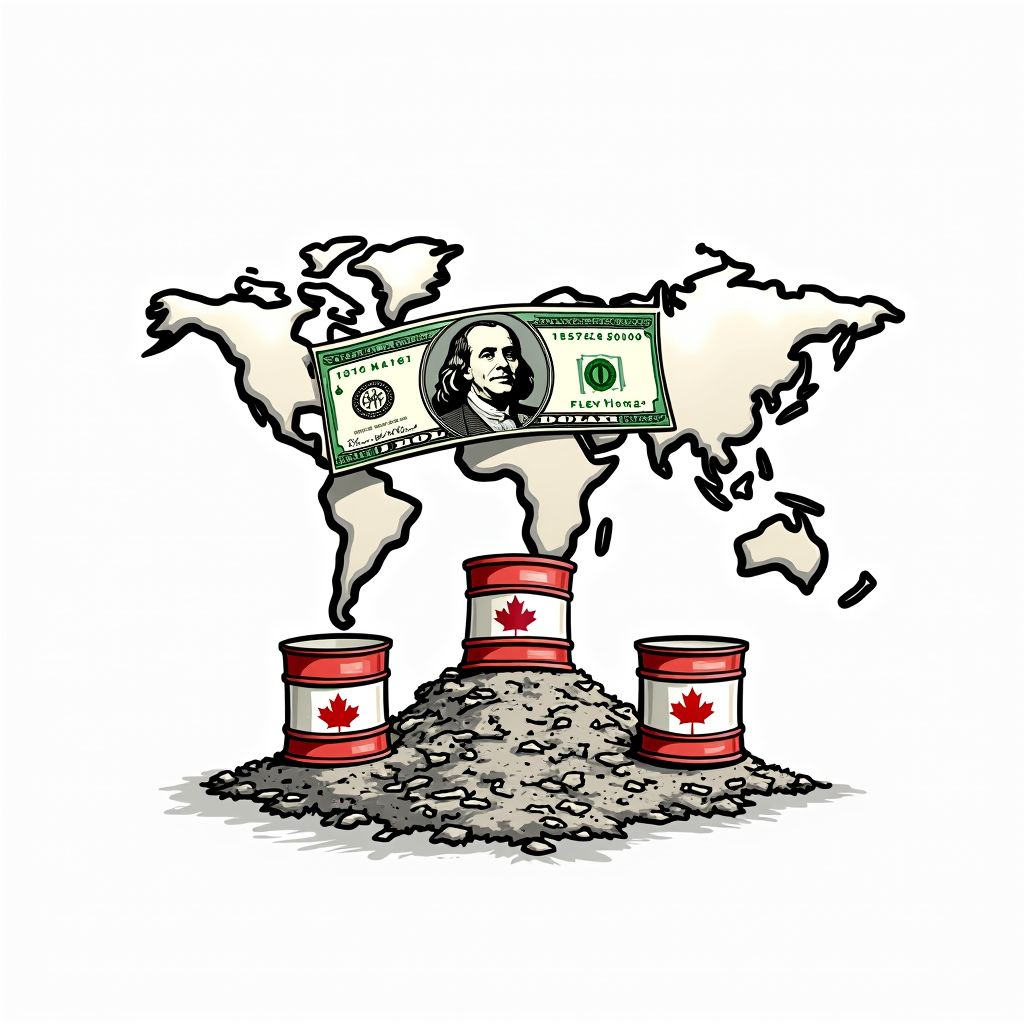
With the Strait of Hormuz closure trapping 140 million oil barrels, Canada’s resource-linked currency is surging. This energy shock positions the dollar as a rare safe haven amid global volatility.
A Singular Outperformer
As of market close on Friday, March 6, 2026, the divergence between the Canadian dollar and broader equity markets has become stark. While the S&P 500 retreated by 1.33% and the Nasdaq Composite fell 1.59% amid risk aversion, the Canadian dollar appreciated by approximately half a cent against the U.S. dollar [5]. This resilience is directly tethered to the violent repricing of energy assets; West Texas Intermediate (WTI) crude oil settled at $90.90 per barrel, a single-day surge of $9.89 or 12.21% [5]. Shaun Osborne, chief currency strategist at Scotiabank, describes the currency as a “singular outperformer,” noting that the improvement in Canada’s terms of trade is currently outweighing typical risk-off correlations [5]. The spread between Brent crude, which settled at $92.69, and WTI has narrowed to just 1.79 dollars per barrel, reflecting tight supply dynamics across North American and global benchmarks [5].
The Strait of Hormuz Crisis
The catalyst for this volatility is the logistical paralysis in the Middle East following the escalation of the U.S.-Israeli conflict with Iran earlier this week [5]. The Strait of Hormuz has effectively closed, trapping approximately 140 million barrels of oil—equivalent to 1.4 days of global demand—over the past seven days alone [5]. The impact extends well beyond crude oil; LNG shipping rates have skyrocketed 650% to reach $300,000 USD per day as tankers remain unable to navigate the region [6]. Market structures are screaming tightness; the spread between front-month Brent contracts and six-month contracts has widened to nearly $10, marking the steepest backwardation since the Russia-Ukraine war in 2022 [5].
Economic Implications for Canada
For the Bank of Canada (BoC), the resurgence in energy prices introduces a stabilizing variable into a fragile economic equation. Analysts at TD Securities highlight that while “interminable” CUSMA negotiations and geopolitical strife weigh on investment intentions, the energy sector provides a critical offset to negative sentiment [3]. The BoC’s January 2026 Monetary Policy Report had conservatively assumed a WTI price of just $55 per barrel [7]. With prices now hovering near $90, this variance could add between 0.4 and 0.5 percentage points to Canada’s baseline growth trajectory [7].
Sources
- www.bnnbloomberg.ca
- www.bnnbloomberg.ca
- www.fxstreet.com
- www.theglobeandmail.com
- aubullion.ca
- www.fxstreet.com