Dynamic Aerospace Advances Autonomous Drone Delivery with Three New Patents
New York, Monday, 18 May 2026.
Dynamic Aerospace Systems filed three patents today enabling perpetual drone delivery cycles. This strategic expansion targets the rapidly growing autonomous logistics market using advanced structural battery technology.
Expanding the Autonomous Logistics Ecosystem
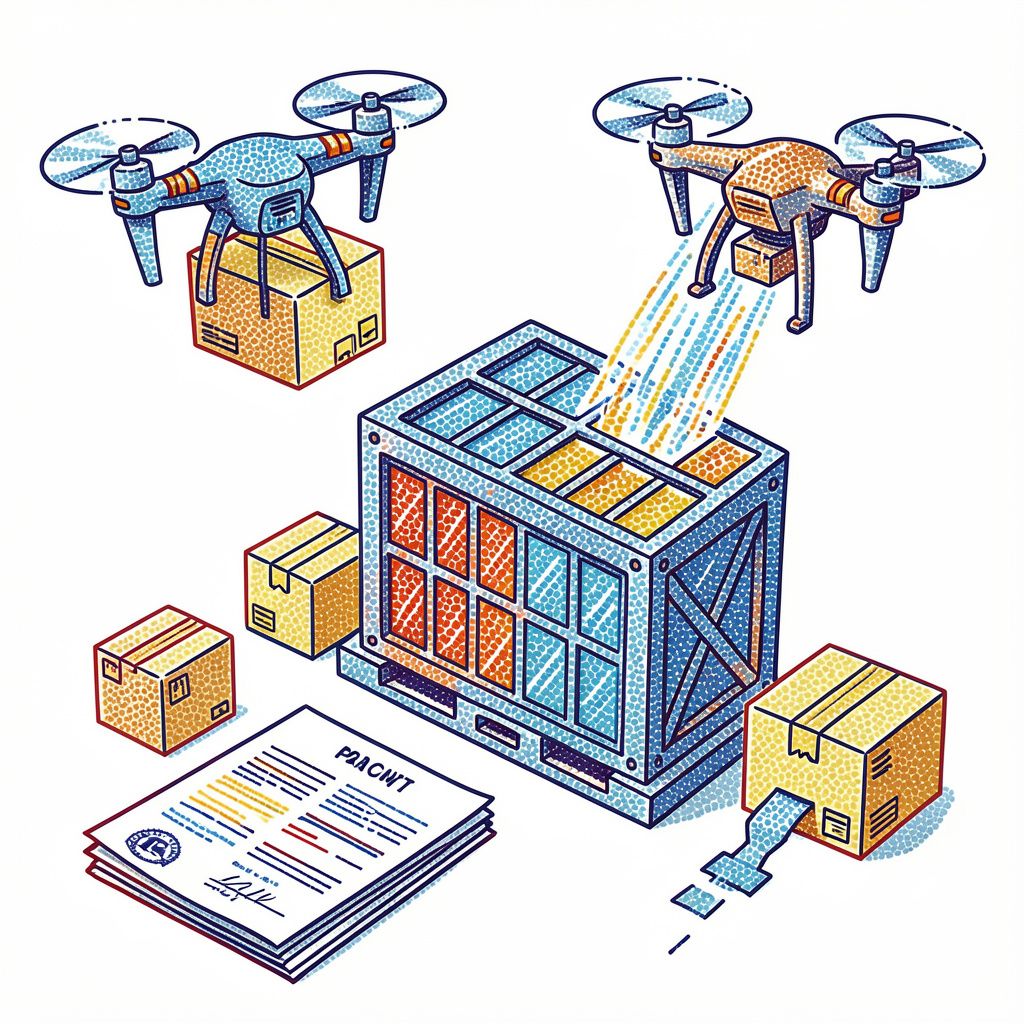
Today, May 18, 2026, Dynamic Aerospace Systems, a Nevada-incorporated company trading on the OTCQB Market under the ticker symbol BRQL, announced the filing of three provisional patent applications [1][3]. [alert! ‘Source 1 mentions both May 17 and May 18 as the filing date; using May 18 based on the primary announcement date’] The new intellectual property focuses on establishing continuous unmanned aerial vehicle (UAV) logistics operations and modular aircraft architectures [1]. Specifically, the patents cover a Continuous Loop Autonomous UAV Logistics System, a Mobile Fulfillment Node (MFN) Repositioning System, and a Detachable Structural Battery Arm Architecture [1]. These innovations are designed to enable drones to operate in perpetual mission cycles through automated exchanges and predictive movement of mobile infrastructure [1]. Kent Wilson, the Chief Executive Officer of Dynamic Aerospace Systems, emphasized that the company’s vision extends beyond manufacturing drones to creating a fully integrated, AI-driven logistics ecosystem capable of real-world scalability [1].
Financial Performance and Strategic Positioning
This aggressive expansion of intellectual property coincides with the release of the company’s first-quarter financial results for 2026, filed with the SEC on May 15 [2][3]. For the quarter ending March 31, 2026, Dynamic Aerospace Systems reported a GAAP net loss of approximately $1.05 million [2][3]. However, the company highlighted an adjusted operational loss of approximately $773,000, which translates to a monthly burn rate of roughly $258,000 [2]. The gap between the GAAP net loss and the adjusted operational loss is primarily attributed to several non-cash accounting items, including stock-based compensation of $399,000, amortization of debt discount totaling $192,000, and a fair-value gain on derivative liabilities amounting to $437,000 [2][3]. Using these figures, the total non-cash expenses excluding the derivative gain amounted to 678000 dollars [3].
Capitalizing on a Growing Aerospace Market
The strategic maneuvers by Dynamic Aerospace Systems align with robust growth projections in the broader aerospace robotics sector [GPT]. The global aerospace robotics market, valued at $2.86 billion in 2025, is projected to reach $3.19 billion in 2026 [4]. Market analysts forecast this sector will expand to $7.69 billion by 2034, representing a compound annual growth rate (CAGR) of 11.5% [4]. This rapid expansion represents an overall projected market growth of 141.066 percent from 2026 to 2034 [4]. Key drivers for this growth include rising defense budgets allocated toward autonomous systems, the proliferation of military UAVs, and the integration of artificial intelligence and machine learning technologies [4].