Lockheed Martin Unveils Shipping Container System to Launch Military Drones in Minutes
Bethesda, Monday, 12 October 2026.
Lockheed Martin’s new containerized drone system enables rapid, runway-free deployment of four autonomous aircraft in remote locations, transforming military logistics and operational agility in challenging environments.
Rapid Deployment Unveiled
Lockheed Martin Corporation (NYSE: LMT), through its subsidiary Sikorsky, announced the launch of the Nomad 100 Fast Pack on October 12, 2026 [1]. The system is engineered to rapidly deploy autonomous vertical takeoff and landing (VTOL) drones in remote and challenging locations without requiring extensive ground infrastructure [1][5]. This innovation highlights the growing defense sector demand for modular, highly mobile unmanned aerial systems (UAS) [5]. The announcement was made at the Association of the United States Army conference in Washington, D.C. [8].
Containerized Efficiency
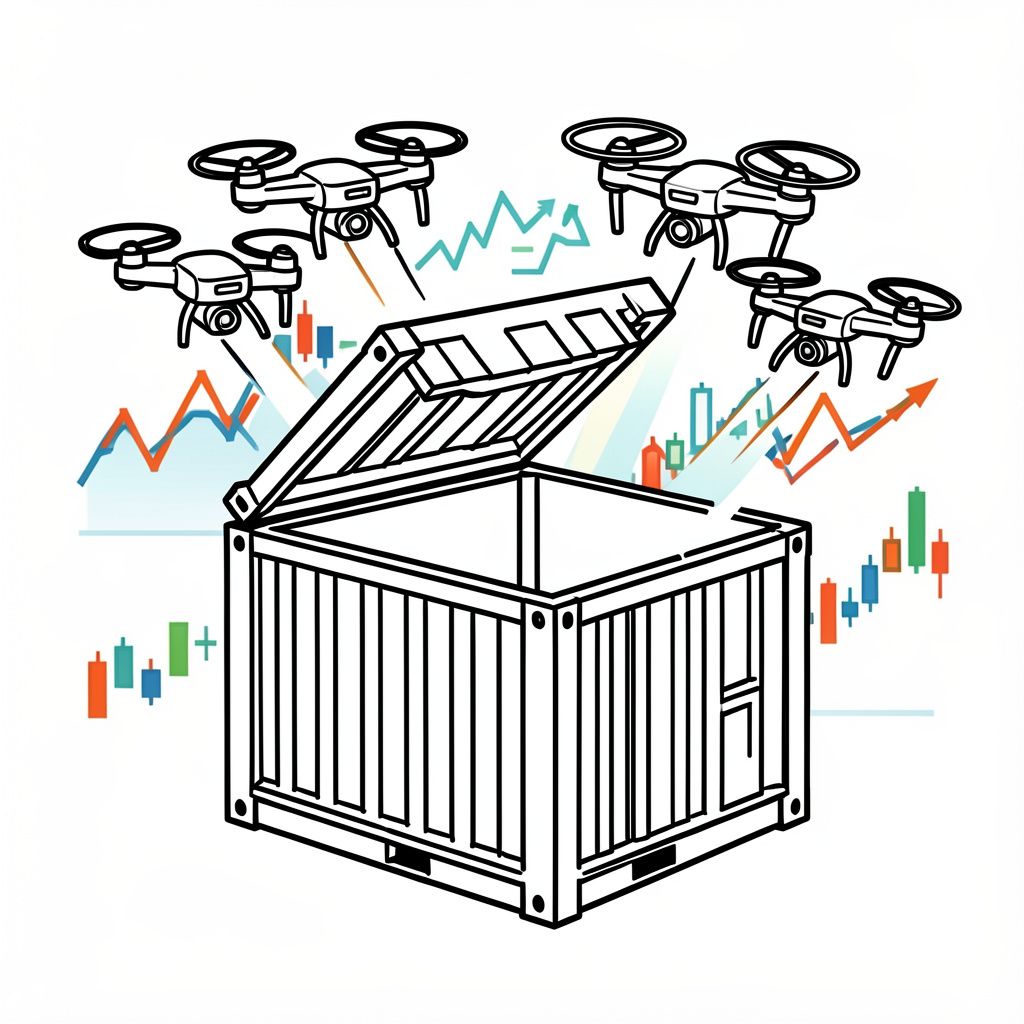
The Nomad 100 system houses four drones per container, including all necessary command, communications, power, and maintenance equipment [1][3]. The platform utilizes MATRIX autonomous technology to combine helicopter hovering capabilities with fixed-wing speed and range [1][2]. The system is designed for shipboard or improvised site operations, supporting intelligence, surveillance, reconnaissance, and targeting (ISR-T) missions [3][4]. This containerized kit is designed to deploy four Nomad 100 uncrewed aircraft from locations with limited infrastructure [3].
Operational Readiness Timelines
Operational specifications indicate that in a planned configuration, two aircraft become available in under 15 minutes [1][2]. The remaining two require 4 to 6 hours for deployment, ensuring sustained operational capacity [1][4]. The total capacity of the system is 4 drones per container [1]. This staggered readiness allows for immediate response capabilities followed by sustained operations [4].
MATRIX Technology and Development
Development of the Nomad 100 was supported by the Defense Advanced Research Projects Agency (DARPA) under the Early VTOL Aircraft Demonstration (EVADE) program [2][4]. A larger version of the Nomad 50, the aircraft completed initial ground and flight testing in July 2026 [2]. Lockheed Martin describes its current autonomy evolution as moving beyond simple concepts to operator-commanded systems that can plan and execute complex operations [1][3]. The Nomad 50 flew for the first time in March 2025 [2].
Strategic Mission Profiles
The system supports multiple mission profiles, including light attack and contested logistics [1][3]. It is capable of runway-independent launch from naval vessels, tactical vehicle staging areas, and improvised landing zones [1][2]. After a mission, the kit can be repacked, loaded onto transport vehicles, and moved to new sites to support follow-on operations [3][4]. The communications, power and sustainment equipment are intended to keep aircraft available with less external support [3].
Leadership Perspective
Rich Benton, vice president and general manager of Sikorsky, stated that military leaders are challenging industry to expand the inventory of uncrewed aircraft [1][3]. He noted that packaging aircraft and sustainment into a single containerized system makes it easier to move and employ VTOL UAS capability with urgency [1][4]. Sikorsky is delivering proven autonomous air capability with speed and scale to deploy systems where they are needed most [1][3]. The system enables rapid relocation to support follow-on operations [1].
Sources
- news.lockheedmartin.com
- aviationweek.com
- defence-industry.eu
- uasweekly.com
- ca.marketscreener.com
- insidedefense.com