Oil Tanker Attack Near Oman Triggers Security Concerns and Rate Spikes
Muscat, Monday, 14 September 2026.
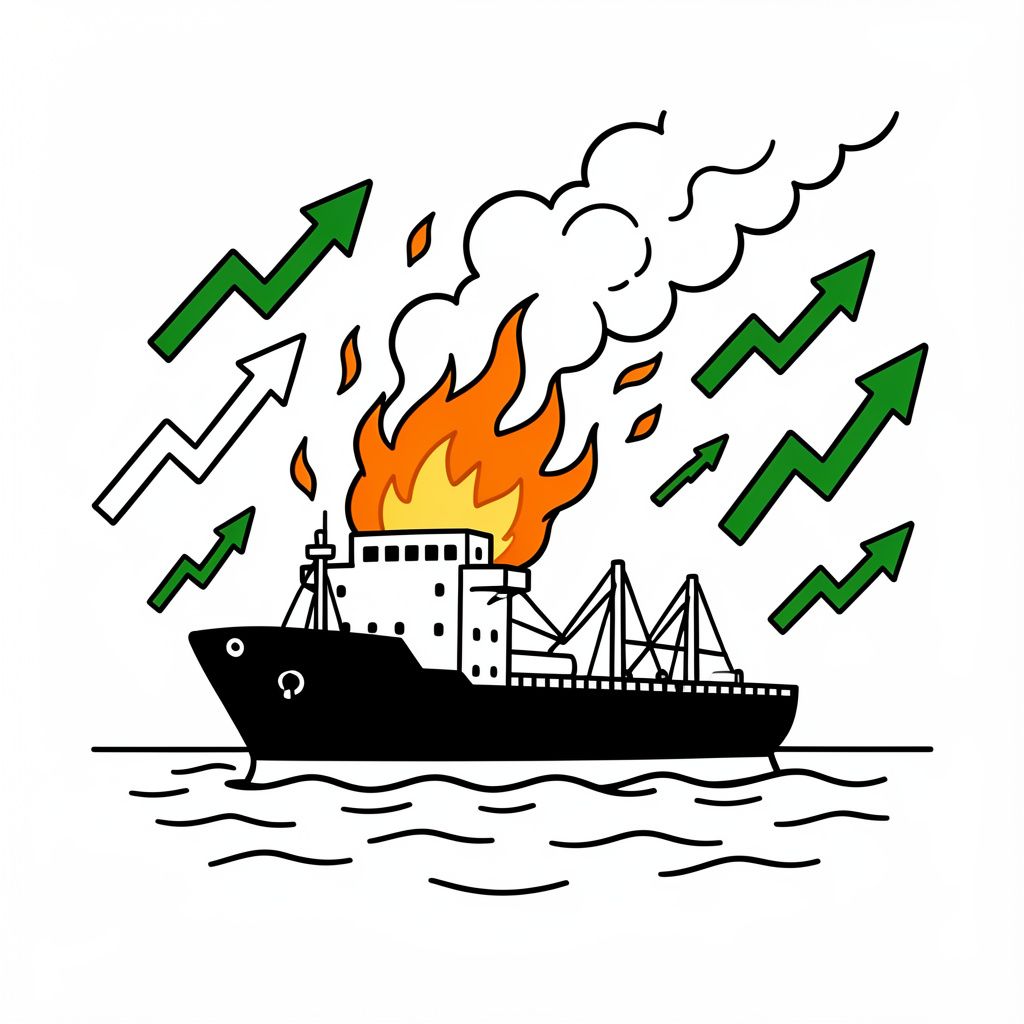
An attack on the tanker MT El Gaia off Oman set the vessel ablaze and pushed Gulf oil shipping costs to a record Worldscale 450.
Incident Overview and Casualty Status
On 13 September 2026, the Panama-flagged tanker MT El Gaia was attacked off the coast of Oman, resulting in a fire and vessel drift [1][3]. Of the 14 Indian crew members on board, 13 have been rescued and shifted ashore, representing 92.857 of the total crew [1][2]. Search and rescue operations continue for the one missing Indian national, coordinated by the Indian Embassy in Oman alongside local authorities [2][4]. The Ministry of External Affairs (MEA) confirmed the incident occurred earlier today relative to their statement on 13 September 2026 [1][2].
Diplomatic Response and Security Concerns
The Government of India has condemned the attack, emphasizing that the targeting of commercial shipping and seafarers is unacceptable [1][2]. Prime Minister Narendra Modi previously stated during the BRICS Summit Business Forum in New Delhi that global trade progress relies on secure sea lanes and safe seafarers [1]. The MEA reiterated the call for an immediate de-escalation of tensions and the pursuance of dialogue to bring peace to the region [2][4]. This incident follows a pattern of maritime insecurity, including the sinking of the Indian-flagged vessel MSV Faize Noore Oliya in the Red Sea off Yemen in August 2026 [1][2].
Market Reaction and Shipping Rates
The security incident has triggered immediate repercussions in global shipping markets, with VLCC Gulf of Oman-China freight rates hitting a record Worldscale 450 [3]. This rate translates to approximately USD 11.50 per barrel, driven by heightened regional security risks [3]. Additionally, the 80,000-mt Vancouver-China Aframax tanker route reached a record-high cost of USD 7.5 million on 10 September 2026, prior to this latest attack [3]. Maritime authorities are advising Masters to treat transit lanes near Qeshm, Hengam, and Musandam as a live threat area until official incident mapping is clarified [3].
Regional Infrastructure and Outlook
Compounding the supply chain risks, Saudi Arabia’s 1,200-km East-West pipeline was temporarily shut down following drone attacks, eliminating a critical crude-routing alternative to the Strait of Hormuz [3]. A planned meeting of Persian Gulf coastal-state foreign ministers to discuss maritime arrangements was postponed at the request of some regional countries, leaving transit authority unsettled [3]. As of 14 September 2026, the situation remains fluid with ongoing search and rescue efforts and heightened threat assumptions across the region [3][4].