Trump’s Washington Facelift: A Political Gamble Amid Economic Storms
Washington D.C., Sunday, 14 June 2026.
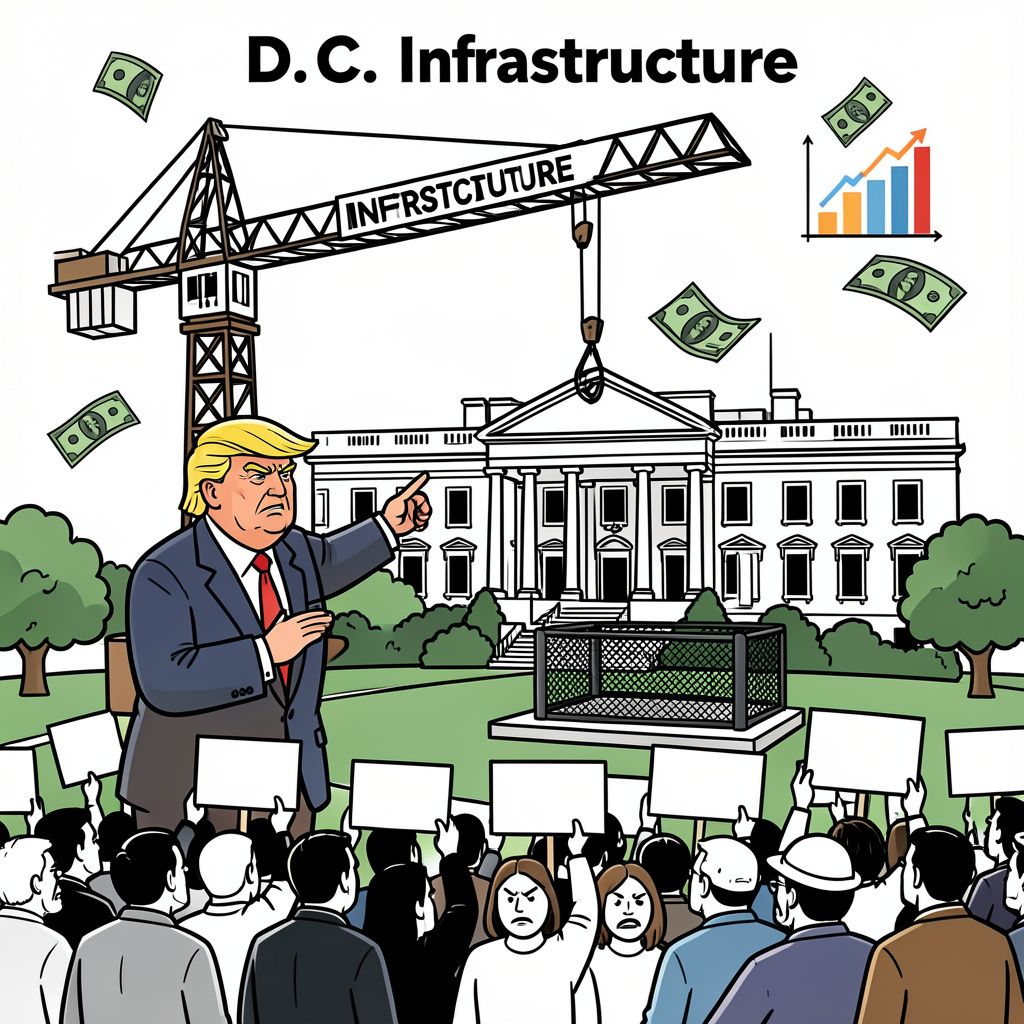
With inflation at a three-year high and approval ratings sinking, Trump is betting big on a $250 million D.C. infrastructure overhaul—including a UFC cage on the White House lawn. But as critics question the timing, a grassroots protest spells out a blunt message: ‘Remove the 47th president.’
A $250 Million Bet on Bricks and Mortar
In a move that has divided Washington, former President Donald Trump (Republican) is pushing forward with an ambitious $250 million infrastructure overhaul in the nation’s capital, even as economic indicators flash warning signs. The Kennedy Center renovation, which includes a two-year closure and a budget approved by Congress in early 2026, is just one facet of a broader initiative to modernize federal buildings and public spaces [1]. The Reflecting Pool resurfacing, repairs to iconic fountains, and the construction of a 250-foot arch near the Lincoln Memorial are all part of what the Trump administration has dubbed ‘Operation Capital Revival’ [1]. While the projects are framed as job creators—with the May 2026 jobs report showing 172,000 new positions added—their timing has raised eyebrows, given the broader economic context [1].
Inflation and Geopolitics Overshadow Infrastructure Push
Trump’s infrastructure gambit unfolds against a backdrop of economic turbulence. The Consumer Price Index (CPI) surged to 6.8% in May 2026, the highest level in three years, driven by soaring energy and housing costs [1]. The inflationary pressures are compounded by geopolitical instability: a conflict with Iran has claimed 13 American lives and sent gas prices above $4 per gallon, while negotiations collapsed on 7 June 2026 after a brief moment of optimism [1]. Critics argue that the administration’s focus on Washington’s aesthetic upgrades—including a planned UFC cage match on the White House South Lawn for Trump’s 14 June 2026 birthday—diverts attention from these pressing national challenges [1]. Trump has defended the troop presence in the Middle East, claiming ‘Operation Epic Fury’ costs ‘very little’ and poses minimal danger to personnel, a statement that has drawn skepticism from military analysts [1].
Approval Ratings Sink as Grassroots Protests Emerge
The infrastructure push comes as Trump’s approval rating hits a nadir. An NBC News poll released on 7 June 2026 shows only 42% of Americans approve of his performance, the lowest of his second term [1]. The discontent is not confined to polling data. Between 8 and 9 June 2026, a grassroots protest materialized on the National Mall, where activists used dead or discolored grass to spell out the numbers ‘86 47’—a slang term for removing the 47th president [2]. The Interior Department has launched an investigation into the incident, which was captured in aerial footage from the Washington Monument [2]. The same number sequence, ‘86 47,’ was previously used in a social media post by former FBI Director James Comey, who has since been charged with making threats against the president, though he denies the allegations [2].
Symbolism vs. Substance: The Political Calculus
Trump’s infrastructure initiative is widely seen as a strategic effort to counterbalance his declining political fortunes. By delivering tangible, visible improvements to the capital, his team aims to project an image of decisive leadership amid economic and international uncertainties [1]. The Kennedy Center renovation, however, has become a flashpoint. On 12 June 2026, spectators gathered outside the venue to cheer as construction crews prepared to remove Trump’s name from the building, a symbolic rebuke to his branding efforts [3]. The $250 million project, initially hailed as a revitalization effort, is now mired in controversy, with critics questioning whether the funds could be better spent addressing inflation, job market instability, or the ongoing geopolitical crisis [1][3].
Economic Impact: Stimulus or Distraction?
Proponents of the infrastructure overhaul argue that the projects will stimulate local job growth and provide a much-needed economic boost to the D.C. metropolitan area. The May 2026 jobs report, which added 172,000 new positions nationwide, suggests a resilient labor market, though the unemployment rate remains undisclosed [1]. Economists are divided on the long-term benefits of the initiative. While some point to the multiplier effect of construction spending—estimating that every dollar invested could generate 1.5 to 2.0 in economic activity—others warn that the focus on Washington’s infrastructure may do little to address the root causes of inflation or the economic anxieties of Americans outside the capital [GPT]. The debate underscores a broader question: Is Trump’s infrastructure push a shrewd political maneuver or a misplaced priority in an era of economic and geopolitical upheaval?