Why More Than Half of Americans Believe the American Dream Is Out of Reach
Washington, Monday, 27 July 2026.
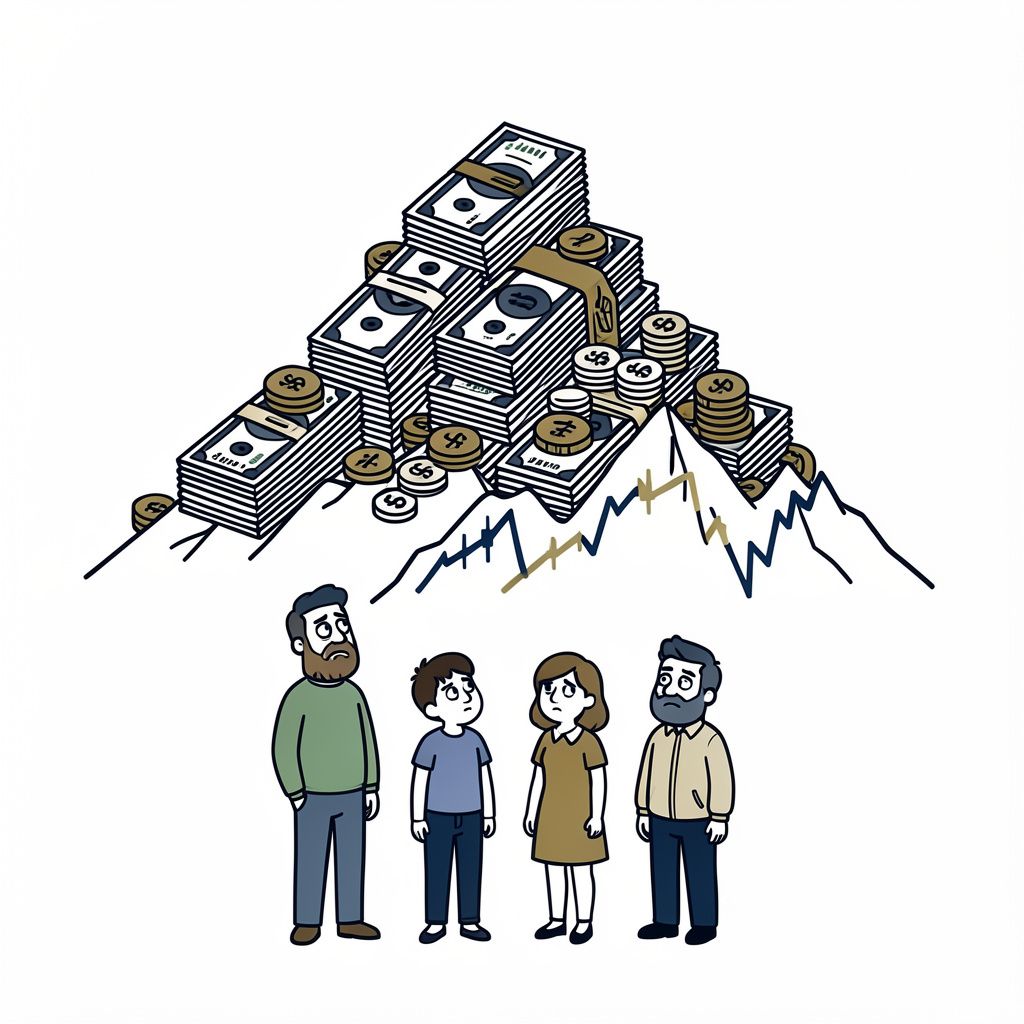
A new national poll reveals 52% of Americans believe the American Dream is unattainable due to soaring living costs, as national pride experiences a sharp year-over-year decline.
Economic Realities and the Strained American Dream
The economic foundations supporting the traditional American Dream are showing severe signs of strain. According to the 4th Annual Heart of America Survey, released on July 27, 2026, by the National Collaborative for Health Equity (NCHE), a striking 52% of Americans now believe the American Dream is completely out of reach [1][3]. This widespread disillusionment is primarily fueled by escalating daily costs, with 81% of respondents identifying the cost of groceries as a major financial pressure, followed closely by concerns over wages at 75%, healthcare at 72%, and housing at 71% [1]. This economic anxiety has directly impacted national pride; only 62% of Americans currently report feeling proud of their nationality, representing a decline of 10 percentage points from the 72% recorded in 2025 [1].
Economic Realities and the Strained American Dream
This financial distress is unfolding against a highly volatile political backdrop. Following the return of Republican Donald Trump to the presidency in 2025, the administration has implemented aggressive economic policies, including the extraction of $165 billion in tariffs from businesses [3]. Analysts at the Yale Budget Lab and the Tax Foundation project these tariffs will ultimately reduce long-term U.S. gross domestic product (GDP) by 0.2% to 0.3% [3]. Furthermore, actual policy implementation has coincided with notable labor market disruptions, including the loss of 108,000 U.S. manufacturing jobs recorded in February 2026, during Trump’s first year back in office [3].
Ambivalent Patriotism and the Battle Over Democratic Ideals
The NCHE survey, conducted alongside Empirica Advisors between May 28 and June 3, 2026, highlights a phenomenon researchers describe as “ambivalent patriotism” [1]. While citizens maintain a strong emotional attachment to the nation’s identity as it celebrates its 250th anniversary in July 2026, only 36% believe the United States is currently delivering on its founding promises of freedom, fairness, and equal opportunity [1][2]. Dr. Gail C. Christopher, Executive Director of the NCHE, noted that while the promise of America endures at this historic 250-year milestone, public confidence in the country’s ability to live up to these ideals is deeply strained [1]. Shannon-Janean Currie, CEO of Empirica Advisors, emphasized that while Americans share a common language around democracy, they no longer share a common lived experience [1].
Ambivalent Patriotism and the Battle Over Democratic Ideals
This disconnect is particularly visible in public attitudes toward civil rights and historic representation. The survey revealed overwhelming support for democratic participation, with 89% of respondents favoring universal voting rights and 92% supporting voting access as a tool for racial healing—an increase of 7 percentage points from the 85% support recorded in 2024 [1]. However, a mere 11% of Americans believe that current congressional voting maps, which are often drawn by partisan state legislatures, provide fair representation [1]. This desire for systemic change is also reflected in growing support for federal reparations, which rose to 56% in 2026 from 46% in 2023, marking an increase of 10 percentage points [1].
Corporate Accommodation and the Cost of Political Instability
The ongoing shift in public sentiment and political governance has also transformed the corporate landscape. Following the January 6, 2021, Capitol riot, the National Association of Manufacturers (NAM), led by President Jay Timmons, strongly condemned the event as “sedition” and “mob rule” [3]. However, since Trump’s return to power in 2025, major corporations such as Caterpillar, T-Mobile, and Altria have transitioned from public opposition to active accommodation, funding the administration’s initiatives [3]. This accommodation occurs alongside unprecedented state interventions, such as US Steel ceding strategic control to the federal government via a “golden share” agreement in June 2025 following its partnership with Nippon Steel [3]. This shifting environment has introduced significant risk, with 43% of U.S. chief executive officers identifying political and economic uncertainty as the primary negative factor clouding their 2026 business outlook [3].
Corporate Accommodation and the Cost of Political Instability
This corporate hesitation persists even as the administration’s allies benefit from new federal policies. Reports from June 30, 2026, revealed that Trump generated at least $2.2 billion in personal income in 2025, with approximately $500 million in no-bid government contracts awarded directly to political allies [3]. Daniella Ballou-Aares, Founder and CEO of the Leadership Now Project, argued that corporate leaders cannot afford to remain passive, stating that the belief that large, influential business actors can stay out of political affairs when democracy is threatened is entirely an illusion [3]. This corporate-political dynamic contrasts sharply with past efforts by nonpartisan and progressive organizations, such as the Congressional Black Caucus Foundation (CBCF), which held its 54th Annual Legislative Conference in September 2025 [4]. Co-chaired by Democratic Senator Angela Alsobrooks and Democratic Representative Joe Neguse, that conference focused on utilizing civic engagement and economic empowerment to secure equal voices in public policy [4].
Educational Shifts and the Path to National Unity
The debate over national identity has also heavily impacted the American educational system. The 2026 NCHE survey found that 92% of Americans support teaching the full scope of U.S. history, including slavery and racism, while 86% believe that educating children about race is vital for national healing, up 7 percentage points from 79% in 2024 [1]. Despite this strong public consensus, state policymakers have enacted highly structured legislative mandates [3]. In June 2026, Iowa’s Republican Governor Kim Reynolds signed legislation mandating specific civics courses for graduation [3]. This policy was implemented after the University of Iowa’s Center of Intellectual Freedom was forced to postpone its spring 2026 classes due to critically low enrollment, recording only two students in its “Political and Economic Institutions” course [3].
Educational Shifts and the Path to National Unity
Despite deep divisions over education, governance, and the economy, Americans still express a strong desire for social cohesion. The NCHE survey indicated that the public’s desire to connect and trust one another rose to 85% in 2026, an increase of 7 percentage points from 78% in 2023, with 59% believing they can personally contribute to national unity [1]. While respondents identified political divisiveness at 52%, racism at 49%, and poverty at 47% as the primary barriers to national unity, many remain optimistic about the future [1]. Looking ahead, a significant portion of the public is focused on upcoming political milestones; approximately 70% of Americans report remaining hopeful that a path toward national reconciliation and healing will begin to materialize following the elections in November 2026 [3].