U.S. Customs Chief Ordered to Testify Over $166 Billion Tariff Refund Delays
Washington D.C., Friday, 29 May 2026.
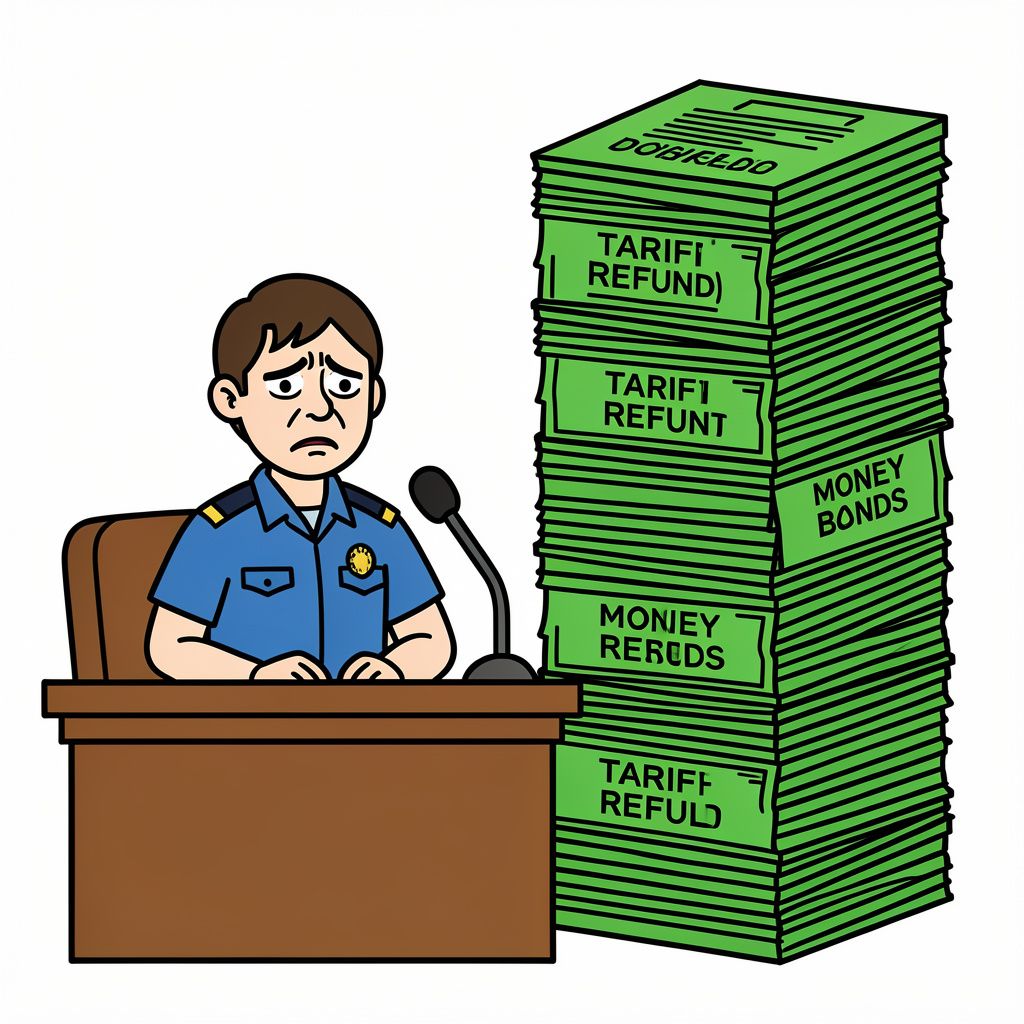
A federal court ordered the U.S. Customs chief to testify on delayed tariff refunds after the agency admitted it can only process $127 billion of the $166 billion owed.
A Judicial Mandate for Transparency
On Wednesday, May 27, 2026, the U.S. Court of International Trade mandated that U.S. Customs and Border Protection (CBP) Commissioner Rodney S. Scott appear in person at a June 9, 2026, hearing in New York [1][2][3]. The court intends to question Scott extensively regarding the agency’s compliance with returning tariff payments to American businesses [1]. This judicial intervention stems from a landmark February 2026 Supreme Court decision that struck down reciprocal tariffs implemented by President Donald Trump, representing the Republican Party [GPT], under the International Emergency Economic Powers Act (IEEPA) [2][4]. The high court ordered the administration to return the collected revenues with interest but left the logistical process up to the government [1][2].
Political Pressures and Refund Mechanics
The logistical challenges of refunding the tariffs are compounded by overt political pressure from the White House. Leading up to the 2026 midterm elections [4], President Trump has actively campaigned against corporations reclaiming their capital, linking compliance with future political favor [1]. In a recent CNBC interview, the President stated, “If they don’t do that, I’ll remember them,” signaling a clear intent to reward companies that abandon their refund applications [1]. Furthermore, Trump took to Truth Social on May 10, 2026, to publicly rebuke Supreme Court Justices Amy Coney Barrett and Neil Gorsuch for their roles in overturning the IEEPA tariffs [4].
Shifting Tariff Authorities and Future Deadlines
As businesses await their capital, the administration is simultaneously pivoting to alternative trade policies to replace the struck-down IEEPA levies. The government implemented a new 10% global tariff in February 2026 under Section 122 of the Trade Act of 1974 [4]. This replacement policy has also faced legal turbulence; however, on May 12, 2026, the U.S. Court of Appeals for the Federal Circuit paused a lower court ruling, thereby restoring the collection of the Section 122 tariff against plaintiffs who had previously won a reprieve [4]. Unless Congress intervenes, this specific tariff is scheduled to expire on July 24, 2026 [4].