Why Recessions Are Necessary for Long-Term Economic Health
Berlin, Thursday, 5 February 2026.
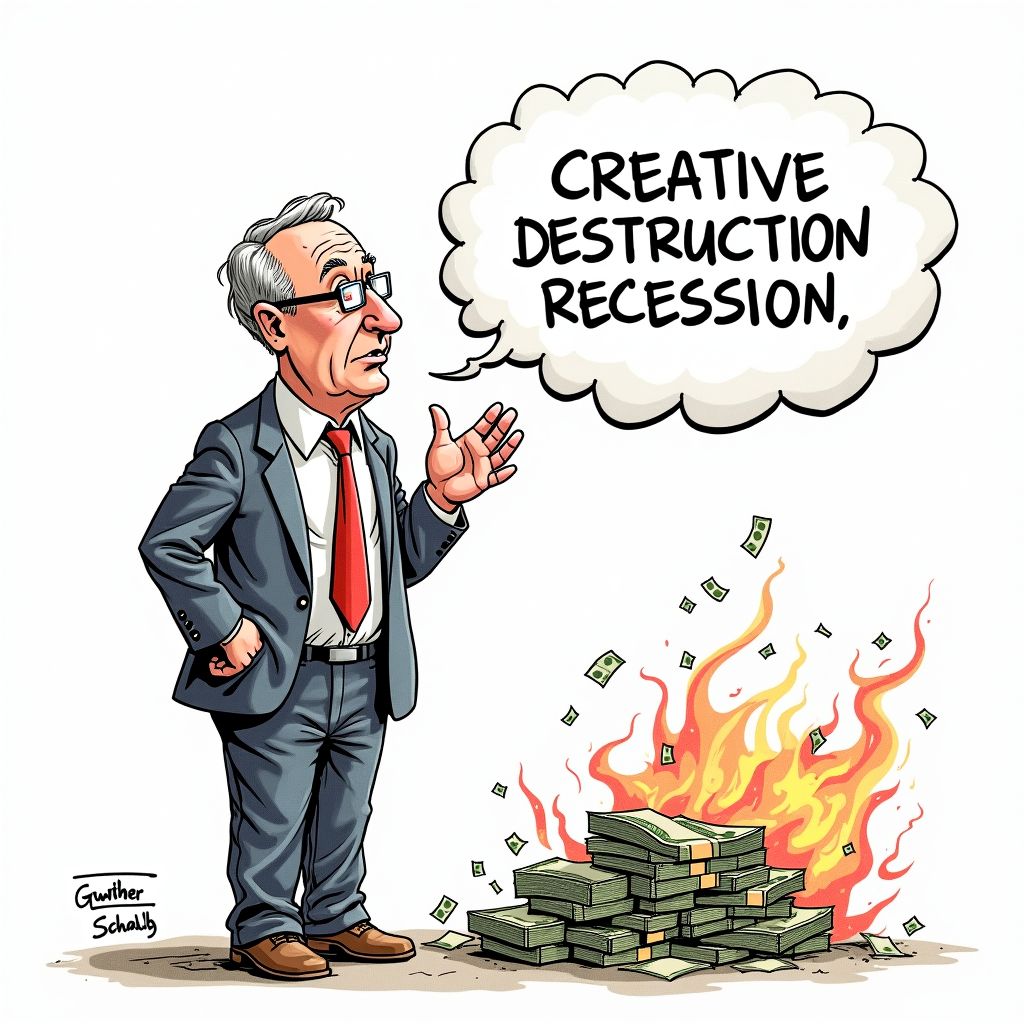
Prominent economist Gunther Schnabl warns that suppressing recessions preserves inefficient “zombie” firms, blocking the essential “creative destruction” needed for true economic innovation and growth.
The Trap of Stability Without Dynamism
In the current economic landscape of February 2026, the prevailing wisdom among advanced economies has been to avert economic downturns at any cost. Gunther Schnabl argues that this strategy, while politically attractive, is a “fatal mistake” that leads to “stability without dynamism” [1]. The core of this issue lies in the survival of “zombie” companies—inefficient firms that, under normal market conditions, would face insolvency. By maintaining these entities through government stimulus and monetary easing, capital is effectively trapped, preventing it from flowing toward more innovative and productive ventures [1]. This suppression of natural market cycles blocks the process of “creative destruction,” a concept championed by Joseph Schumpeter, which posits that the dismantling of old structures is a prerequisite for genuine innovation and growth [1].
European Policy vs. Global Deregulation
The divergence in global economic strategies has become increasingly sharp as of early 2026. In Europe, leaders including Keir Starmer, Emmanuel Macron, and Friedrich Merz have continued to rely on debt-financed government expenditure to combat anemic growth [1]. This approach is bolstered by the Bank of England and the European Central Bank, which have been cutting interest rates since 2024 to stave off contraction [1]. Conversely, other regions are pursuing aggressive deregulation. In Argentina, President Javier Milei is implementing reforms grounded in Austrian economics, focusing on monetary stabilization and the removal of regulatory hurdles [1]. Similarly, in the United States, Donald Trump is pushing for a combination of deregulation and fiscal consolidation, signaling a move away from the interventionist policies that characterize the current European model [1].
Labor Market Signals and Trade Shifts
The ramifications of these macroeconomic shifts are visible in the global labor market. As of today, February 5, 2026, data indicates a massive demand for administrative and financial oversight, arguably a byproduct of complex regulatory environments and economic restructuring. There are currently 294407 combined job openings for Economists and Finance Specialists listed on LinkedIn [2]. Furthermore, the sheer volume of project management roles, standing at 253,048, suggests a heavy emphasis on organizational maintenance over organic entrepreneurial growth in many sectors [2]. Amidst these internal adjustments, international trade dynamics are also evolving; the European Union and India have recently agreed on a free trade agreement, attempting to inject external vitality into the trading bloc [2].
Looking Ahead: The Future of European Cooperation
As policymakers grapple with the tension between stability and innovation, the dialogue on Europe’s economic future continues. Tomorrow, February 6, 2026, Dr. Christiane Liermann Traniello will visit the Friedrich Naumann Foundation for Freedom to discuss the trajectory of German-Italian relations [2]. With Germany and Italy sharing a dense network of economic and cultural ties, this meeting highlights the ongoing effort to find collaborative solutions within the EU [2]. However, Schnabl’s analysis suggests that without a fundamental shift away from recession-avoidance policies—similar to the reforms of Ludwig Erhard in 1948 or Margaret Thatcher in the late 1970s—Europe risks prolonged stagnation while other global powers embrace the volatile but vital process of economic renewal [1].