NTSB Report Reveals Geese Caused Engine Failure on Amazon Cargo Jet
Cincinnati, Saturday, 28 February 2026.
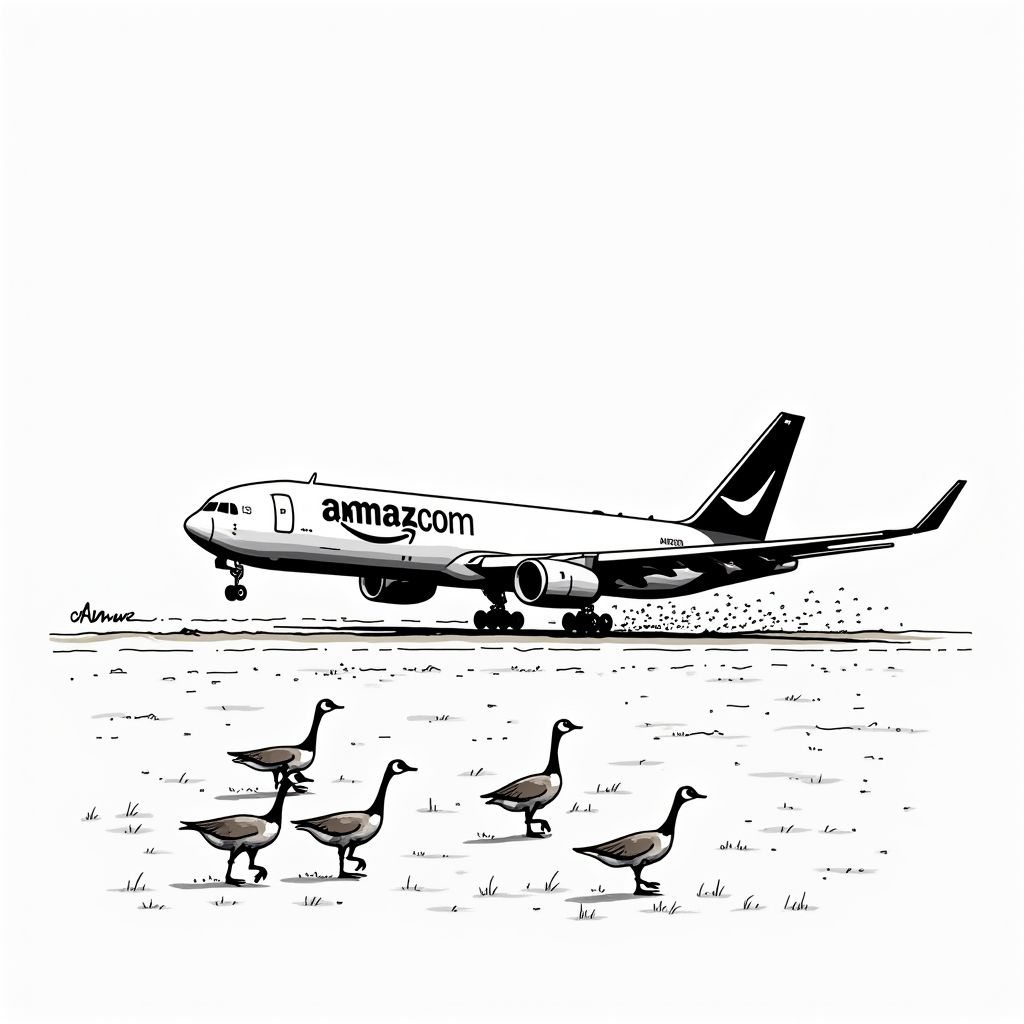
An NTSB report confirms eight Canada geese disabled an engine and filled the cockpit with smoke, forcing an Amazon cargo jet into an emergency landing shortly after takeoff.
Operational Disruption at CVG Hub
The National Transportation Safety Board (NTSB) has released preliminary findings regarding a severe bird strike incident involving an Amazon Air contracted flight operated by Alaska Airlines (ALK) [1][2]. The event, which took place on January 28, 2026, at the Cincinnati/Northern Kentucky International Airport (CVG), highlights the vulnerability of critical logistics aircraft to environmental hazards during takeoff phases [2][4]. The Airbus A330-300, designated as Alaska Airlines flight 2616, departed at 15:05 local time bound for George Bush Intercontinental Airport in Houston before encountering a flock of Canada geese during its initial climb [4].
Critical Systems Failure and Crew Response
According to the NTSB report released this week, the flight crew encountered the wildlife hazard at an altitude between 274.32 and 304.8 meters [3]. The captain, acting as the pilot monitoring, visually identified the flock and called out “birds” moments before the crew felt multiple impacts on both the left and right sides of the airframe [1][8]. The collision resulted in immediate mechanical distress, triggering “ENG 1 FAULT” and “ENG 1 FAIL” warnings on the Electronic Centralized Aircraft Monitor (ECAM), indicating a failure of the left engine [2]. In a recording of the incident, a pilot can be heard stating, “Left engine, we took a bird intake, we just want to come back and land” [4].
Assessment of Structural Impact
Post-accident inspections conducted by airport rescue and firefighting personnel revealed significant damage across the aircraft’s structure. Investigators recovered the remains of eight Canada geese from the scene [1][2]. The left engine sustained substantial damage, with the fan described as “visibly misaligned” and showing restricted rotation [1][8]. Evidence of bird ingestion was found in both engines, with additional damage noted on the right engine’s inlet cowl acoustic liner, spinner, and exhaust nozzle [2]. The biological debris extended beyond the propulsion systems, impacting the left main landing gear, left-wing flap, and right-wing slat [2][5].
Recurring Environmental Hazards
This report coincides with a broader pattern of environmental risks facing Alaska Airlines’ cargo operations. Just days ago, on February 26, 2026, another Alaska Airlines freighter—a Boeing 737-900—was forced to return to Ted Stevens Anchorage International Airport following a separate bird strike involving geese [3]. That flight, carrying a full load of cargo and nine crew members, also landed safely despite ingesting birds into at least one engine [3]. While the NTSB investigation into the CVG incident remains ongoing with a final report expected in several months [5], these consecutive events underscore the persistent challenge of wildlife management in aviation logistics.