Trump Administration Unveils $12 Billion Farm Aid Package to Mitigate Trade Losses
Washington, Friday, 12 December 2025.
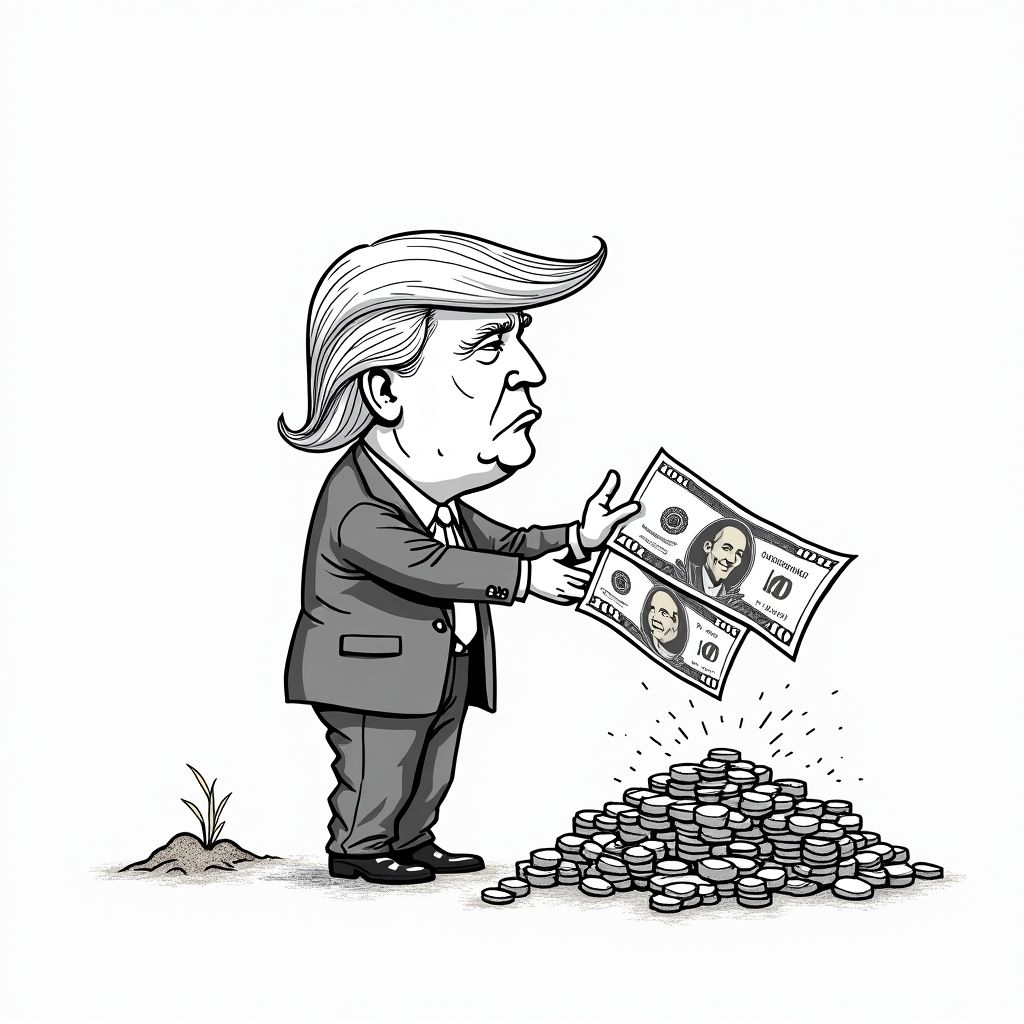
While President Trump dismisses the affordability crisis as a “hoax,” his administration unveiled a $12 billion farm bailout that producers characterize as a mere “garden hose” fighting an economic “inferno.”
Analyzing the Fiscal Stopgap
On Monday, December 8, 2025, the U.S. Department of Agriculture (USDA) released the specific parameters of the administration’s latest fiscal intervention: a $12 billion support package designated as the Farmer Bridge Assistance (FBA) program [2][8]. The structure of this capital injection is heavily weighted toward major commodities, with $11 billion allocated to row crop producers—including corn, soybeans, and wheat—while a significantly smaller tranche of $1 billion is reserved for specialty crop growers [2][6]. Livestock producers are notably excluded from this specific relief mechanism [2]. While the administration frames this as a necessary measure to stabilize the sector, the financial reality for producers is stark; the $12 billion package arrives against a backdrop of estimated losses for nine major commodity crops ranging between $35 billion and $44 billion in 2025 alone [4]. Consequently, the aid covers only a fraction of the sector’s deficit, a disparity that led Doug Sombke, president of the South Dakota Farmers Union, to vividly describe the measure as trying to put out an “inferno” with a “garden hose” [3].
The High Cost of Trade and Tariffs
The economic pressure on the agricultural sector is not merely a function of market cycles but is deeply intertwined with trade policy and inflationary pressures. Data from North Dakota State University’s Agricultural Trade Monitor indicates that tariffs on imported machinery, seeds, and fertilizer—currently sitting at 9%—are costing U.S. farmers approximately $33 billion [6]. When weighed against the new aid package, the federal relief effectively offsets just over one-third of these specific tariff-induced costs 36.364 percent. This imbalance has drawn criticism from economists like Ryan Loy of the University of Arkansas, who characterized the funds as a “Band-Aid on a bigger wound” [6]. Furthermore, the trade war with China has fundamentally altered export dynamics; while a new trade deal was struck in November 2025, China has shifted significant purchasing volume to Brazil [3]. Although Beijing has committed to purchasing 12 million metric tons of American soybeans by February 2026, this follows a period where the Asian superpower had halted purchases, leaving domestic stockpiles high and prices depressed [3][4].
Operational Timelines and Future Legislation
For producers seeking liquidity, the administrative timeline for this capital infusion is tight. Farmers are required to verify their 2025 acreage reporting by 17:00 on December 19, 2025, a deadline less than a week away [2][8]. Despite the immediate application window, actual disbursements are not scheduled to reach bank accounts until February 28, 2026 [2]. Agriculture Secretary Brooke Rollins has described this funding as a “bridge” intended to sustain operations until more comprehensive legislative changes take effect [4]. This refers to the “One Big Beautiful Bill Act,” a spending package scheduled for implementation in October 2026, which promises to increase commodity reference prices by 10% to 21% [4]. Until that long-term structural adjustment occurs, the sector remains in a precarious position; the American Bankers Association anticipates that fewer than half of farm borrowers will be profitable in 2026 [4]. In Iowa, a key agricultural hub, farm income for 2026 is projected to be 37% lower than 2022 levels, underscoring the severity of the downturn [7].
Sources
- www.npr.org
- www.hklaw.com
- www.npr.org
- www.reuters.com
- www.cnbc.com
- fortune.com
- www.desmoinesregister.com
- www.farmprogress.com