China Looks to Lunar New Year Festivities to Jumpstart Consumer Economy
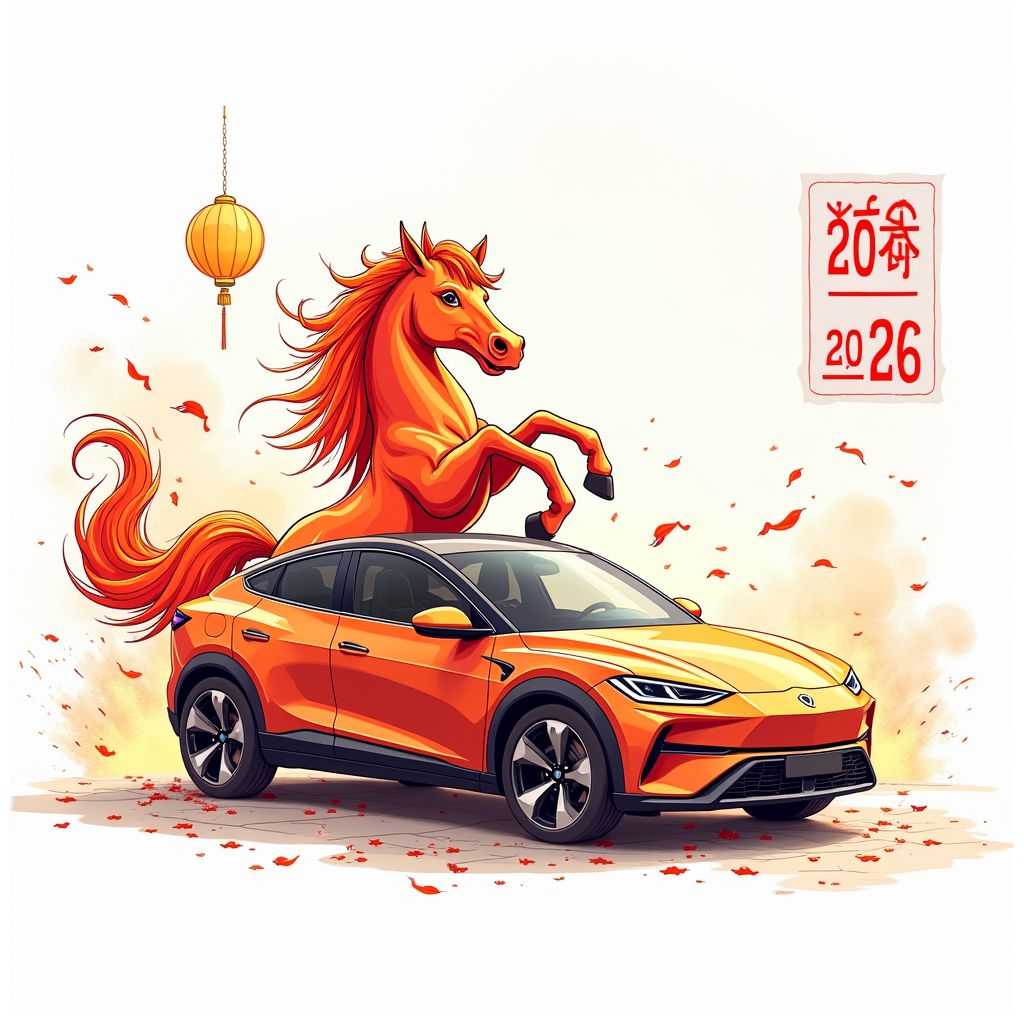
Beijing, Tuesday, 17 February 2026.
As the Lunar New Year commences on February 17, 2026, Beijing is leveraging the “Year of the Fire Horse” to revitalize domestic consumption amidst mixed economic signals. While authorities have deployed over 360 million yuan in consumer vouchers and project a record 9.5 billion passenger trips, early 2026 data suggests lingering caution. Notably, retail sales for New Energy Vehicles fell 20% in January—the first year-over-year decline since 2024—while Tesla saw a dramatic 45% sales crash as local competitors like Xiaomi gain ground. Markets are now watching to see if the holiday’s traditional surge in mobility can overcome these structural headwinds and catalyze the sustained recovery policymakers envision for the upcoming 15th Five-Year Plan.
Symbolism Meets Economic Reality
As the Year of the Fire Horse begins, a zodiac sign traditionally associated with energy, volatility, and forward movement [1][3], Beijing is attempting to harness this cultural dynamism to fuel a consumption recovery. The stakes are high for the 15-day celebration [1], with the government projecting a massive surge in mobility; authorities anticipate 9.5 billion passenger trips during the 40-day Spring Festival period, an increase of approximately 5.556% from the 9 billion trips recorded in 2025 [2]. To ensure this movement translates into spending, the government issued over 360 million yuan ($52 million) in consumer vouchers in January 2026 [2]. However, this liquidity injection faces a complex backdrop: while China closed 2025 with 5% GDP growth, domestic demand has shown persistent weakness, prompting a strategic pivot in economic policy toward consumption and clean energy sectors [3].
A Stumble in the Auto Sector
Despite the festive optimism, the automotive sector—often a bellwether for consumer confidence—started 2026 on shaky ground. In January, retail sales of New Energy Vehicles (NEVs) dropped to 596,000 units, marking a 20% year-over-year decline and the first such dip since March 2024 [4]. This contraction was largely driven by policy shifts; the expiration of full tax exemptions replaced by a 5% purchase tax, alongside the end of trade-in subsidies, dampened buyer enthusiasm [4]. While battery electric vehicle (BEV) sales slumped 17%, the industry found a silver lining in international trade, with exports of passenger NEVs more than doubling year-over-year [4]. This divergence highlights a critical imbalance: Chinese manufacturers are increasingly relying on external markets as domestic consumption struggles to gain traction.
Tesla’s Market Share Under Siege
The competitive landscape within China’s EV market is shifting rapidly, with foreign incumbents facing intensifying pressure from domestic rivals. Tesla, specifically, experienced a severe contraction in January 2026, with domestic sales crashing 45% year-over-year to just 18,485 units—the lowest level in over three years [8]. This decline follows a challenging 2025, where Tesla’s market share eroded from 10% to 8% [8]. Compounding these financial headwinds is a shift in public sentiment; state media outlet China.com recently amplified a viral report regarding a Tesla Model Y power failure, signaling a potential hardening of Beijing’s stance toward the American automaker [8]. Concurrently, local competitors are surging ahead; Xiaomi’s SU7 delivered 258,164 units in 2025, outselling the Tesla Model 3 by nearly 30% [8].
Strategic Priorities for the Year Ahead
Looking beyond the holiday period, investors are closely monitoring the rollout of China’s 15th Five-Year Plan, scheduled for launch in 2026, which is expected to formalize the country’s next developmental stage [3]. Financial institutions like Fidelity International suggest that as these policies translate into tangible actions, sectors focused on technology and innovation—such as robotics and autonomous driving—may offer renewed opportunities [3]. Furthermore, structural reforms aimed at capital market liberalization and the continued internationalization of the renminbi are seen by strategists as potential tailwinds for the economy [3]. As the festivities conclude and the Year of the Fire Horse unfolds, the durability of this recovery will depend on whether the current burst of travel and policy support can overcome the structural caution evident in the January data.