Industrial Automation Shifts as Humanoid Robots Enter Commercial Production
Austin, Monday, 16 November 2026.
Tesla and Amazon are rapidly advancing factory humanoid deployment, moving beyond experimental trials as Agility Robotics secures over $300 million in commercial orders, signaling profound shifts for industrial labor.
From Fiction to Factory Floor: The Humanoid Robot Revolution
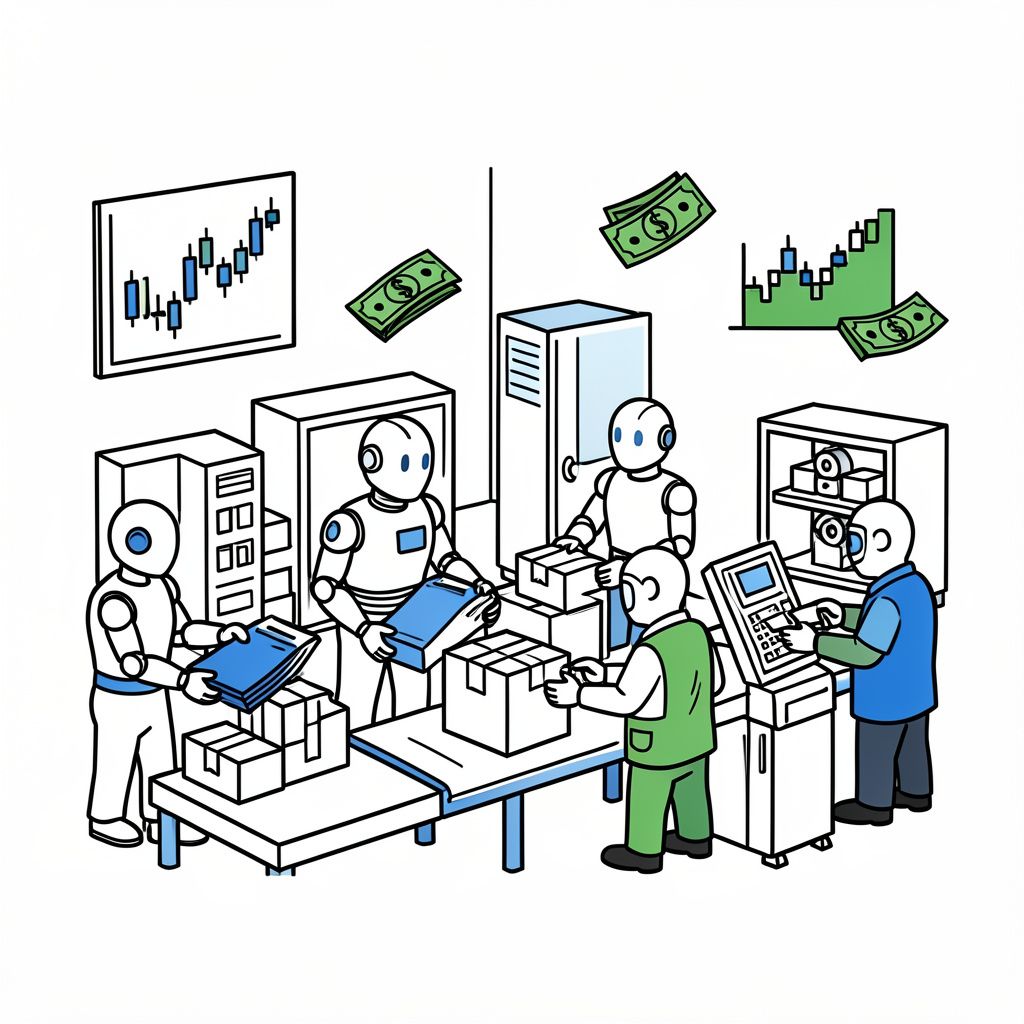
The concept of humanoid laborers that never tire or demand wages—a theme first explored in Karel Čapek’s 1921 play *R.U.R. (Rossum’s Universal Robots)*—is now transitioning from science fiction to industrial reality. As Tesla (NASDAQ: TSLA) initiates early manufacturing of its Optimus humanoid robot and Amazon (NASDAQ: AMZN) deepens its collaboration with Agility Robotics, corporations are poised to redefine factory and warehouse operations through autonomous, non-wage workforces. Čapek’s vision of robotic ‘serfs’—as described by Alisa Zhulina, associate professor of theatre studies at New York University—has evolved into a 21st-century economic experiment that could reshape labor markets globally [1].
Amazon’s Strategic Bet on Humanoid Logistics
Amazon’s long-standing relationship with robotic automation has reached a new milestone with its investment in Agility Robotics’ Digit humanoid robot. Following the company’s acquisition of Kiva Systems in 2012 and the deployment of its 1 millionth warehouse robot by mid-2025, Amazon began testing Digit in operational environments as early as October 2023 [1][GPT]. By November 2026, Agility Robotics had completed a SPAC merger with Churchill Capital Corp XI, listing on Nasdaq and securing over $300 million in multi-year orders from Amazon, GXO Logistics, Schaeffler, and Toyota’s Canadian manufacturing arm [1]. Xavier Van Chau, Amazon’s spokesperson for AI and robotics, emphasized the company’s commitment to advancing physical AI systems capable of processing real-time data for split-second operational decisions [1].
Tesla’s Optimus Enters Early Production Amid Factory Restructuring
Tesla has begun early production of its Optimus humanoid robot at its Fremont, California facility, repurposing a former car manufacturing line to accommodate the new technology. The company described these units as ‘the first production-quality bots’ manufactured to date, signaling a strategic pivot from automotive manufacturing toward humanoid robotics [5]. Elon Musk has indicated that scaling production to 1 million units annually could take ‘a year, maybe longer,’ with current targets set at 20,000 units per week. Initial manufacturing costs are projected to decline from $30,000 to $20,000 per unit, though these figures remain unconfirmed [5]. External deliveries of Optimus to commercial customers are planned for late 2027, positioning Tesla at the forefront of industrial humanoid deployment [5][4].
Robotics Experts Weigh In: Innovation vs. Practicality
While Tesla’s rapid iteration on Optimus has impressed some industry observers, robotics experts remain divided on the robot’s technological maturity and commercial feasibility. Georgia Chalvatzaki of Technische Universität Darmstadt noted that while the engineering velocity was commendable, the demonstrated behaviors lagged behind legacy systems like Honda’s Asimo from two decades prior [6]. Ryan Gariepy, CTO of Clearpath Robotics, acknowledged the team’s engineering prowess but questioned the lack of novelty compared to established competitors such as Boston Dynamics [6]. Cynthia Yeung of MIT Media Lab highlighted skepticism around Tesla’s claim of a 2.3 kWh battery powering Optimus for a full day, comparing it unfavorably to Agility Robotics’ Digit, which operates for only 3 hours on similar tasks [6].
Macroeconomic Implications: Productivity Gains and Labor Disruption
The accelerated deployment of humanoid robots by industry titans raises critical questions about long-term labor market dynamics. Erica Groshen, senior economics advisor at Cornell University’s ILR School and former commissioner of the Bureau of Labor Statistics, cautioned that automation could exacerbate economic inequality by concentrating capital ownership and taxable gains among ‘owners of capital,’ leaving displaced workers without compensatory mechanisms [1]. Groshen also noted that while advanced robotics may increase productivity, gaps in adjustment pathways—such as retraining programs or social safety nets—could hinder societal adaptation [1]. Chase Kaniecki, a partner at Cleary Gottlieb, echoed concerns about national security risks associated with foreign-produced humanoid robots, citing China’s dominance in global humanoid manufacturing as a primary driver behind the U.S. Federal Communications Commission’s decision to block certain imports under national security grounds [1].
Global Competitive Landscape: China’s Dominance in Humanoid Production
Despite U.S. advancements, China remains the dominant force in global humanoid robotics production. In the first half of 2026, Chinese manufacturers shipped over 97% of the world’s humanoid robots, with 69% of these units deployed in research, education, exhibitions, and government data centers according to IDC data [1]. This concentration underscores the geopolitical dimensions of the humanoid robotics race, particularly as nations seek to onshore critical supply chains to qualify for domestic production incentives [1]. Meanwhile, U.S.-based initiatives like Tesla’s Optimus and Amazon’s Digit are positioned to capture industrial automation markets, though their long-term competitiveness hinges on overcoming technical and regulatory hurdles [5][1].
Future Outlook: A Workforce Transformed by 2030
Looking ahead, Tesla and Amazon are laying the groundwork for a transformative shift in industrial labor. Tesla’s planned Fremont facility aims for 1 million Optimus units annually, while Amazon’s internal projections suggest its automation efforts could avoid hiring over 600,000 U.S. workers by 2033—assuming current deployment timelines hold [5][1]. Alisa Zhulina’s characterization of Čapek’s robots as ‘serfs’ underscores the historical echoes of this transition, though Groshen emphasized that policy responses—such as taxing capital gains from automation—could mitigate adverse labor market effects [1]. As OpenAI integrates its robotics team into core AI research and targets a humanoid demo for 2027, the convergence of advanced AI models and physical robotics signals an impending leap in autonomous system capabilities [1][alert! ‘OpenAI’s 2027 demo is not yet confirmed’].