Trump Labels UK's Chagos Islands Transfer an Act of Total Weakness
Washington, Tuesday, 20 January 2026.
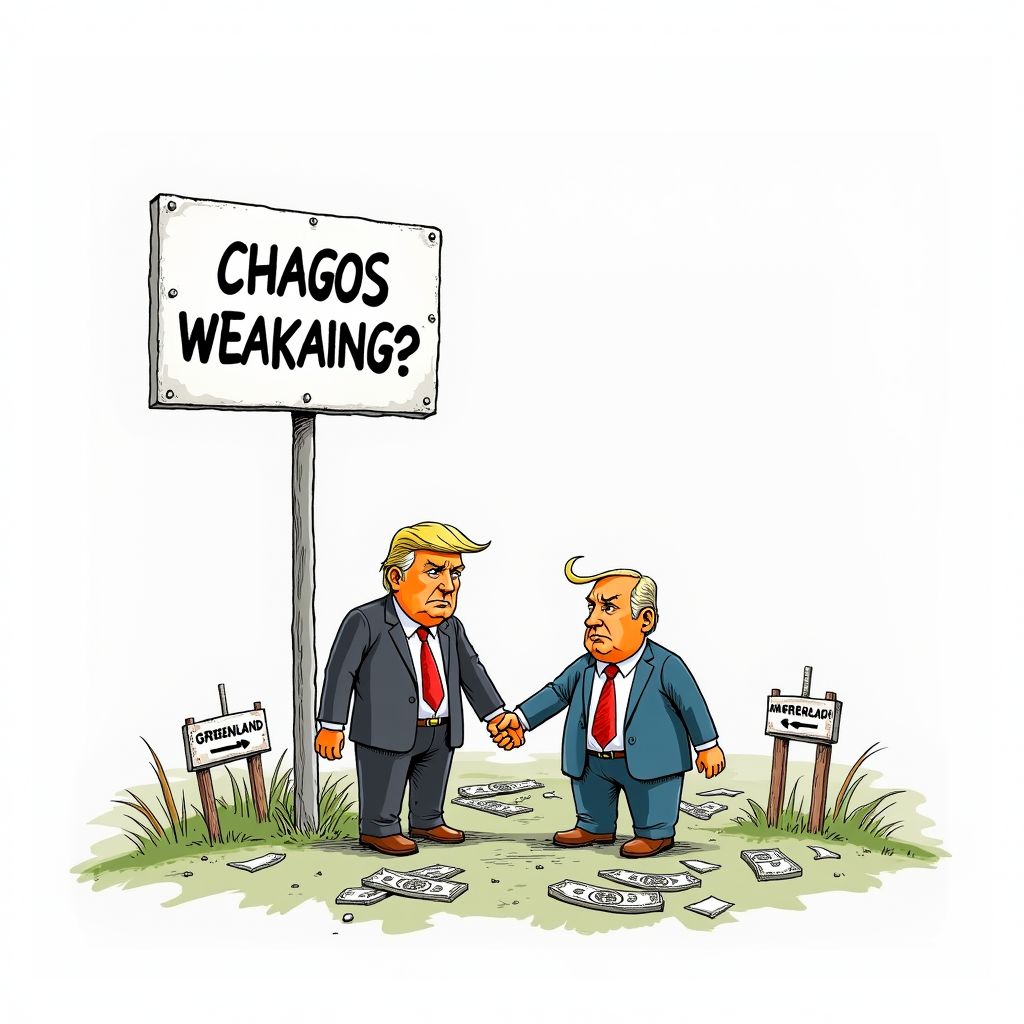
President Trump has condemned the UK’s £3.4 billion Chagos transfer as “great stupidity,” explicitly citing this perceived weakness to justify his controversial ambition to acquire Greenland for national security.
Diplomatic Fissures and Fiscal Realities
On Tuesday, January 20, 2026, the trans-Atlantic relationship faced a sudden stress test as President Donald Trump publicly lambasted the British government’s agreement to transfer sovereignty of the Chagos Archipelago to Mauritius [1][2]. Writing on social media, the President characterized the deal—which involves a 99-year leaseback of the strategic Diego Garcia military base—as an “act of total weakness” and “great stupidity” [2][5]. This rhetorical pivot marks a significant departure from the diplomatic landscape of May 2025, when the Trump administration, through Secretary of State Marco Rubio, had reportedly “welcomed” the agreement as a “monumental achievement” [3][6]. The deal, designed to resolve decades of legal uncertainty surrounding the British Indian Ocean Territory, requires the United Kingdom to pay Mauritius £101 million annually [6]. Over the duration of the agreement, the total financial commitment is estimated at £3.4 billion [5][6].
A Reversal of Geopolitical Fortune
The President’s intervention has injected volatility into what British officials viewed as a settled matter of international law and national security. While Downing Street maintains that the treaty is a “legal necessity” to secure the base’s operation for the next century following adverse international court rulings, President Trump now asserts the transfer is being done “for no reason whatsoever” [2][4]. He argued on Tuesday that the move signals vulnerability to global rivals, stating, “There is no doubt that China and Russia have noticed this act of total weakness” [1]. This stance contradicts the assessment provided by U.K. Cabinet Minister Darren Jones, who defended the treaty on January 19 as the “right way to secure the future of the island” in an increasingly volatile geopolitical climate [3][6]. The British government insists the deal provides “very important security guarantees” regarding the base, which houses approximately 2,500 personnel and serves as a critical platform for U.S. operations in the Indian Ocean [1][3][7].
Domestic Fallout and the Greenland Connection
The President’s criticism has immediately reverberated through Britain’s domestic political landscape, emboldening opposition figures. On January 19, Conservative MP Andrew Rosindell defected to Reform UK, explicitly citing the government’s failure to “stand up” for the Chagos Islands as a primary factor in his decision [4]. Reform UK leader Nigel Farage praised Trump’s intervention, claiming the President has effectively “vetoed the surrender” of the territory [1][6]. Meanwhile, Conservative leader Kemi Badenoch aligned herself with the President’s assessment, labeling the deal “complete self sabotage” [2][5]. President Trump has explicitly linked this perceived British weakness to his renewed ambition to acquire Greenland, arguing that the Chagos transfer illustrates why the U.S. must expand its own territorial holdings for national security [2][7]. This escalation follows a weekend of tension where thousands of Greenlanders protested against takeover attempts between January 17 and 18, and U.K. Prime Minister Keir Starmer rejected the Greenland acquisition idea as “completely wrong” on January 18 [1][7].
Sources
- apnews.com
- www.reuters.com
- www.bbc.com
- www.theguardian.com
- www.reuters.com
- www.bbc.com
- www.euronews.com