World Cup Protests Expose Iran’s Political Divide in Los Angeles
Los Angeles, Tuesday, 16 June 2026.
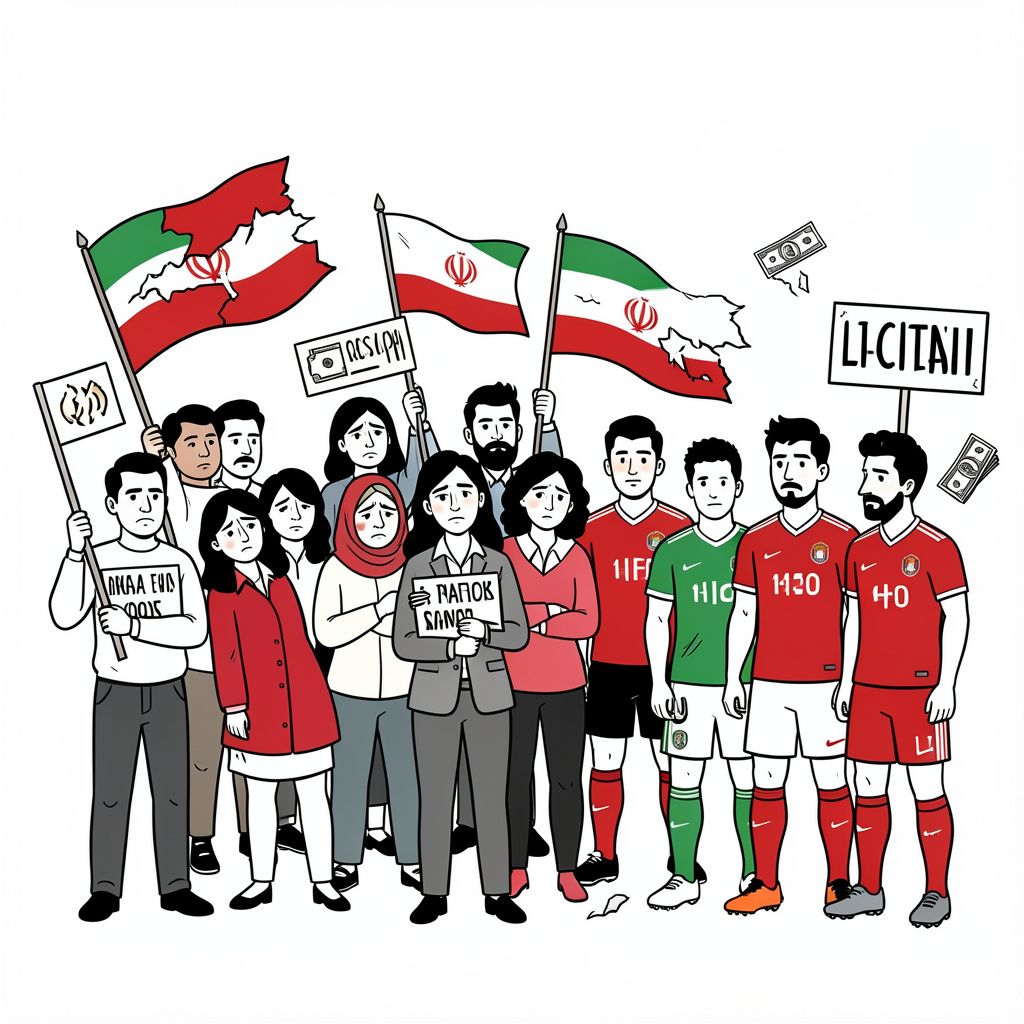
Over 200 Iranian-Americans protested Iran’s World Cup debut, chanting ‘My real footballers are in prison’—a stark contrast to the team’s arrival in the U.S. The demonstrations, marked by desecrated flags and calls for regime change, revealed deep fractures in diaspora identity. With 11 Iranian delegates denied entry and stadiums bracing for anti-regime symbols, the match became a battleground for politics, not just sport. The protests underscore how Iran’s repression and regional conflicts now play out on global stages, even as fans grapple with divided loyalties.
A Stadium Divided: Protests and Pride Collide
On 14 June 2026, outside the SoFi Stadium in Inglewood, Los Angeles, over 200 Iranian-Americans gathered to protest Iran’s World Cup debut against New Zealand [1]. The demonstration, held as Iran’s national football team arrived in the United States, transformed the sporting event into a political battleground. Protesters chanted ‘Democracy for Iran, alternatives for Iran’ and held signs reading ‘My real footballers are in prison,’ a direct reference to imprisoned activists and athletes in Iran [1]. The stark contrast between the celebratory atmosphere of the World Cup and the somber political messaging underscored the deep fractures within the Iranian diaspora, where support for the national team is increasingly complicated by disillusionment with the regime [2].
Symbols of Defiance: Flags, Slogans, and Identity
The protests were marked by symbolic acts of defiance. Demonstrators desecrated both the current Iranian flag and the pre-revolutionary flag, reflecting a rejection of both the Islamic Republic and the monarchy that preceded it [1]. Some protesters wore MAGA-style caps emblazoned with ‘Make Iran Great Again’ (MIGA), a slogan that echoed the political rhetoric of former U.S. President Donald Trump [1]. Others wore shirts and jewelry bearing the faces of victims of Iran’s political repression and regional conflicts, turning the protest into a memorial for those lost to state violence [1]. The display of anti-regime flags was anticipated inside the stadium as well, with reports indicating that spectators planned to bring similar symbols of dissent into the match [4].
Voices from the Diaspora: Anger, Fear, and Hope
Interviews with protesters revealed a complex mix of emotions. Maryam, a demonstrator who declined to provide her full name for safety reasons, expressed her anger and frustration: ‘Estoy enfadada… Ese no es mi equipo. No es mi selección. Mis verdaderos futbolistas están en la cárcel. O quizá muertos…’ (‘I’m angry… That’s not my team. It’s not my national team. My real footballers are in prison. Or maybe dead…’) [1]. Her words captured the sentiment of many in the diaspora who feel disconnected from a team representing a regime they oppose. Maryam also highlighted the personal risks of returning to Iran, stating, ‘No puedo [regresar a Irán], sería muy peligroso’ (‘I can’t [return to Iran], it would be very dangerous’) [1]. Another protester, Mahtab, described the experience as ‘una sensación agridulce’ (‘a bittersweet feeling’), reflecting the conflicted emotions of supporting a national team while condemning the government it represents [1].
The Team’s Arrival: A Microcosm of Geopolitical Tensions
Iran’s national team arrived in the United States under a cloud of controversy. Eleven members of Iran’s delegation were denied entry into the U.S., a decision that heightened tensions ahead of the match [4]. The team’s captain acknowledged the somber mood surrounding the tournament, stating that the World Cup experience was overshadowed by the ongoing tensions between Iran and the United States [1]. The protests in Los Angeles were not isolated incidents; similar demonstrations were expected in other cities with significant Iranian diaspora populations, including Toronto and London [GPT]. The team’s presence in the U.S. also coincided with the announcement of a peace agreement between Iran and the U.S. on 14 June 2026, a development that protesters viewed with cautious optimism but also skepticism, particularly regarding the role of former President Trump [1].
The Global Stage: How Sports and Politics Intersect
The protests in Los Angeles highlighted the broader global impact of Iran’s domestic and foreign policies. The World Cup, a event meant to unite nations through sport, instead became a platform for political expression. The Iranian embassy in New Zealand further fueled controversy by publishing a Lego animation on its social media page ahead of the match, which generated widespread reactions and criticism [6]. The animation, perceived by some as a propaganda tool, added another layer of complexity to the narrative surrounding Iran’s participation in the tournament [6]. Meanwhile, the U.S. government’s decision to deny entry to 11 members of Iran’s delegation underscored the ongoing geopolitical strains between the two nations, even as diplomatic efforts appeared to make progress [4]. The protests served as a reminder that for the Iranian diaspora, the World Cup was never just about football—it was about justice, identity, and the future of their homeland.