Stiglitz Warns Blue-Collar Job Crisis Will Deepen Despite Policy Interventions
Washington D.C., Saturday, 21 February 2026.
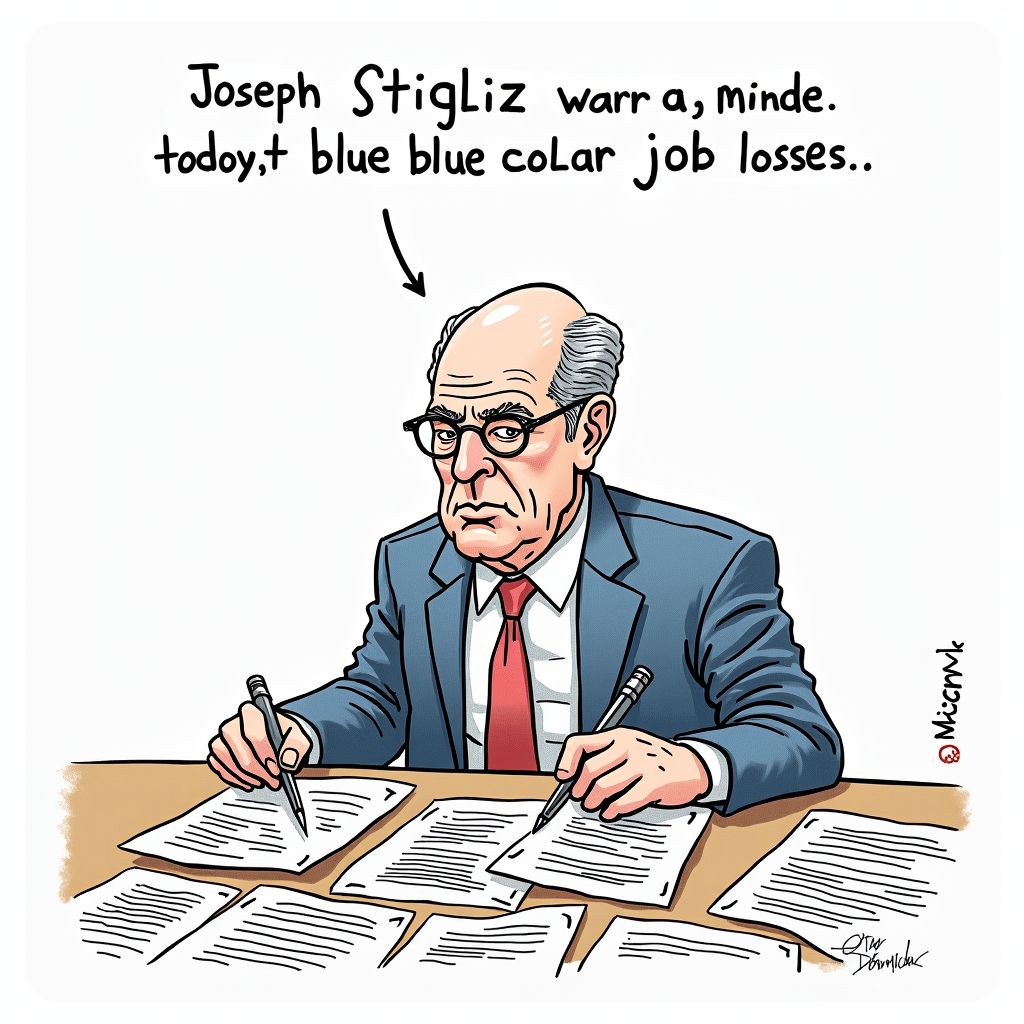
Citing a loss of 166,000 blue-collar jobs over the last year, Nobel laureate Joseph Stiglitz warns the economy will deteriorate further as tariffs fail to counter the impact of automation.
Structural Shifts and Policy Misalignments
Speaking to CNBC on February 19, 2026, Joseph Stiglitz characterized the current state of the U.S. economy as “not great,” predicting that conditions are likely to worsen due to a misalignment between administration policy and market realities [1][2]. While the broader economy added 130,000 jobs in January 2026, primarily in the healthcare sector, this growth masks a deepening recession in traditional manufacturing [1]. Between February 2025 and January 2026, blue-collar industries shed 166,000 jobs, effectively erasing gains the administration had previously touted, such as the 9,000 auto jobs claimed in January 2025 [1]. Stiglitz argues that the reliance on tariffs to revive these sectors has failed, stating explicitly that the manufacturing decline persists despite protectionist measures [1].
Legal and Financial Blows to Tariff Policy
The administration’s economic strategy faced a severe legal setback on February 19, 2026, when the Supreme Court ruled that tariffs could not be imposed under the International Emergency Economic Powers Act (IEEPA) [1]. This decision is expected to trigger approximately $175 billion in refunds to companies that were impacted by the levies, a massive liquidity injection that underscores the legal fragility of the administration’s trade agenda [1]. Stiglitz contends that these tariffs were not only ineffective but “regressive and distortive,” disproportionately affecting the bottom 10% of U.S. households, who faced a potential 3.5 percentage point reduction in disposable income due to rising costs [2].
The Automation Disconnect
Beyond trade policy, a profound structural transformation is reshaping the labor market. Oxford Economics reports that approximately 20% of total U.S. jobs are currently at risk due to automation, with the transportation and logistics sector seeing a “high vulnerability” rate of roughly 60% for robotic replacement [1]. Despite this, Kevin Warsh, the administration’s nominee for Federal Reserve chairman, has suggested that AI could unlock a productivity boom that might allow for lower interest rates—a view Stiglitz finds disturbing given the immediate displacement of workers [2]. Ford CEO Jim Farley highlights a paradoxical nuance in this trend: while low-skill roles disappear, there is a simultaneous dearth of qualified blue-collar workers for specialized tasks, which is currently slowing the construction of data centers critical for the very tech industry driving this automation [1].
Growth Slowdown and Fiscal Headwinds
These structural frictions are occurring against a backdrop of decelerating macroeconomic growth. In the fourth quarter of 2025, U.S. GDP growth slowed to an annual rate of 1.4%, a sharp decline from the 4.4% growth recorded in the third quarter and well below the 3% forecast by analysts [3]. This represents a drop of 3 percentage points in the growth rate quarter-over-quarter. The slowdown was exacerbated by a record-breaking 43-day government shutdown, which the Congressional Budget Office (CBO) estimates shaved 1.5 percentage points off the quarter’s GDP [3]. While Treasury Secretary Scott Bessent projects a rebound to at least 3.6% growth in 2026, the combination of unrecoverable economic losses—estimated between $7 billion and $14 billion due to the shutdown—and lingering inflation pressures, with the PCE price index hitting 2.9% in December 2025, suggests a precarious path forward [3].