Tech Giants Bet Trillions on Artificial Intelligence Infrastructure Despite Mounting Losses
San Francisco, Sunday, 27 September 2026.
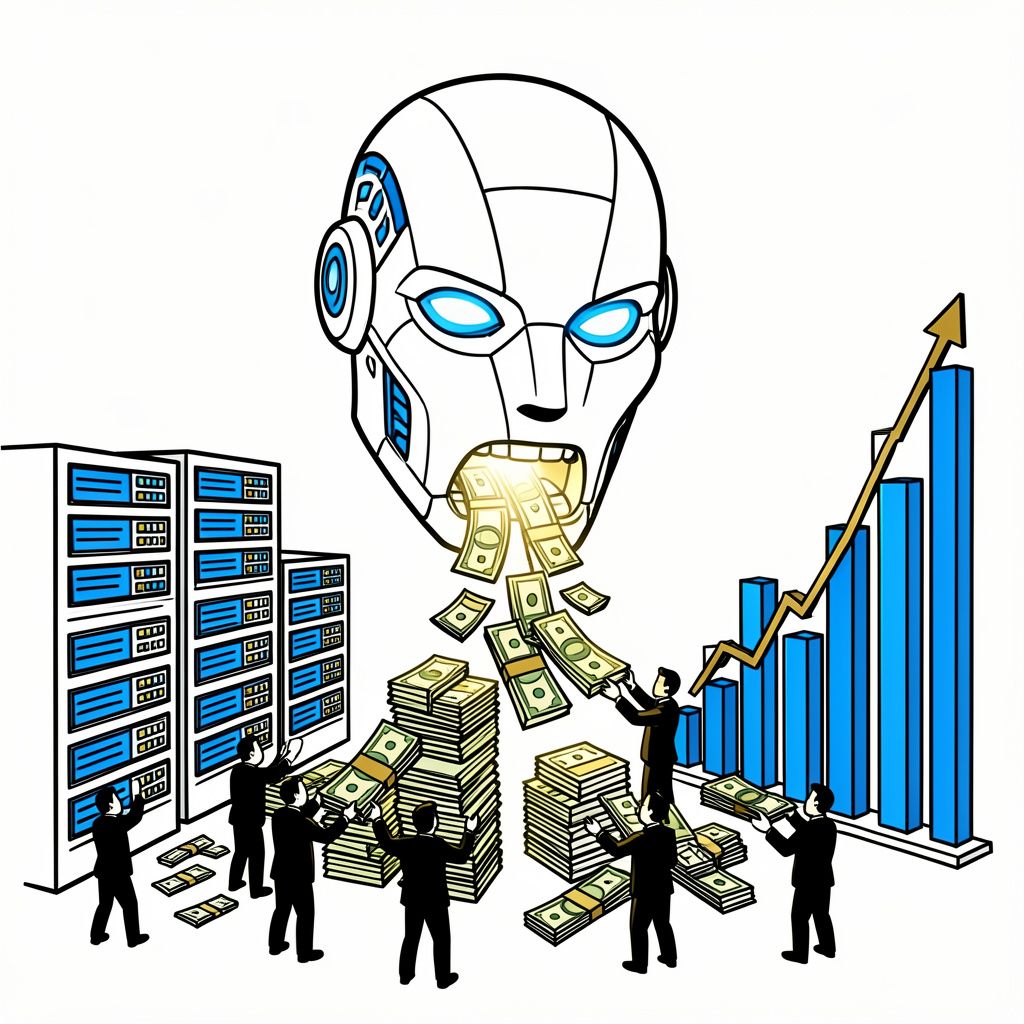
Hyperscalers are projected to spend over $10 trillion on artificial intelligence infrastructure, prioritizing long-term economic transformation over current losses, as political leaders frame the race as vital for national survival.
Unprecedented Capital Deployment in AI Infrastructure
Major technology corporations are directing trillions of dollars into artificial intelligence infrastructure, prioritizing long-term structural shifts over immediate profitability. Five major hyperscalers, including Alphabet, Amazon, Meta, Microsoft, and Oracle, are projected to spend $4.2 trillion in capital expenditure during the four-year period ending in 2029 [2]. Broader estimates from the Brookings Institution suggest total data-center spending will reach $10.3 trillion between 2025 and 2032, averaging 3.6% of US GDP annually [2]. This investment scale exceeds combined spending on historical canals, railroads, and power grids, marking it as the biggest economic bet in US history [2]. Recent data indicates the US composite PMI rose to 58.4 in September 2026 from 56 in August 2026, marking the strongest private-sector activity expansion since July 2021 [2]. This represents a percentage increase of 4.286 in private-sector activity momentum over the month [2].
Revenue Realities and Profitability Gaps
Financial analysis reveals a stark contrast between investment volumes and current revenue generation. Since 2024, six hyperscaler firms including Google, Amazon, Microsoft, Meta, Oracle, and SpaceX have invested approximately $1.2 trillion in AI while generating only $277 billion in revenue, creating a roughly $1 trillion gap [3]. To justify current investments, these six firms must achieve between $2.4 trillion and $3.8 trillion in revenue over the next six years [3]. This necessitates an increase of 13 to 45 times their current incremental AI revenues [3]. Within the next year, these hyperscalers must generate between $520 billion and $850 billion in revenue to reach profitability, which is three to four-and-a-half times their estimated 2026 revenue [3]. AI computation chips have a useful life of 5–6 years, forcing expenses to be recouped over a relatively short period [3].
Strategic Shift to National Survival Narratives
Industry leaders and government officials are increasingly framing AI development as a matter of national security rather than traditional commerce. U.S. Secretary of the Treasury Scott Bessent characterizes the artificial intelligence race as the absolute fulcrum of human history and a winner-take-all scenario for national survival [1]. Bessent stated that if the U.S. loses to China in AI, then nothing absolutely nothing matters and the USA will lose forever [1]. This perspective suggests that high-level officials perceive AI as a matter of national survival rather than a mere tool for corporate efficiency [1]. Key industry insiders argue that massive capital deployments in computing power are laying the groundwork for automated systems that could fundamentally alter traditional labor markets [1]. The text contends that viewing AI development through the lens of quarterly earnings or return on investment is a fundamental misunderstanding [1].
Economic Implications and Future Timelines
The labor market is already showing signs of transformation driven by AI investment. LinkedIn data indicates AI investment has created 750,000 new jobs since 2023, with a median annual salary of approximately $180,000 [2]. This is significantly higher than the $80,000 median for all jobs [2]. However, actual regular employee usage of AI remains low at 17% in services and 7% in manufacturing despite adoption metrics rising [2]. Recent data shows AI usage among service firms rose from 25% to 61% over the last two years since September 2024 [2]. Foreign investors hold a record $39 trillion in US equities and bonds, indicating continued confidence despite profitability concerns [2].
Sources
- sylvainsaurel.substack.com
- thenextrecession.wordpress.com
- econjared.substack.com
- medium.com
- finance.yahoo.com