Illinois Farm Incomes Rebound Slightly but Fall Short of Historical Averages
Urbana, Friday, 18 September 2026.
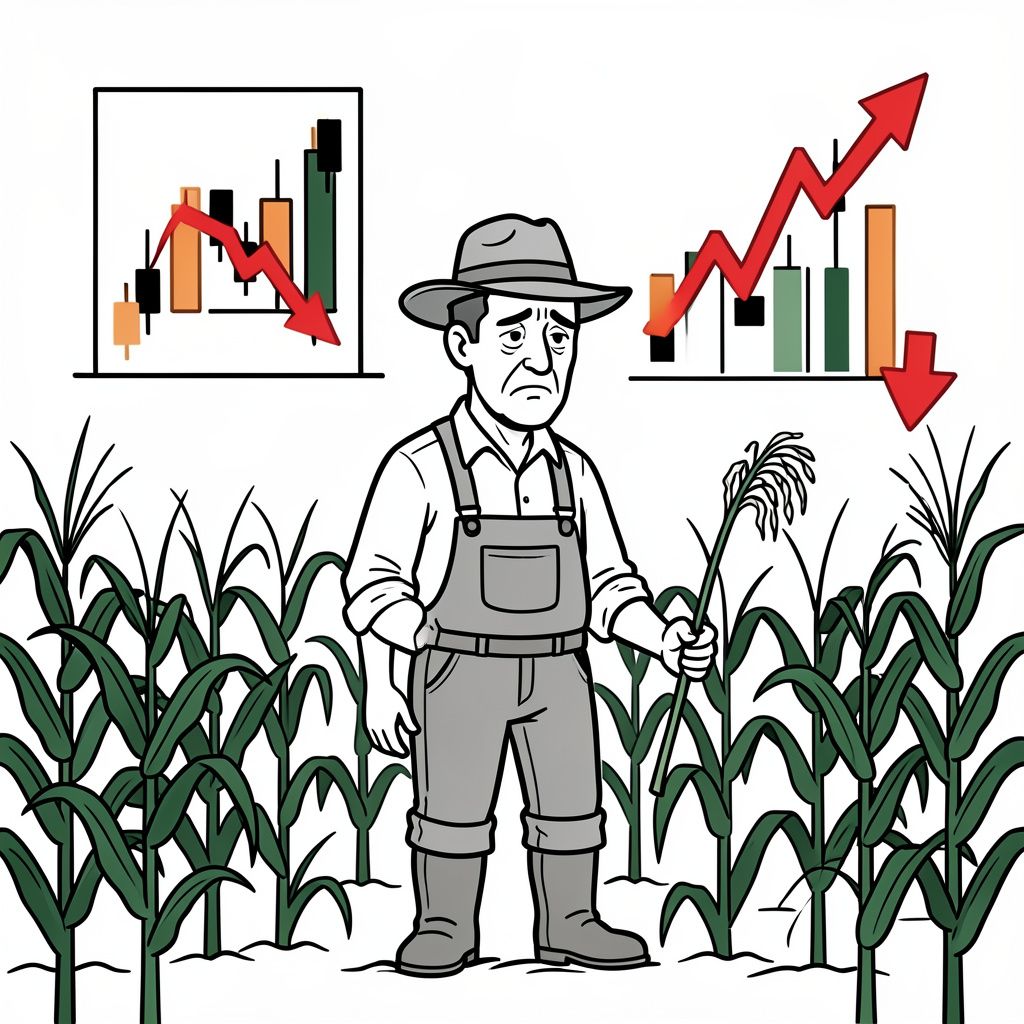
Despite an $81,419 earnings rebound in 2025, Illinois farm returns remained negative, highlighting persistent economic pressure as Midwestern agricultural bankruptcies surged by 70%.
2025 Earnings Recovery and Historical Context
Data released in September 2026 by the University of Illinois Farmdoc project indicates that Illinois farm labor and management earnings saw a modest recovery in 2025, rising by $81,419 compared to severe losses of negative $104,610 in 2024 [1]. This improvement is calculated as 81419, resulting in an average return to operators’ labor and management of negative $23,191 for the year [1]. Despite this financial rebound, average returns remain $139,505 below their five-year historical average, highlighting persistent margin pressure across the Midwestern agricultural sector [1]. Regional variation was significant, with 2025 operators’ labor and management income ranging from a low of negative $210,024 in southernmost Illinois to a high of $26,901 in northeastern Illinois [1]. Net farm income also rose to $97,674 in 2025, following values of $492,803 in 2022, $71,681 in 2023, and $18,358 in 2024 [1].
Bankruptcy Rates and Debt Projections
While earnings showed improvement, broader economic indicators suggest continued instability within the agricultural sector. In 2025, bankruptcies on family farms rose by 46% nationwide and 70% across the Midwest [2]. University of Illinois economists project corn returns will be approximately $45 per-acre below the break-even point in northern Illinois, with total U.S. farm debt potentially reaching a record $624.7 billion in 2026 [2]. This surge in insolvencies underscores the fragility of the recovery, as earnings improvements were largely driven by commodity prices exceeding beginning-of-year inventory values and Farmer Bridge Assistance payments rather than fundamental cost reductions [1]. The discrepancy between rising earnings and rising bankruptcies suggests that liquidity remains a critical challenge for many operators despite improved income statements [2].
Technology Adoption and Regulatory Landscape
In response to thin profit margins, farmers are pivoting to precision technology to lower costs, such as retrofitting existing planters with smarter controls instead of purchasing new high-speed equipment [2]. Precision tools currently in use include real-time planting sensors, GPS-guided systems for row accuracy and fertilizer efficiency, and $40,000 spray drones that serve as alternatives to $500,000 traditional sprayers [2]. However, the regulatory environment remains uncertain; in 2025, every U.S. state introduced AI legislation, resulting in approximately 100 measures passed across 38 states, including Illinois [2]. Lawmakers are currently developing regulations for artificial intelligence applications in agriculture, which will influence the accessibility and cost of precision farming tools [2]. Industry leaders warn that every dollar spent navigating different compliance requirements is a dollar that cannot go toward making these tools more affordable and accessible to farmers [2].
Economic Outlook and Sector Stability
The agricultural sector faces a complex landscape where operational efficiency gains must offset structural financial pressures. Long-term performance metrics show average labor and management earnings were $116,314 for 2021–2025 and $87,585 for 2016–2025, with the 10-year average sitting $110,776 above the 2025 result [1]. Livestock sectors provided some relief, with 2025 beef cow enterprise returns increasing by $656 per cow, marking the highest level in five years [1]. Ultimately, the stability of regional banking and agribusiness depends on whether the 2025 earnings recovery can be sustained without reliance on assistance payments or inventory value fluctuations [1][2]. As of September 2026, the industry remains in a precarious balance between technological adaptation and financial solvency [2].