Surging Debt for Artificial Intelligence Triggers Record Insurance Costs for Tech Giants
New York, Friday, 16 October 2026.
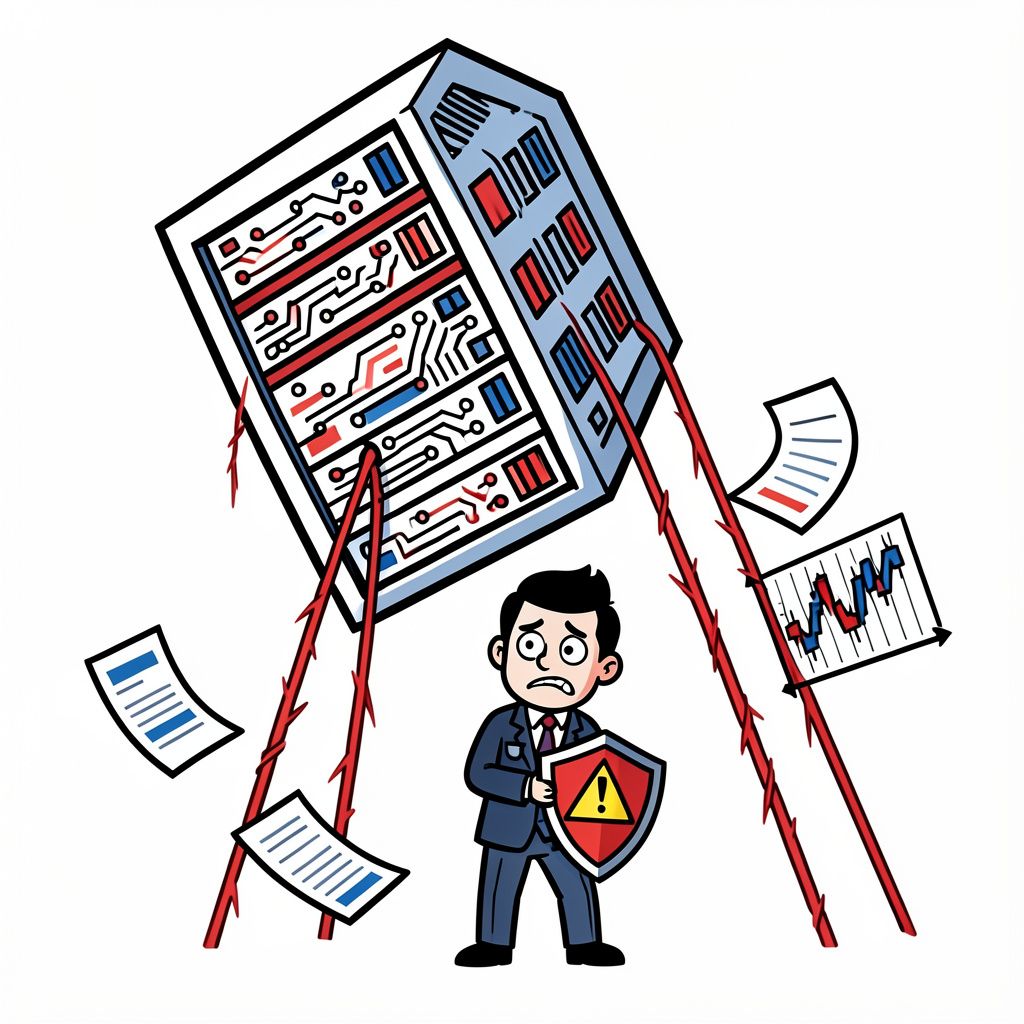
Surging debt from artificial intelligence expansion has pushed default insurance costs for tech firms to record highs, with market pricing implying a 63% default risk for data center operator CoreWeave.
Market Alarm Bells Ring
Credit default swap costs for major US technology companies have reached record levels, signaling rising credit stress in the AI investment boom [4]. As of 15 October 2026, U.S. technology sector Credit Default Swap (CDS) spreads surged to record highs due to concerns over AI-related debt obligations and insufficient revenue generation from data center infrastructure [6]. Market pricing implies a 63% probability of default within five years for data center operator CoreWeave, up from approximately 30% a year prior [4]. During the week of 12 October 2026 to 16 October 2026, the spread on CoreWeave’s five-year credit default swaps peaked at a record 1.14 per cent before settling at 1.03 per cent, according to ABC News [1]. However, other market trackers recorded significantly higher distress levels, with Global Markets Investor noting CoreWeave’s 5-year CDS up to a record 982 basis points [2]. This variance highlights the volatility and intense scrutiny facing AI-focused firms as investors reassess risk [1][2].
Broader Tech Sector Impact
The pressure is not isolated to smaller operators; Oracle, Nvidia, STMicroelectronics, and SpaceX have experienced sharp increases in CDS costs [1]. Oracle’s 5-year CDS spread increased by 26 basis points to a record 288 basis points, while SpaceX’s rose to approximately 203 basis points [2][6]. Credit default swap spreads for Amazon, Alphabet, and Meta have reached record highs as of 15 October 2026, though their growth rate lags behind Oracle and CoreWeave [1]. Brian Stutland, Portfolio Manager at Equity Armor Investments, noted that some credit default swaps for firms involved in the data center buildout are trading at a 50% chance of default [3]. This reflects growing concerns that these firms cannot deliver strong revenue and profit margins despite significant capital expenditure [3]. Anna Wu, founder of Floodlines Research, stated that the situation has revived worries about how the AI build-out is being financed [1].
Future Issuance and Outlook
Goldman Sachs analysts say the current calm in investment-grade credit markets is temporary, driven by a pause in AI-related bond issuance since September 2025 [4]. Goldman Sachs projects hyperscaler debt issuance to jump from $250 billion in 2026 to a massive $420 billion in 2027 [2]. This represents a 68 per cent increase in expected issuance volume [2]. AI-related debt issuance is projected to reach $275 billion in 2027, potentially flattening the credit curve and displacing other borrowers [4]. BondCliQ CEO Chris White added that investors are going to be demanding a lot more yield for taking on risk [5]. As the bill for this AI-linked debt issuance arrives, potentially in January 2027, the market will test whether AI revenues can justify the enormous spending [2][4].