Supreme Court Blocks Trump's Deployment of National Guard to Chicago
Chicago, Tuesday, 23 December 2025.
In a rare split, three conservative justices joined the liberal minority to block the administration’s deployment of National Guard troops to Chicago, citing insufficient authority for domestic military use.
A Decisive Check on Executive Power
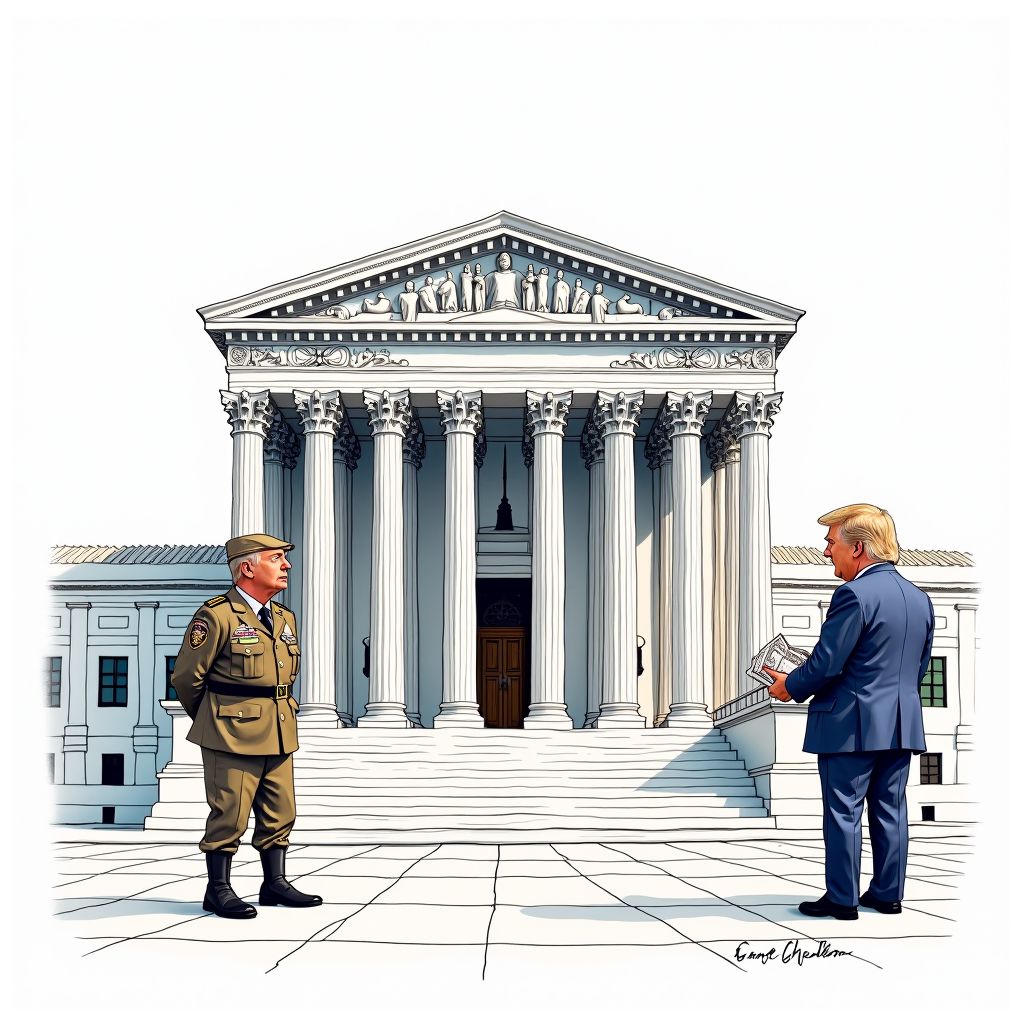
On December 22, 2025, the Supreme Court delivered a significant blow to the Trump administration’s efforts to utilize military assets for domestic law enforcement, rejecting a request to deploy National Guard troops to the Chicago area [1][5]. In a 6-3 decision that exposed a rare fracture within the court’s conservative bloc, three conservative justices joined the three liberal justices to deny the administration’s application to overturn a lower court’s injunction [2]. The ruling effectively prevents the White House from unilaterally sending troops to Illinois, affirming the decision of U.S. District Judge April Perry, who had blocked the move in October 2025 citing a lack of credible evidence regarding a danger of rebellion [2][3].
Constitutional Limits and Legal Reasoning
The court’s majority opinion emphasized that the federal government had not established a sufficient legal basis for the deployment, stating that the administration “failed to identify a source of authority that would allow the military to execute the laws in Illinois” [1][2]. This decision underscores the strict limitations imposed by the Posse Comitatus Act, which generally prohibits the use of federal military forces for domestic law enforcement unless regular forces are unable to restore order [2]. Justices Samuel Alito, Clarence Thomas, and Neil Gorsuch dissented, with Justice Alito expressing “serious doubts” about the majority’s view and criticizing the manner in which the court disposed of the application [2][5]. The administration had argued that the troops were necessary to protect federal personnel and property from violent resistance, a claim the majority found unpersuasive at this preliminary stage [5].
Escalation at the Broadview Facility
The legal battle originated from heightened tensions surrounding immigration enforcement in the Chicago suburbs. Following the administration’s application to the Supreme Court on October 17, 2025, which cited “intolerable risks” to the safety of federal personnel, the situation on the ground remained volatile [1]. The focus of the administration’s concern was the U.S. Immigration and Customs Enforcement (ICE) facility in Broadview, Illinois, which has been the site of ongoing protests [3][5]. Tensions spiked on December 15, 2025, when authorities arrested 21 protesters and reported injuries to four officers outside the facility [3][5]. Despite these incidents, Judge Perry and subsequently the 7th U.S. Circuit Court of Appeals maintained that the events did not warrant a military response, a stance now implicitly backed by the Supreme Court’s refusal to intervene [1][2].
Political Fallout and National Implications
The ruling has drawn sharp lines between state and federal leadership. Illinois Governor J.B. Pritzker, a Democrat, hailed the decision as a crucial step in curbing what he termed the administration’s “abuse of power” and “march toward authoritarianism” [2]. Pritzker had previously condemned the deployment as “political theater,” arguing that the state’s National Guard should not be used against its own citizens [3]. In contrast, White House spokeswoman Abigail Jackson asserted that the ruling would not detract from the President’s core agenda to safeguard the public [2]. The decision has immediate logistical consequences: a contingent of approximately 200 National Guard troops from Texas has been sent home from Chicago, and hundreds of troops deployed in Illinois and Oregon are set to return to their home states [2][3].
A Broader Pattern of Judicial Resistance
This case represents just one front in a wider legal conflict regarding the deployment of National Guard troops to Democratic-led cities. The administration has faced similar judicial roadblocks across the country, including a permanent block on deployment in Portland, Oregon, and a ruling against deployment in Memphis, Tennessee [3][5]. Additionally, legal challenges are ongoing regarding the presence of over 2,200 troops in Washington, D.C., where a declared crime emergency from August 2025 has since expired [3][5]. As the Trump administration continues to navigate these legal hurdles, the Supreme Court’s December 22 ruling stands as a critical precedent regarding the threshold required for federal military intervention in domestic affairs [1][5].
Sources
- news.bloomberglaw.com
- www.nbcnews.com
- www.fox32chicago.com
- www.washingtonpost.com
- spectrumlocalnews.com