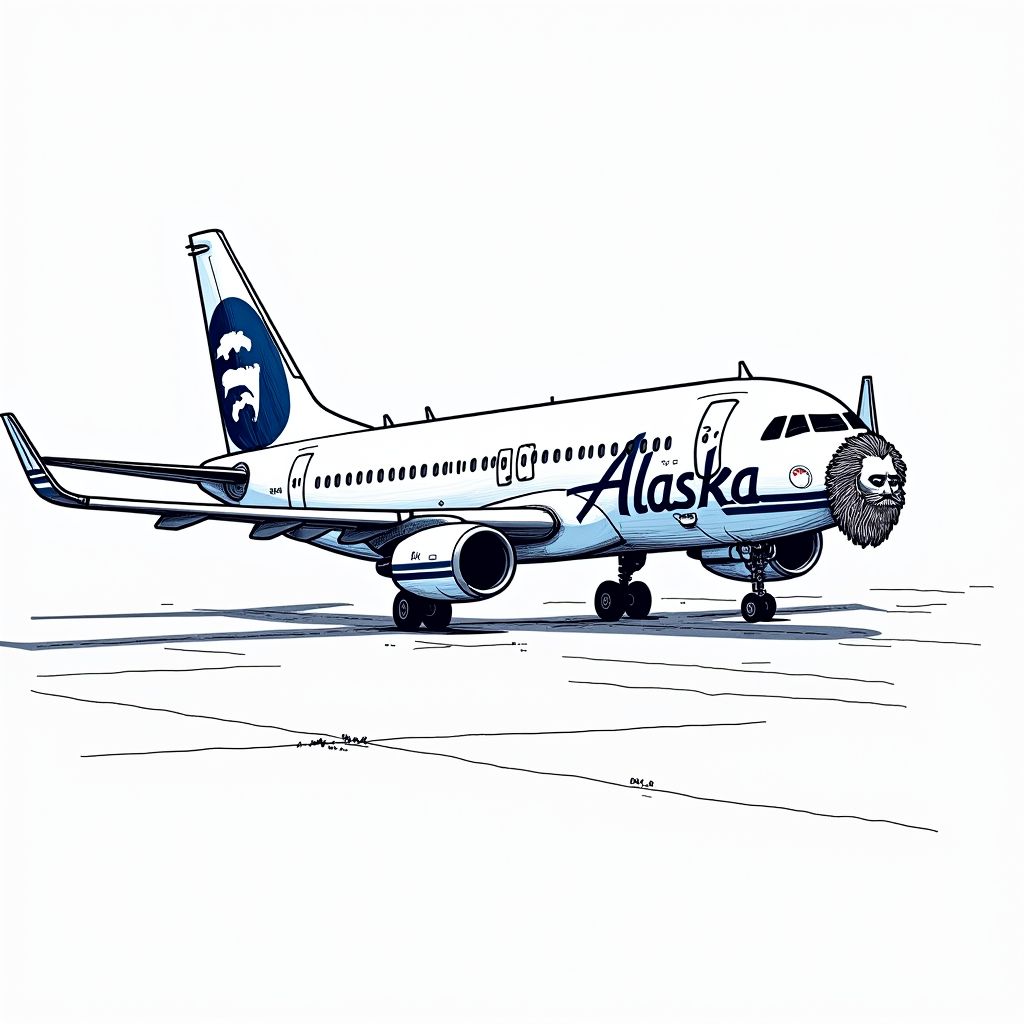
Alaska Airlines Ends Hawaiian Pilots' Rare Beard Exemption Amid Merger Integration
Seattle, Sunday, 5 April 2026.
Alaska Airlines is revoking Hawaiian pilots’ rare cultural beard exemption this April. The post-merger policy cites oxygen mask safety, despite recent science proving beards do not hinder effectiveness.
Standardizing the Flight Deck
Alaska Air Group (NYSE: ALK) is moving swiftly to consolidate its operations following the acquisition of Hawaiian Airlines, with a unified operating certificate in its sights [2]. As part of this corporate integration, Hawaiian Airlines will amend its Flight Operations Manual (FOM) to align with Alaska Airlines’ strict appearance standards [1][2]. The most visible casualty of this alignment is the revocation of a longstanding and rare exemption that allowed Hawaiian Airlines pilots to sport beards for cultural reasons [1][2]. According to internal communications from Alaska’s system chief pilot Scott Day, while mustaches remain acceptable, beards will be strictly prohibited on the flight deck [1]. The exact deadline for compliance appears slightly fractured across internal and public channels; some reports indicate a target date of April 10, 2026 [4], [alert! ‘Source 4 states April 10 for compliance, while Source 2 states the FOM officially changes on April 20, creating a timeline discrepancy’], while the official FOM change is slated for April 20, 2026 [2].
The Science and Safety of Facial Hair
The core of Alaska Airlines’ argument relies heavily on safety and regulatory compliance [1][2]. The carrier points to Federal Aviation Administration (FAA) Advisory Circular 120-43, a guideline originating in 1987 that warns facial hair could compromise the airtight seal of pilot oxygen masks [1][2]. To underscore the necessity of functional oxygen systems, Alaska Airlines specifically cited the harrowing January 2024 incident involving Flight AS1282, where a door plug detached from a Boeing 737 MAX 9 mid-flight, forcing the crew to rely on supplemental oxygen [1]. An Alaska Airlines spokesperson reiterated this stance on social media, declaring that safety remains the airline’s number one priority [4].
Broader Integration Challenges and Financial Headwinds
The cultural friction over grooming standards is just one facet of a complex merger occurring against a backdrop of financial and operational pressures [GPT]. Following a disappointing 2025 where Alaska Airlines posted a mere 5 percent operating margin, the carrier is bracing for a larger first-quarter loss in 2026 [5]. This downturn is driven by surging jet fuel prices, which are estimated to hit between $2.90 and $3.00 per gallon, representing a maximum potential increase calculated as 16.732 percent from the $2.57 per gallon seen in the fourth quarter of 2025 [5].
Sources
- simpleflying.com
- www.paddleyourownkanoo.com
- www.linkedin.com
- www.instagram.com
- airlineweekly.skift.com